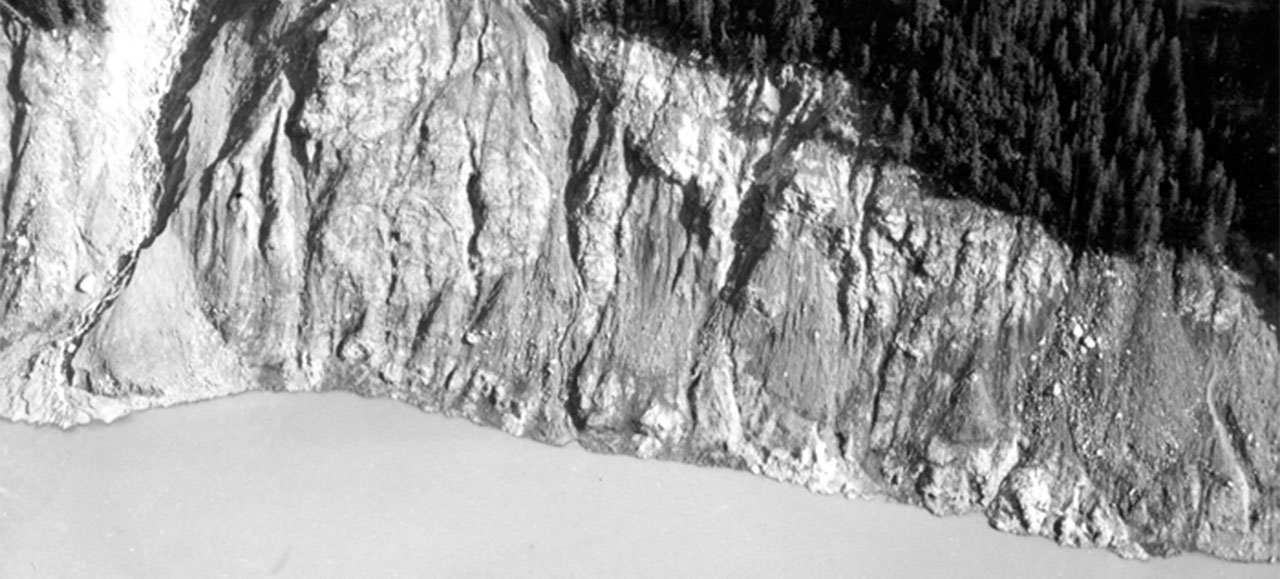
The tallest wave in history was the 1958 Lituya Bay megatsunami, reaching a height of 1,720 feet (524 meters).
The 1,720-Foot Wave That Defied Physics
Imagine a wave taller than the Empire State Building crashing through a narrow Alaskan bay. On July 9, 1958, at 10:16 PM, this nightmare became reality in Lituya Bay when a magnitude 7.8 earthquake shook loose 90 million tons of rock from a mountainside. The massive rockfall plunged 3,000 feet into Gilbert Inlet, displacing water with such violence that the resulting wave surged to an almost incomprehensible height of 1,720 feet (524 meters) up the opposite mountain slope.
This wasn't a traditional ocean tsunami that travels thousands of miles. This was a megatsunami—a rare, localized phenomenon caused by sudden massive displacement of water. The sheer force stripped every tree, plant, and piece of soil from the mountainside up to that record-breaking elevation, leaving a scar that's still visible today.
Three Boats, Two Minutes to Live
Three fishing boats were anchored near the bay's entrance that night. Howard Ulrich and his seven-year-old son aboard the Edrie heard "a deafening crash like an explosion" as they watched the mountain collapse. Ulrich made a split-second decision: turn the boat to face the wave head-on.
The wall of water picked up their boat and carried it over 80-foot-tall trees. Miraculously, the Edrie surfed the monster wave and splashed back down into the bay intact. Father and son survived with only their anchor chain snapped.
Bill and Vivian Swanson on the Badger weren't so lucky. Their boat was destroyed, and Bill broke several ribs when a tree trunk smashed through the pilothouse. They escaped in a small skiff, paddling through darkness surrounded by ice blocks up to 75 feet long and massive debris, until another boat rescued them two hours later.
The third boat, the Sunmore, tried to exit the bay. The wave caught them. Neither the boat nor its two occupants were ever found.
Faster Than a Fighter Jet
The wave didn't just tower—it moved at speeds between 97 and 130 mph as it funneled through the narrow bay. That's faster than a Category 5 hurricane. Witnesses reported it reached Cenotaph Island, 2.5 miles away, in just two minutes.
- The initial impact created a wave that splashed 1,720 feet up the mountain
- As it traveled through the bay, it was still 50-100 feet tall
- It stripped mature forest down to bare rock along its entire path
- The sound could be heard 50 miles away
Why So Tall? The Perfect Storm
Several factors created this record-breaker. Lituya Bay is a narrow, steep-sided fjord—essentially a natural funnel. When 30 million cubic meters of rock fell from 3,000 feet up, it was like dropping a boulder in a bathtub. The confined space forced the water upward instead of outward.
The opposite slope was also critical. The wave didn't just pass by at 1,720 feet—it ran up the mountainside like a ramp, achieving that maximum height through a process called "run-up." Think of it as the difference between a wave's height in open water versus how high it reaches when it hits a beach.
Not the First, Won't Be the Last
This wasn't Lituya Bay's first megatsunami. Evidence shows similar events in 1853 and 1936, though not as large. The bay's unique geography—a T-shaped fjord surrounded by unstable mountain slopes in an active earthquake zone—makes it particularly susceptible.
The 1958 event forced scientists to completely rethink what was possible. Before that night, most researchers didn't believe waves could reach such heights. The trimline of destroyed vegetation provided undeniable proof, leading to new understanding of impact-generated waves and their potential dangers.
Today, Lituya Bay remains remote and largely uninhabited, which is fortunate—because the geology hasn't changed. The same forces that created the tallest wave in recorded history are still active, waiting for the next big shake.
Frequently Asked Questions
How tall was the Lituya Bay tsunami compared to famous buildings?
Did anyone survive the 1958 Lituya Bay megatsunami?
What caused the Lituya Bay megatsunami?
How fast did the Lituya Bay wave travel?
Could another megatsunami happen in Lituya Bay?
Verified Fact
This fact has been reviewed and verified against original sources.