
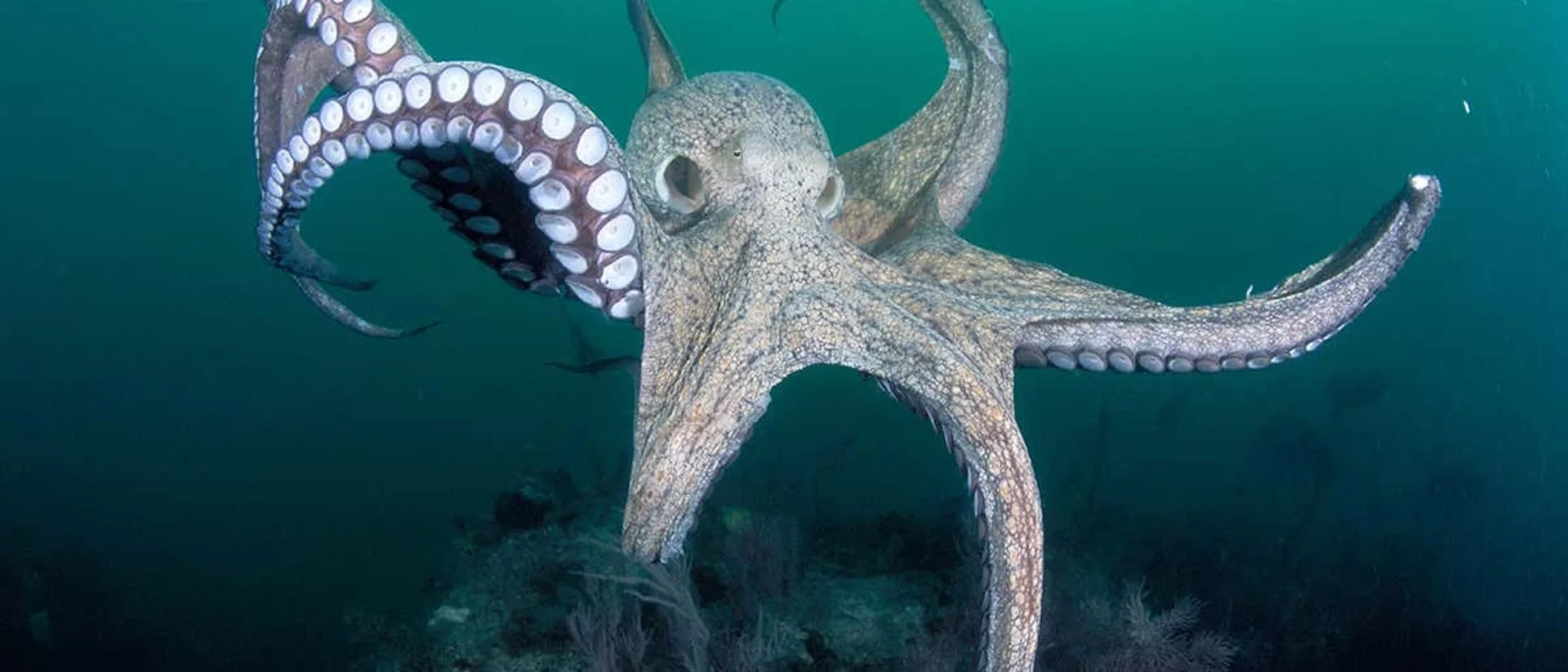
An octopus is less an animal than a separate experiment in intelligence. It has 3 hearts, blue blood (copper-based, not iron), and around 500 million neurons - as many as a dog - but most of them sit in its 8 arms, which can taste, decide, and act on their own. Scientists treat it as the closest thing to alien biology on Earth, and it can even edit its own RNA. When it jet-swims, its main heart stops beating.
The Octopus Has Three Hearts, Blue Blood, and a Brain in Every Arm
The octopus is built so differently from every other intelligent animal that scientists studying the neuroscience of alien life use it as their best available model. Its biology is not a minor variation on the vertebrate plan - it is a complete rebuild, arrived at from a separate starting point over half a billion years of evolution.
Three Hearts, Blue Blood
An octopus runs on three hearts. Two branchial hearts push blood through the gills, where it picks up oxygen. A third - the systemic heart - then pumps that oxygen-rich blood to the rest of the body. The blood itself is blue because the oxygen-carrying protein is haemocyanin, which uses copper instead of the iron-based haemoglobin found in vertebrates. Copper binds oxygen less efficiently, which is part of why octopuses tire quickly when swimming and prefer to crawl. When an octopus does swim by jet propulsion, the systemic heart actually stops beating - a design trade-off built into the circulatory system.
Nine Brains, 500 Million Neurons
An octopus has roughly 500 million neurons - about as many as a dog. What makes the arrangement extraordinary is where they sit. The central brain wraps around the oesophagus and handles learning and memory. But two-thirds of those neurons are distributed through the eight arms themselves, giving each arm its own local nerve cord. Researchers count this as nine brains: one central and eight peripheral.
The result is that each arm can sense, decide, and react without waiting for instructions from the head. When an octopus reaches into a crevice for prey, the arm navigates around obstacles on its own while the central brain watches the outcome. The arm does not just carry out orders - it improvises.
Arms That Taste What They Touch
Each of the roughly 240 suckers on an octopus arm is packed with chemoreceptors - sensory cells that detect chemical signals on contact. The arms do not just feel surfaces; they taste them at the same time. This gives the octopus a map of its environment that combines touch and taste in a single action. Individual sections of the same arm can carry out different tasks simultaneously: one part anchors to a rock while another explores a gap, and each sucker samples its own patch of surface independently.
Rewriting Its Own Genetic Code
Octopuses also edit their own RNA - the molecular messenger that carries instructions from DNA to the protein-building machinery of each cell. Most animals edit RNA at only a handful of sites. Octopuses and their cephalopod relatives do it at hundreds of thousands of sites - orders of magnitude more than any other animals studied so far. A significant number of those editing sites sit in nervous system genes that control how neurons fire. When water temperature drops sharply, a California two-spot octopus can ramp up RNA editing across more than 13,000 sites within hours, adjusting the behaviour of its own nervous system without changing a single letter of its DNA.
Why Scientists Call It Alien Intelligence
Human and octopus intelligence evolved on completely separate paths. The last common ancestor of vertebrates and cephalopods was a simple, flat worm-like creature that almost certainly lacked a complex nervous system. Everything that followed - the 500 million neurons, the distributed arms, the RNA editing - developed independently. That is why neuroscientists and astrobiologists both find the octopus useful: it is a proof of concept that complex, flexible intelligence can arise from a completely different biological starting point. If intelligence can evolve twice on the same planet from different origins, the same process may be possible elsewhere.
Frequently Asked Questions
Why do octopuses have blue blood?
How many brains does an octopus have?
Can octopus arms act on their own without the brain?
What is RNA editing and why are octopuses unusual?
Are octopuses actually related to aliens?
Verified Fact
Verified Jun 15, 2026
Source: View sourceShow verification details
Claims checked
- Three hearts (two branchial, one systemic)
- Systemic heart stops during jet propulsion
- Blue blood / haemocyanin / copper-based
- ~500 million neurons
- Two-thirds of neurons in arms
- Severed arm reacts up to one hour
- RNA editing 'within hours'
- RNA editing 'more than 13,000 sites' (temperature response)