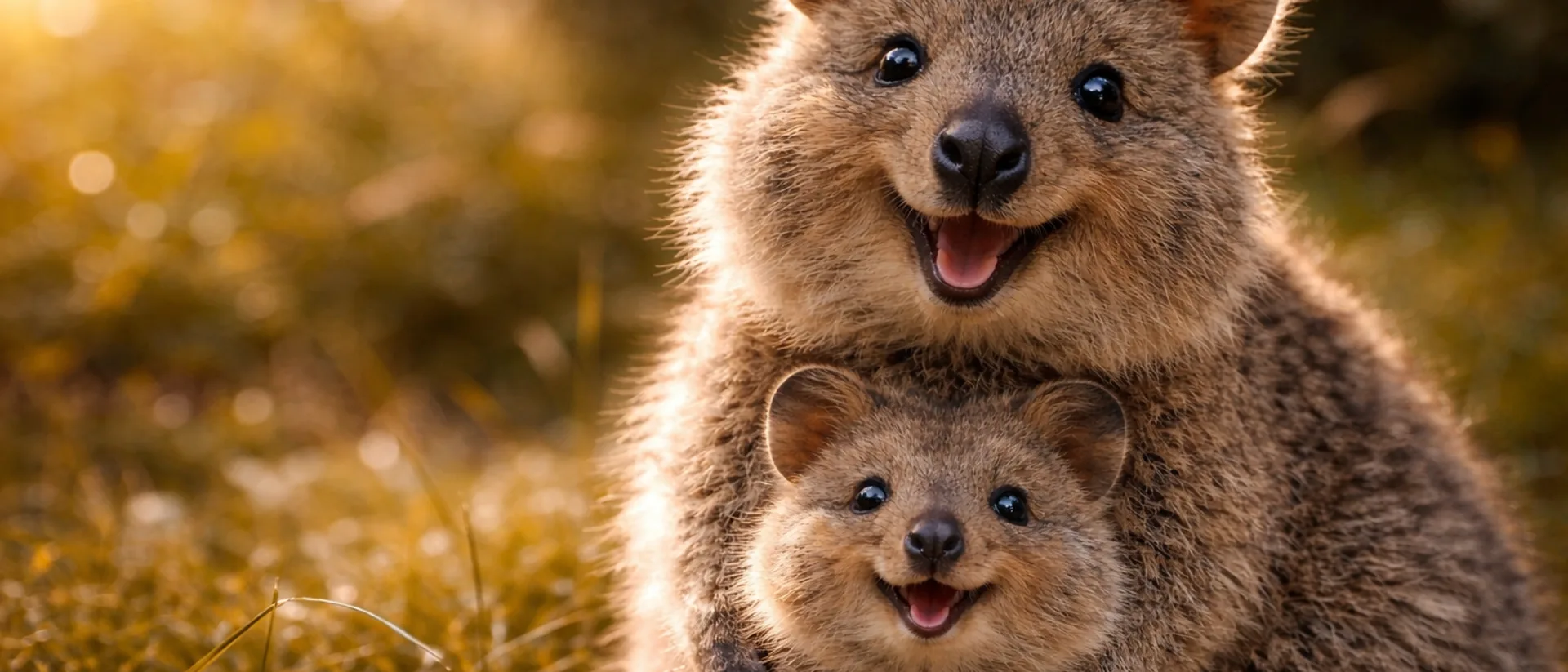
Quokkas are known as the world's happiest animal because they always look like they're smiling. But when a predator shows up, mothers eject their baby from the pouch and let it flop around on the ground as a distraction while they run away.
Quokkas Are the World's Happiest Animal — With a Dark Survival Secret
If you've spent any time on the internet, you've probably seen a quokka. These small marsupials, native to a handful of islands off the coast of Western Australia, have become one of the most photographed animals on Earth — and for good reason. Their round faces and upturned mouths make them look like they're permanently beaming with joy.
But behind that famously cheerful face lies one of nature's most ruthless survival strategies.
The World's Happiest Animal
Quokkas (Setonix brachyurus) earned their nickname as the "world's happiest animal" thanks to their facial structure. The shape of their mouth naturally curves upward, giving the appearance of a constant smile. Combined with their curious, fearless nature — they'll happily approach humans and even pose for selfies — it's no wonder they became internet celebrities.
They're found almost exclusively on Rottnest Island, about 18 kilometers off the coast of Perth. The island was actually named after them: when Dutch explorer Willem de Vlamingh landed in 1696, he mistook the quokkas for giant rats and called the place "Rattennest" — rat's nest. The name stuck, though the creatures themselves are far more endearing than their namesake suggests.
The Dark Side: Sacrificing Their Young
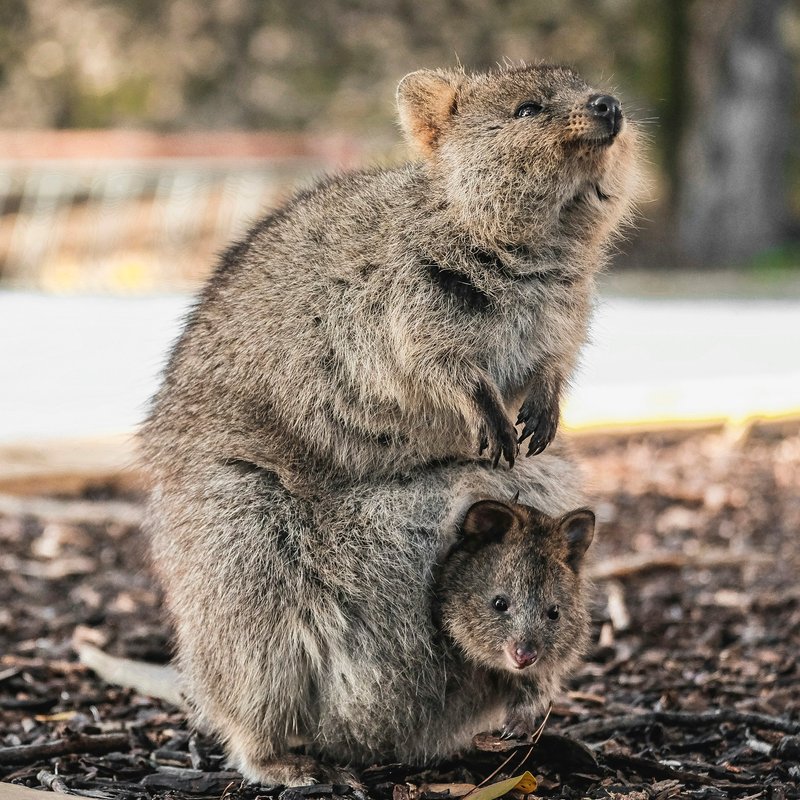
When a predator threatens a quokka mother, her survival instincts override everything else. The muscles controlling her pouch — normally held tight to keep her joey secure — relax, causing the baby to drop out onto the ground.
The ejected joey doesn't just lie still. It wriggles and hisses, creating noise and movement that attracts the predator's attention. While the threat is distracted by the baby, the mother makes her escape.
To be clear: quokkas don't throw their babies, despite the popular internet claim. The mother relaxes her pouch muscles under stress, and the joey falls out. But the result is the same — the baby becomes bait.
Why Would Evolution Favour This?
It sounds brutal, but from an evolutionary perspective, it makes cold, calculated sense:
- The mother is a proven breeder. She has already survived to reproductive age and demonstrated she can carry young. She can produce more offspring.
- The joey is unproven. It may not survive to adulthood regardless, and it certainly can't reproduce yet.
- One sacrifice, many future offspring. By surviving, the mother can breed again — potentially multiple times — producing far more offspring than the single joey she lost.
This kind of trade-off isn't unique to quokkas. Many species have evolved strategies that prioritise the survival of breeding adults over their current young. But few do it in quite such a dramatic fashion.
Not All Bad Parenting
It's worth noting that this behaviour appears to be a stress response rather than a deliberate, calculated decision. Some researchers believe the pouch muscles simply fail under extreme duress — similar to how humans might lose control of certain muscles when terrified.
Under normal circumstances, quokka mothers are attentive parents. Joeys spend about six months developing in the pouch, and the mother provides milk and protection throughout. The predator-response behaviour is a last resort, not standard parenting.
Conservation Status
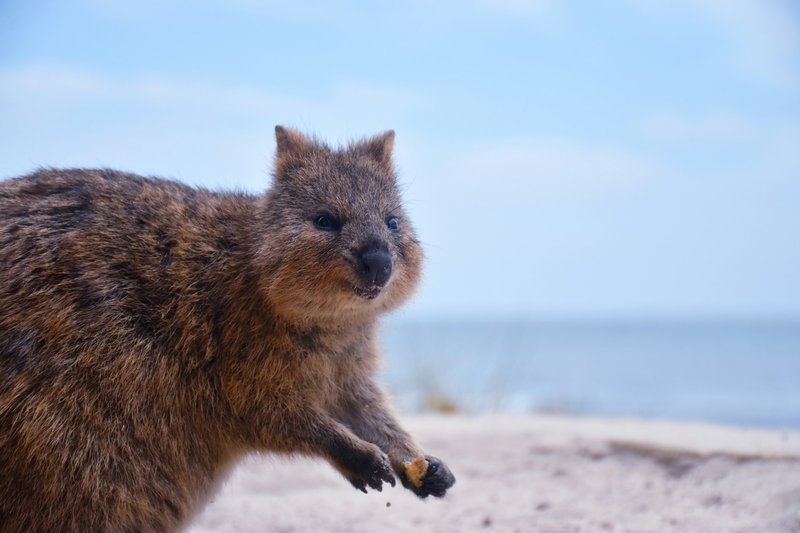
Quokkas are classified as vulnerable by the IUCN. Their main threats aren't predators on Rottnest Island (where they have few natural enemies) but habitat loss on the Australian mainland, where foxes and cats have decimated their populations. On Rottnest Island itself, the biggest threats are actually tourists — feeding them human food or handling them roughly. It's illegal to touch a quokka in Western Australia, with fines of up to $300.
So the next time you see a quokka's famous smile, remember: behind those adorable eyes is an animal that has made peace with one of nature's harshest bargains. Smile for the camera, sacrifice the kid if things go south. Evolution doesn't do sentiment.
Frequently Asked Questions
Do quokkas really throw their babies at predators?
Why are quokkas called the world's happiest animal?
Where do quokkas live?
Is it legal to touch a quokka?
Why would a quokka sacrifice its baby?
Verified Fact
This fact has been reviewed and verified against original sources.
Source: View sourceShow verification details
Joey ejection behaviour documented by researchers studying quokka anti-predator responses. Not a deliberate "throw" but a stress-induced pouch muscle relaxation. Confirmed by University of Newcastle and multiple wildlife biology sources. "World's happiest animal" is a widely-used nickname based on facial structure.