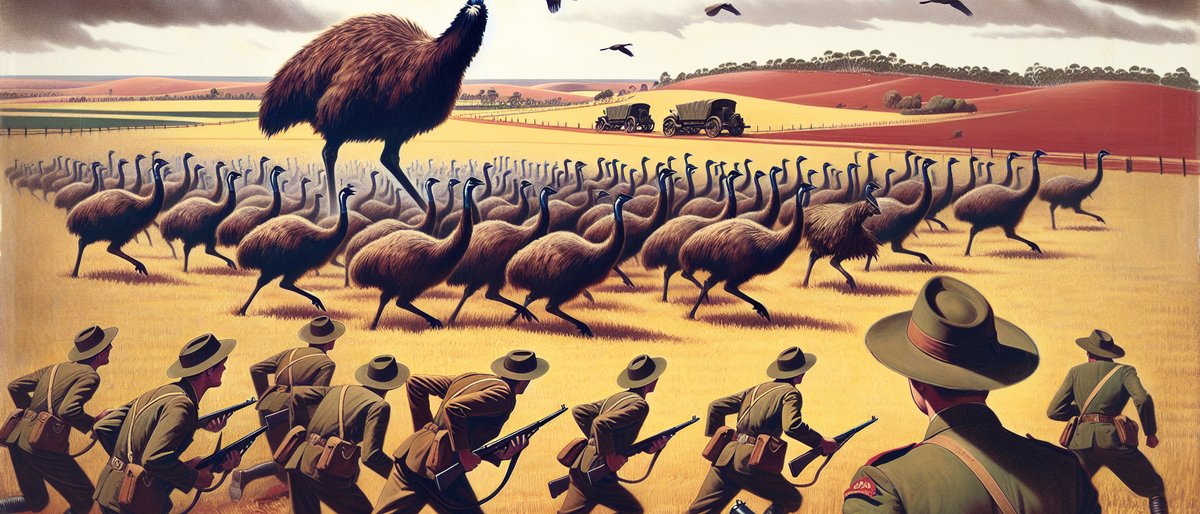
In 1932, the Australian military deployed soldiers armed with machine guns to combat an invasion of 20,000 emus destroying farmland in Western Australia. After six days of failed attacks, the emus outsmarted the soldiers, and the military withdrew in defeat.
In 1932, Australia Went to War Against Emus and Lost
In late 1932, Australia faced an unusual enemy: approximately 20,000 emus that had descended upon the wheat fields of Western Australia. Following World War I, the government had granted land to discharged veterans to farm, but these farmers found their crops being decimated by massive flocks of the large flightless birds. The emus consumed wheat, trampled fields, and created gaps in fences that allowed rabbits to cause further damage.
The desperate farmers appealed to the government for help, and in an unprecedented decision, the military was called in. On November 2, 1932, the Australian Army deployed Major Gwynydd Purves Wynne-Aubrey Meredith of the Royal Australian Artillery, along with Sergeant S. McMurray and Gunner J. O'Halloran, armed with two Lewis machine guns and 10,000 rounds of ammunition.
The Emus Prove Formidable Foes
What seemed like a straightforward pest control operation quickly turned into a military embarrassment. The emus demonstrated remarkable tactical awareness and resilience. According to soldiers' reports, one emu in each group acted as a lookout, warning others of approaching danger. When the soldiers opened fire on the first group of about 50 emus, the birds scattered in all directions, making them nearly impossible targets.
On November 4, the soldiers attempted a new strategy by setting up an ambush at a local water source. They waited until thousands of emus gathered before opening fire. However, one of the machine guns jammed after just a few rounds, and the emus quickly dispersed. The soldiers even tried mounting a gun on a truck for mobile attacks, but the rough terrain made the vehicle too slow and the ride too bumpy for accurate shooting.
A Humiliating Defeat
After just six days of operations, the military campaign was halted on November 8, 1932. Major Meredith offered a begrudging compliment to his feathered adversaries: "If we had a military division with the bullet-carrying capacity of these birds, it would face any army in the world. They can face machine guns with the invulnerability of tanks."
The operation was briefly resumed on November 13 following farmer complaints, but was permanently called off on December 10. According to Britannica, Major Meredith reported 986 confirmed emu kills using 9,860 rounds of ammunition - approximately 10 rounds per bird. He claimed an additional 2,500 wounded emus later died, though these numbers remain disputed.
The "Great Emu War" became a source of national and international ridicule. Despite farmer requests for military assistance in 1934, 1943, and 1948, the government refused, instead relying on a bounty system that proved far more effective. In just six months of 1934, bounties were claimed for 57,034 emus. Today, emus are protected under Australian environmental law, and their population thrives with more than 600,000 birds across the continent - a testament to their victory over the Australian Army.
Enjoyed this? Get a new fact every morning.
A fascinating fact in your inbox every morning. Free. Unsubscribe anytime.
Frequently Asked Questions
Why did Australia declare war on emus?
How did the emus defeat the Australian military?
How many emus were killed in the Great Emu War?
Did Australia ever try another Emu War?
Are emus still a problem in Australia?
Verified Fact
Verified Sep 11, 2026 · 4 sources checked
Source: Emu War - BritannicaShow verification details
Claims checked
- Australia sent soldiers with two Lewis machine guns against roughly 20,000 emus destroying WA wheat crops in 1932
- Major Meredith led the operation with Sgt McMurray and Gunner O'Halloran; a jammed gun and a too-slow truck-gun undercut the first six-day attempt
- Meredith reported 986 confirmed kills (9,860 rounds) plus 2,500 more said to have died later, figures historians dispute
- Farmers were refused military help again in 1934, 1943 and 1948; a bounty system claimed 57,034 emus in six months of 1934
Sources: Britannica, History Hit, Wikipedia