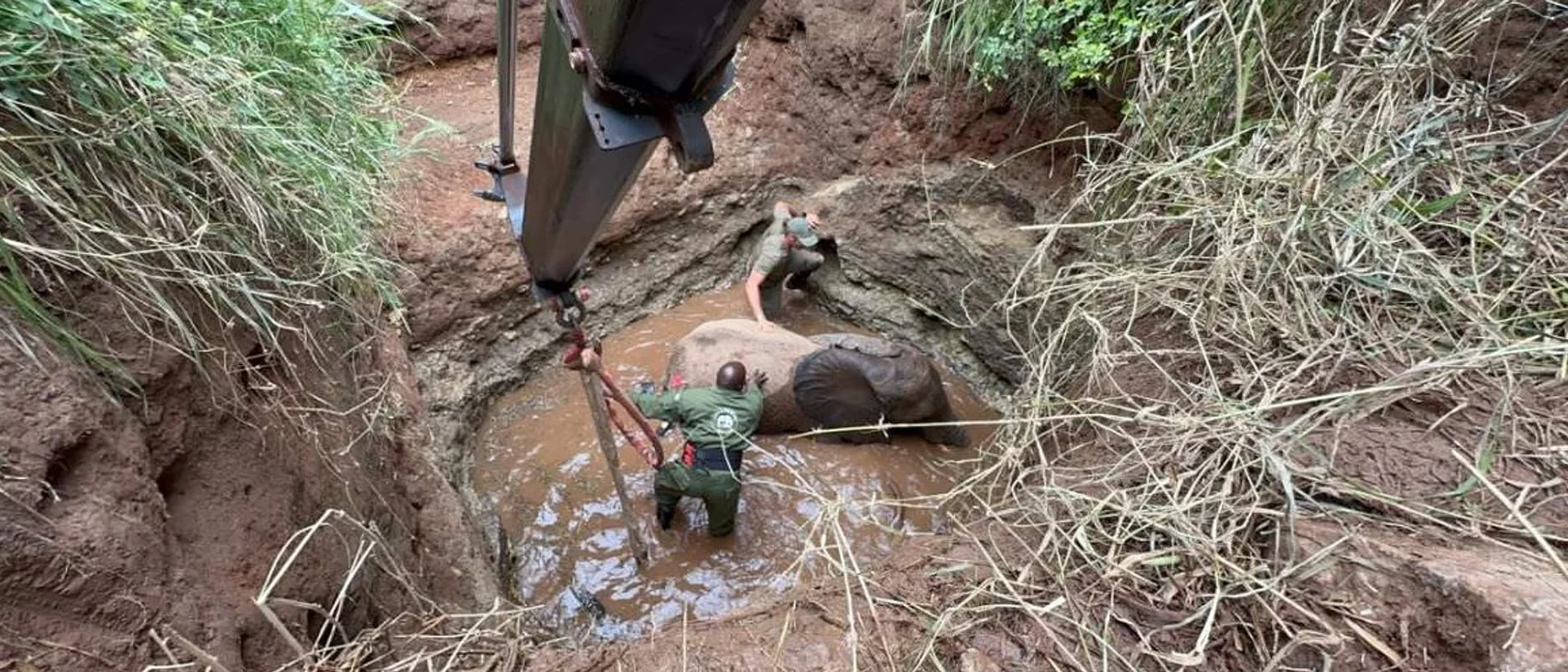
An elephant spent 12 hours submerged in a 45-foot well near Tsavo, Kenya - breathing only through his trunk like a snorkel. The Sheldrick Wildlife Trust pumped out 150,000 liters of water, drove a crane from Mombasa overnight, and lowered a vet into the pit to sedate and lift him out. 22 hours later, he walked into the bush on his own.
Elephant Used His Trunk as a Snorkel for 12 Hours in a 45-Foot Well
Deep in the bush south of Tsavo West National Park, a sub-adult elephant - about 10 years old - had fallen into a farmer's well. By the time the Sheldrick Wildlife Trust received the call on April 19, 2024, he had been trapped for at least 12 hours. The well was 45 feet deep and filled with water. He was fully submerged, keeping himself alive by holding his trunk above the surface like a snorkel.
A Race Against Time
The team's pilot Roan Carr-Hartley flew over the site first. From the air, he could see the well was nearly 300 meters from solid ground, with only a single narrow track running down a ridgeline to reach it. Time mattered - an elephant can't stay afloat indefinitely. Three water pumps were brought in and set running simultaneously, slowly draining the well. Over hours, roughly 150,000 liters of water were removed.
The Crane from Mombasa
No equipment nearby was powerful enough to lift a young elephant. The nearest supersized crane was in Mombasa, hours away. It made the journey on a low loader along the main road, then pushed further for hours on rough bush tracks. Once it arrived, veterinarian Dr. Limo from the SWT/KWS Mobile Vet Unit descended into the now-drained well to administer a sedative. KWS rangers followed him down and worked in the dark pit to loop straps securely around the elephant's body. Then, slowly, the crane pulled him straight up.
He Walked Out on His Own
From the moment the team arrived at the site, it took 22 hours to get the elephant back on his feet. Once he was on solid ground, Dr. Limo reversed the anesthetic and administered preventive medication against pneumonia - a real risk after prolonged immersion. Despite everything he had endured, the elephant stood up and walked into the bush on his own. The team watched him go.
The Organisation Behind the Mission
The Sheldrick Wildlife Trust, founded by Dame Daphne Sheldrick and now run by her daughter Angela, has been operating elephant rescue and rehabilitation work in Kenya for decades. The SWT/KWS Mobile Vet Unit responds to calls like this throughout Tsavo - elephants falling into irrigation wells, getting snared, or separated from their herds. For the team involved, this operation - 22 hours, 150,000 liters of water, and a crane from the coast - stands as one of the most complex they have ever run.
Frequently Asked Questions
How did the Sheldrick Wildlife Trust rescue the elephant from the well?
How long was the elephant trapped in the well?
How did the elephant survive underwater for so long?
What is the Sheldrick Wildlife Trust?
Where did this elephant rescue take place?
Verified Fact
This fact has been reviewed and verified against original sources.
Source: Sheldrick Wildlife TrustShow verification details
Core claims verified against Sheldrick Wildlife Trust official report and multiple secondary sources.