
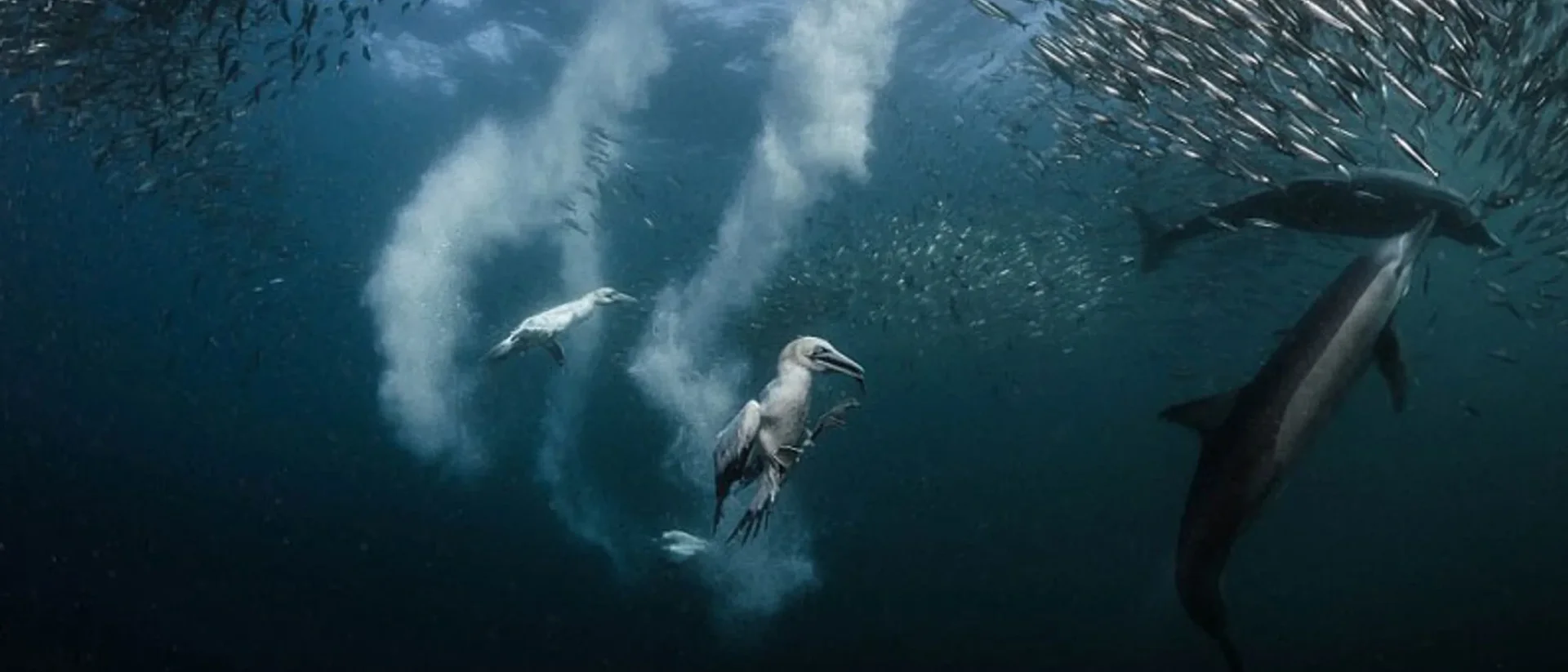
Every winter there's a migration bigger than the Serengeti's - and almost nobody has heard of it. Hundreds of millions of sardines surge up South Africa's east coast in a shoal over 7km long. Dolphins herd them into bait balls near the surface. Sharks rush in from below. Cape gannets plunge at up to 86km/h and a Bryde's whale swallows the whole ball in one pass. Scientists still debate why the sardines bother.
The Migration Nobody Talks About
Every year between May and July, one of the most dramatic events in nature unfolds beneath the waves off South Africa's east coast. Almost nobody on land knows it is happening. It is called the Sardine Run, and it involves more biomass than the wildebeest migration across the Serengeti.
The Greatest Shoal on Earth
Each winter, cold water wells up along the Agulhas Bank at the southern tip of Africa and pushes north along the KwaZulu-Natal and Eastern Cape coastline. South African sardines follow it in extraordinary numbers. The shoals they form are often more than 7km long, 1.5km wide and 30m deep - dense enough to be visible from satellite and dark enough to be tracked from spotter aircraft flying above. Scientists at BioGraphic estimate that in terms of total biomass, the run rivals East Africa's great wildebeest migration, yet it takes place entirely underwater and receives only a fraction of the attention.
The Feeding Frenzy
The sardines do not travel alone for long. As many as 18,000 common dolphins work in coordinated packs, blowing streams of bubbles to herd pockets of fish upward into compressed, spinning "bait balls" near the surface. Once a bait ball forms, the spectacle erupts. Sharks drive in from below. Cape gannets fold their wings and plunge from heights of up to 20m, hitting the water at confirmed speeds of up to 86km/h (53mph). Fur seals wheel through the edges. Then, rising from below, a Bryde's whale - typically 12 to 14 metres long - lunges through the entire ball with its mouth open, swallowing thousands of fish in one pass. Each bait ball is gone in under 20 minutes.
An Ecological Trap
For decades, the reason the sardines make the run puzzled scientists. A landmark 2021 study in Science Advances offered a sobering answer: the run may be an ecological trap. The sardines follow a pulse of cold upwelling water northward - an initially favorable cue - but end up stranded in warm subtropical conditions that push beyond their physiological limits. The sardines that make the journey face higher mortality and lower reproductive success than those that stay on the south coast. The researchers proposed the migration may be a relic behavior from a previous glacial period, when the cold-water corridor extended much further north. The ocean has warmed. The instinct remains.
A Run That May Be Fading
At its peak in the early 2000s, the total sardine biomass involved was estimated at around four million tonnes. By the mid-2020s that figure had fallen below one million tonnes, with warmer ocean temperatures and fishing pressure both implicated. In some years the sardines fail to arrive at all. Researchers and dive operators who have tracked the run for decades describe it as less predictable than it once was - a warning sign for one of the ocean's most spectacular annual events.
Enjoyed this? Get a new fact every morning.
A fascinating fact in your inbox every morning. Free. Unsubscribe anytime.
Frequently Asked Questions
When does the South African Sardine Run happen?
How big is the South African Sardine Run?
Why do sardines migrate during the sardine run?
What predators hunt during the sardine run?
Where is the best place to see the sardine run?
Verified Fact
Verified Jun 20, 2026 · 6 sources checked
Source: Discover WildlifeShow verification details
Claims checked
- Sardine shoal over 7km long
- Dolphins herd sardines into bait balls
- Bryde's whale swallows bait ball in one pass
- Sardine run rivals wildebeest migration in biomass
Sources: Discover Wildlife, Wikipedia, Science Advances, Anadolu Agency, NOAA, PMC