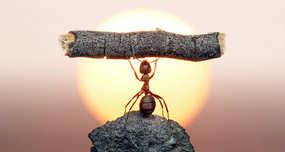
Ants can lift objects 10 to 50 times their own body weight, and can withstand forces up to 5,000 times their weight before their necks rupture.
Ants Can Lift 50x Their Weight (And Survive 5,000x)
Ants are nature's bodybuilders. These tiny insects can hoist objects 10 to 50 times their own body weight—imagine a human casually deadlifting a car. But that's just lifting. Scientists discovered ants can withstand crushing forces up to 5,000 times their weight before their necks finally give out.
Researchers at Ohio State University literally put ants to the test in 2014, using a centrifuge to measure exactly how much force their necks could handle. They studied the Allegheny mound ant, subjecting it to increasingly intense g-forces while monitoring its body. At 350 times body weight, the ant started to stretch. At 3,400 to 5,000 times body weight, the neck finally ruptured.
The Secret: Being Small Is a Superpower
Ants aren't strong despite being small—they're strong because they're small. Inside that hard exoskeleton, ant muscles don't need to waste energy supporting body weight. Nearly all muscle power goes toward lifting and carrying.
This is called the square-cube law. As animals shrink, their strength-to-weight ratio skyrockets. Muscle power scales with cross-sectional area (square), but body weight scales with volume (cube). An ant's muscles are proportionally massive compared to its tiny body mass.
Precision Engineering
Scientists X-rayed ants with micro-CT scanners and examined their muscles under electron microscopes. What they found:
- Muscle fibers arranged at optimal angles for maximum leverage
- Attachment points engineered for force transmission
- Exoskeleton design that distributes stress efficiently
The 2014 study wasn't just academic curiosity—engineers want to build micro-robots with similar strength-to-weight ratios. Understanding how ants achieve such efficiency could revolutionize robotics at tiny scales.
Real-World Ant Strength
Leafcutter ants regularly carry leaf fragments 50 times their weight back to the colony. That's like a 180-pound human hauling 9,000 pounds of groceries. And they do it while navigating vertical surfaces, sometimes upside down.
Asian weaver ants can lift 100 times their weight, and trap-jaw ants snap their mandibles shut at 145 mph—the fastest predatory strike in the animal kingdom. These aren't bodybuilders; they're standard ants.
So the next time you see an ant dragging a crumb five times its size across your kitchen counter, remember: by body weight, it's outperforming every Olympic weightlifter who ever lived. And if you tried to crush it? It could theoretically survive the equivalent of a building falling on it before its neck finally gave out.
Frequently Asked Questions
How much weight can an ant lift?
Why are ants so strong for their size?
How much force can an ant withstand?
Could a human be as strong as an ant?
What is the strongest species of ant?
Verified Fact
This fact has been reviewed and verified against original sources.
Show verification details
Fact significantly understated - ants can lift 10-50x their weight, but can support forces of 5,000x before neck failure
Related Topics
More from Animals
View all Animals →