
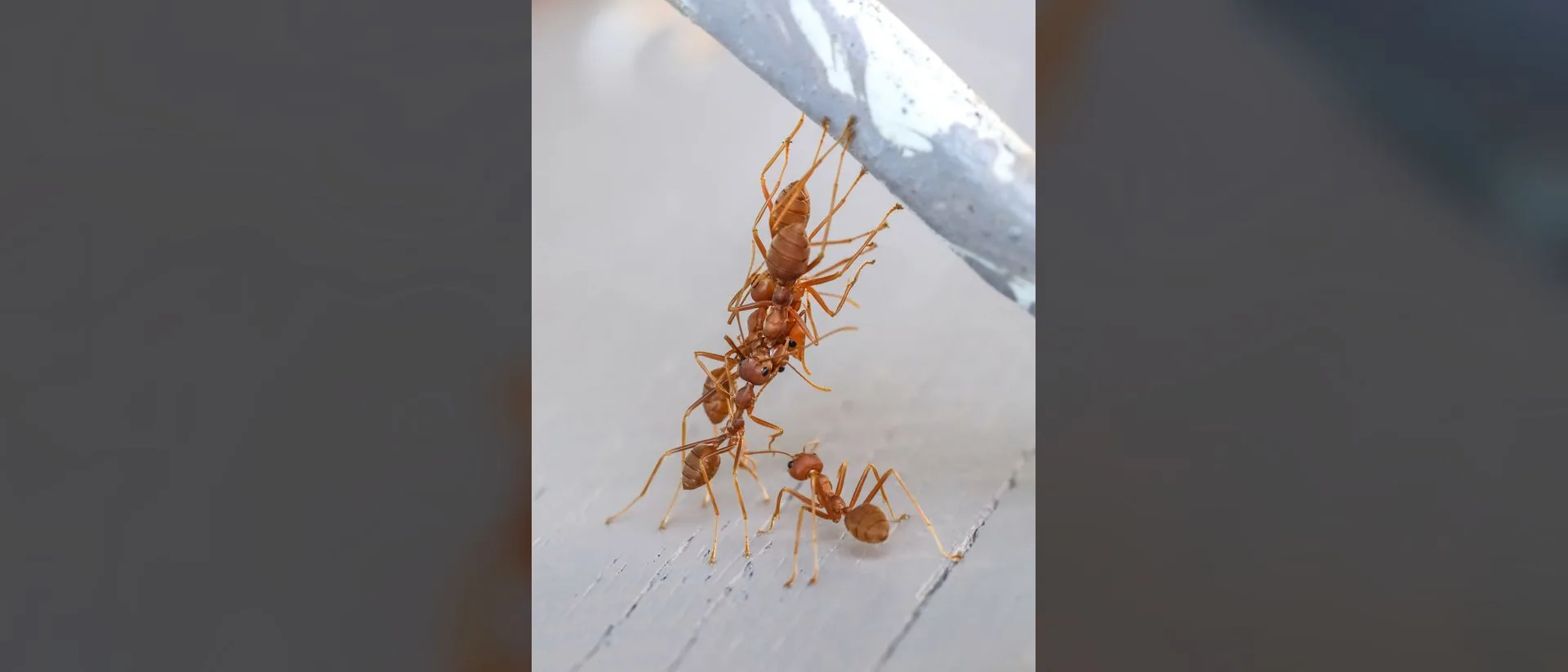
A single weaver ant can pull 60 times its own body weight. But in a group of 15, each ant pulls 103 times its weight. Humans get lazier in groups. Ants get stronger.
Weaver Ants Get Stronger in Groups — The Exact Opposite of What Happens to Humans
In humans, there's a well-documented phenomenon called the Ringelmann effect: the bigger the group, the less effort each individual puts in. It's why group projects in school always had that one person doing all the work.
Ants Don't Do "Social Loafing"
In August 2025, researchers published a study in Current Biology that flipped this idea on its head. They tested weaver ants (Oecophylla smaragdina) — the leaf-nest builders of tropical Asia — and found something extraordinary.
A single weaver ant can pull about 59 times its own body weight. Impressive on its own. But when researchers put them in groups of 15 and measured individual effort, each ant was pulling 103 times its body weight.
They didn't just maintain their effort in a group. They nearly doubled it.
The Force Ratchet
The secret is a system researchers call a "force ratchet." The front ants in a chain actively pull, while the rear ants anchor themselves using sticky pads on their feet. The chain never slips backward. Each ant locks in gains while the others push forward.
It's like a tug-of-war team where nobody ever lets go — and everyone pulls harder because they know the rope won't slip.
Why It Matters Beyond Ants
The findings aren't just a fun animal fact. Engineers studying swarm robotics are using these principles to design robot teams that cooperate more efficiently. If tiny ants can defy one of the most universal patterns of group behaviour, maybe our robots can too.
The Uncomfortable Comparison
The study puts humans in an awkward light. A creature with a brain the size of a pinhead outperforms us at teamwork — not through intelligence, but through sheer mechanical cooperation. No meetings. No emails. No one "circling back." Just pull.
Frequently Asked Questions
How much can a single weaver ant pull?
What is the Ringelmann effect?
How do weaver ants get stronger in groups?
Where was the weaver ant study published?
Verified Fact
This fact has been reviewed and verified against original sources.
Source: Scientific AmericanShow verification details
Species: Oecophylla smaragdina. Individual pulling: 59x body weight (rounded to 60x). Groups of 15: 103x per individual. Mechanism: force ratchet system where front ants pull while rear ants anchor with sticky foot pads.