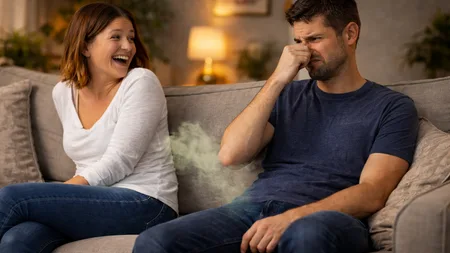
Farts are created mostly by intestinal bacteria fermenting undigested food in your colon.
Your Gut Bacteria Are Fart Factories
Every time you pass gas, you're experiencing the end result of a massive bacterial fermentation party happening inside your colon. It's not just one type of bacteria doing the work—it's an entire ecosystem of microorganisms working together to break down the food your body couldn't digest.
Bacteroides, Ruminococcus, Roseburia, Clostridium, Eubacterium, Desulfovibrio, and Methanobrevibacter are among the most abundant gas-producing microbes in your gut. Yes, E. coli is in there too, but it's just one player on a very crowded team.
The Fermentation Factory
Think of your colon like a brewery, except instead of making beer, it's making... farts. When you eat foods rich in complex carbohydrates—beans, certain vegetables, whole grains—your small intestine can't fully digest them. These leftovers travel to your large intestine, where trillions of hungry bacteria are waiting.
These bacteria ferment the undigested food, and just like yeast fermenting grapes produces carbon dioxide in champagne, gut bacteria fermenting carbohydrates produces gas in your intestines. The process is essentially the same, just with different end results.
What's Actually In a Fart?
Here's where it gets interesting: more than 99% of your farts are completely odorless. The gas composition includes:
- Nitrogen (20-90%)
- Hydrogen (20-50%)
- Carbon dioxide (9-30%)
- Methane (0-10%, only in about one-third of people)
- Oxygen (3-10%)
That remaining less-than-1%? That's the stinky stuff—hydrogen sulfide, ammonia, and skatole. These malodorous compounds are what make everyone evacuate the elevator.
The Smelly Culprits
Different bacteria produce different gases. Some species are champions at producing hydrogen, others specialize in methane, and a few create those sulfur-containing compounds that smell like rotten eggs. The specific mixture depends on your unique gut microbiome—which is why everyone's farts have their own special... character.
Bacterial gases make up about 74% of flatulence in normal, healthy people. The rest comes from swallowed air and gases that diffuse from your bloodstream into your intestines.
So next time you let one rip, remember: you're not just passing gas, you're releasing the gaseous byproducts of trillions of microscopic organisms working hard to help you digest your lunch. It's gross, it's natural, and it's a sign that your gut bacteria are doing their job.
Frequently Asked Questions
What bacteria cause farts?
Why do farts smell bad?
What foods make you fart more?
Is farting a sign of healthy digestion?
Do all people produce methane in farts?
Verified Fact
This fact has been reviewed and verified against original sources.
Show verification details
Corrected to accurately reflect that multiple bacterial species create farts through fermentation, not just E. coli. E. coli is one contributor among many gut bacteria.