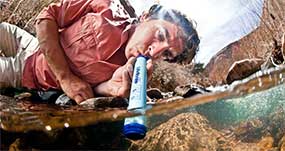
A person can live without food for about a month, but only about a week without water.
Why You Can Survive a Month Without Food But Not a Week Without Water
Your body is a remarkably resilient machine that can endure weeks of starvation, but deprive it of water and you're on a clock that ticks down in mere days. While a healthy adult can survive roughly 3-8 weeks without food (assuming they have water), most people can only last 3-5 days without water, with seven days being an extreme outer limit.
This dramatic difference isn't arbitrary—it's written into every cell of your body.
Why Water Beats Food in the Survival Hierarchy
Water makes up about 60% of your body weight, and it's not just filling space. Every single biochemical reaction in your body occurs in water. Your blood is mostly water, carrying oxygen and nutrients to cells. Your kidneys need water to filter waste. Your brain requires water to maintain electrical signaling. Even your joints depend on water for cushioning.
When you stop drinking, things deteriorate fast:
- Within 24 hours: Significant dehydration symptoms appear—dizziness, rapid heartbeat, drastically reduced urine output
- After 3 days: Critical organ systems begin failing as your blood thickens and your kidneys struggle to function
- By day 5-7: Death is likely as your body simply cannot maintain the chemical reactions necessary for life
The Body's Fasting Reserves
Food deprivation, while unpleasant, operates on a completely different timeline. Your body evolved sophisticated systems to handle periods without eating—systems our ancestors relied on during harsh winters and failed hunts.
When you stop eating, your body shifts through several phases. First, it burns through glucose stored in your liver and muscles (this lasts about 24 hours). Then it begins breaking down fat stores for energy, a process called ketosis that can sustain you for weeks. Finally, if starvation continues, your body reluctantly begins consuming muscle tissue and even non-essential proteins.
The longest medically documented case of survival without food involved Angus Barbieri, who fasted for 382 days under medical supervision in 1965-66, living entirely off his substantial body fat while taking only vitamins and water. While this is an extreme outlier, it demonstrates the body's remarkable ability to operate without external food sources when water remains available.
Environmental Reality Check
These survival timelines assume relatively comfortable conditions. In extreme heat above 90°F (32°C), your survival time without water plummets to just 1-2 days as your body desperately tries to cool itself through sweating. In temperatures exceeding 100°F (38°C), vulnerable individuals might have less than 24 hours.
Physical activity slashes these timelines further—moderate movement in warm conditions can reduce your water-free survival window by 50-75% compared to complete rest.
The Chemistry of Priority
Understanding why water trumps food comes down to chemistry. Dehydration causes your blood volume to drop and thicken, forcing your heart to work harder while delivering less oxygen. Your body temperature regulation fails. Waste products accumulate to toxic levels. Your brain swells as cellular fluid balance collapses.
Starvation, by contrast, is a slower burn. Your metabolism can downshift, your body can cannibalize its own tissues for fuel, and your brain can adapt to running on ketones instead of glucose. It's miserable, but it's survivable for weeks because the core chemical reactions can continue.
The survival rule of threes captures this perfectly: three minutes without air, three days without water, three weeks without food. It's a hierarchy written by evolution, and water sits firmly in second place—right after oxygen, and far ahead of your next meal.
Frequently Asked Questions
How long can you survive without water?
How long can you live without food?
Why is water more important than food for survival?
What happens to your body when you don't drink water?
Can you survive longer without food in cold weather?
Verified Fact
This fact has been reviewed and verified against original sources.
Show verification details
Medical research confirms humans can survive weeks without food but only days without water.