
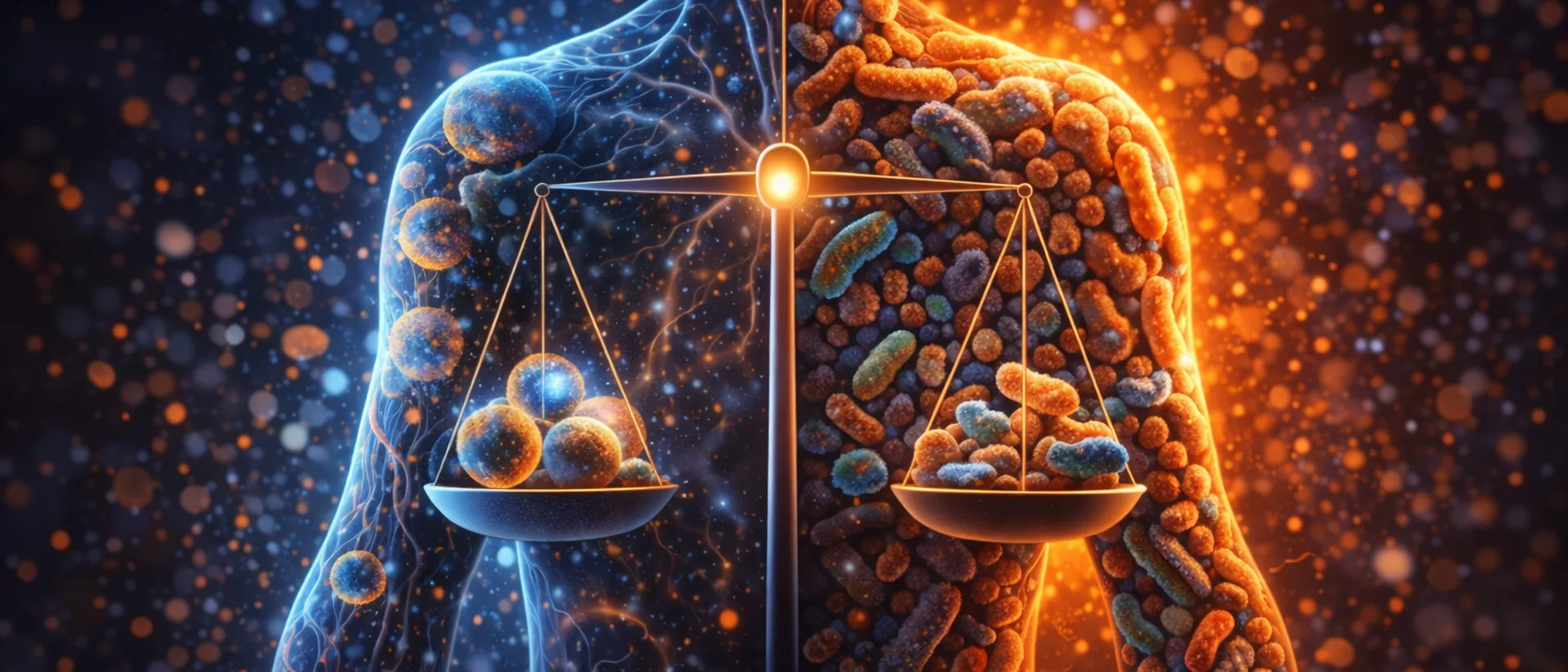
You have roughly equal numbers of bacterial and human cells—about 38 trillion of each. You're a 50/50 partnership with microbes.
You're Not a Person, You're a Bacterial Apartment Complex
You have more bacterial cells in your body than human cells. You're basically a walking, talking microbiome apartment complex, and the rent is paid in leftover pizza.
Welcome to the Tenement of You
Forget the idea of being a solitary, noble organism. You are a bustling, slightly damp city-state for trillions of microscopic tenants. Scientists estimate the ratio is about 1.3 bacterial cells for every single human cell.
That means the 'you' that you think of as 'you' is actually a minority stakeholder in your own body. The majority shareholders are tiny, single-celled entities that don't even have a voting system.
Who Are These Tiny Roommates?
Your microbial residents aren't just squatters; they're essential staff. They work in your gut's digestive department, manage your skin's security detail, and train your immune system's new recruits.
Without this internal ecosystem, or microbiome, you'd be in serious trouble. They break down food you can't, produce vitamins, and politely fight off nastier germs trying to crash the party.
The Great Bacterial Census Debate
Now, some very precise scientists have argued the original '10 times more bacteria' stat was an overestimate. A 2016 review in the journal *Cell* suggested the ratio is closer to a 1:1 tie, or just slightly in favor of bacteria.
But let's be real. Whether it's a 50/50 split or a 60/40 bacterial majority, the point stands: you are never, ever alone. Even when you're 'home alone,' you're hosting the world's most intimate gathering.
You Are the Landlord (A Mostly Chill One)
Your job is to be a good landlord. You provide the infrastructure—warm, moist, nutrient-rich environments from mouth to... well, the other end. In return, they handle waste management, climate control, and pest defense.
Feed them well with fiber, and they throw a peaceful, productive rave. Bomb them with antibiotics, and it's like evicting everyone without notice—sometimes necessary, but chaotic. The wrong tenants might move in during the confusion.
So next time you look in the mirror, don't see just a person. See a high-rise, a subway system, a complex and weirdly squishy planet. Your thoughts might be your own, but the building you're thinking them in is a co-op. Be kind to your tiny citizens—they're the reason the whole operation doesn't fall apart.
Frequently Asked Questions
Is it true you have 10 times more bacteria than human cells?
Where do most of these bacteria live?
Are all these bacteria good for you?
Do antibiotics kill my good bacteria too?
Verified Fact
This fact has been reviewed and verified against original sources.
Source: View sourceShow verification details
Per Sender, Fuchs & Milo (2016) in PLOS Biology, the human body contains approximately 38 trillion bacteria and 30 trillion human cells—a ratio close to 1:1, not the previously cited 10:1.