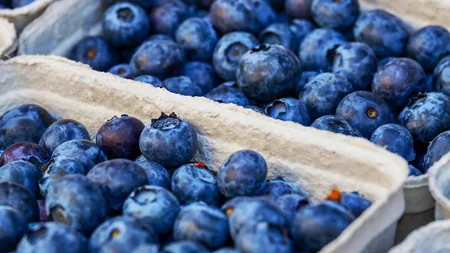
Cranberries are sorted for ripeness by bouncing them; ripe cranberries must bounce at least 4 inches high to pass quality control.
Cranberries Are Sorted by Bouncing Them Like Tiny Balls
If you've ever wondered how farmers separate good cranberries from bad ones, the answer is surprisingly simple: they bounce them. Yes, really. Fresh, ripe cranberries contain air pockets that make them naturally springy, so the industry uses bounce tests to determine which berries are fit for sale.
A cranberry must bounce at least 4 inches high to pass quality control and be sold as fresh fruit. Berries that fail the bounce test are softer, overripe, or damaged, and get diverted to processed products like juice, sauce, or jam.
The Accidental Discovery
This ingenious sorting method wasn't the result of careful scientific research—it was discovered by accident. In 1880, New Jersey farmer John "Peg-Leg" Webb spilled cranberries down a flight of stairs. He noticed that the freshest berries bounced all the way to the bottom, while bruised or spoiled ones stayed behind on the upper steps.
Webb's clumsy moment revolutionized cranberry harvesting. Farmers began using bounce board separators—wooden barriers set at 4 inches high—to automatically sort their harvests. Ripe berries sail over the barrier, while inferior ones thump to the ground.
Why Do Cranberries Bounce?
Unlike most fruits, cranberries have four air pockets inside. These pockets give the berry its characteristic bounce and also allow it to float during wet harvesting (those iconic images of farmers standing waist-deep in cranberry-flooded bogs).
The firmer the berry, the better it bounces. As cranberries age or get damaged, they lose firmness and air, which kills their bounce. It's an elegant quality test: physics does the work.
The Bounce Test Today
Modern cranberry facilities still use this 140-year-old technique. Conveyor belts carry berries over bounce boards, and machines separate them based on how high they bounce. Some systems have multiple barriers at different heights to grade berries by quality level.
Next time you buy fresh cranberries, try the bounce test yourself. Drop one from a few inches up—if it bounces with a satisfying boing, you've got a good berry. If it thuds like a sad grape, it's past its prime.
Frequently Asked Questions
Why do cranberries bounce?
How high does a cranberry need to bounce?
Who invented the cranberry bounce test?
What happens to cranberries that don't bounce?
Do farmers still use the bounce test for cranberries?
Verified Fact
This fact has been reviewed and verified against original sources.
Show verification details
Corrected 'dribbled like a basketball' to accurate 4-inch minimum bounce height standard