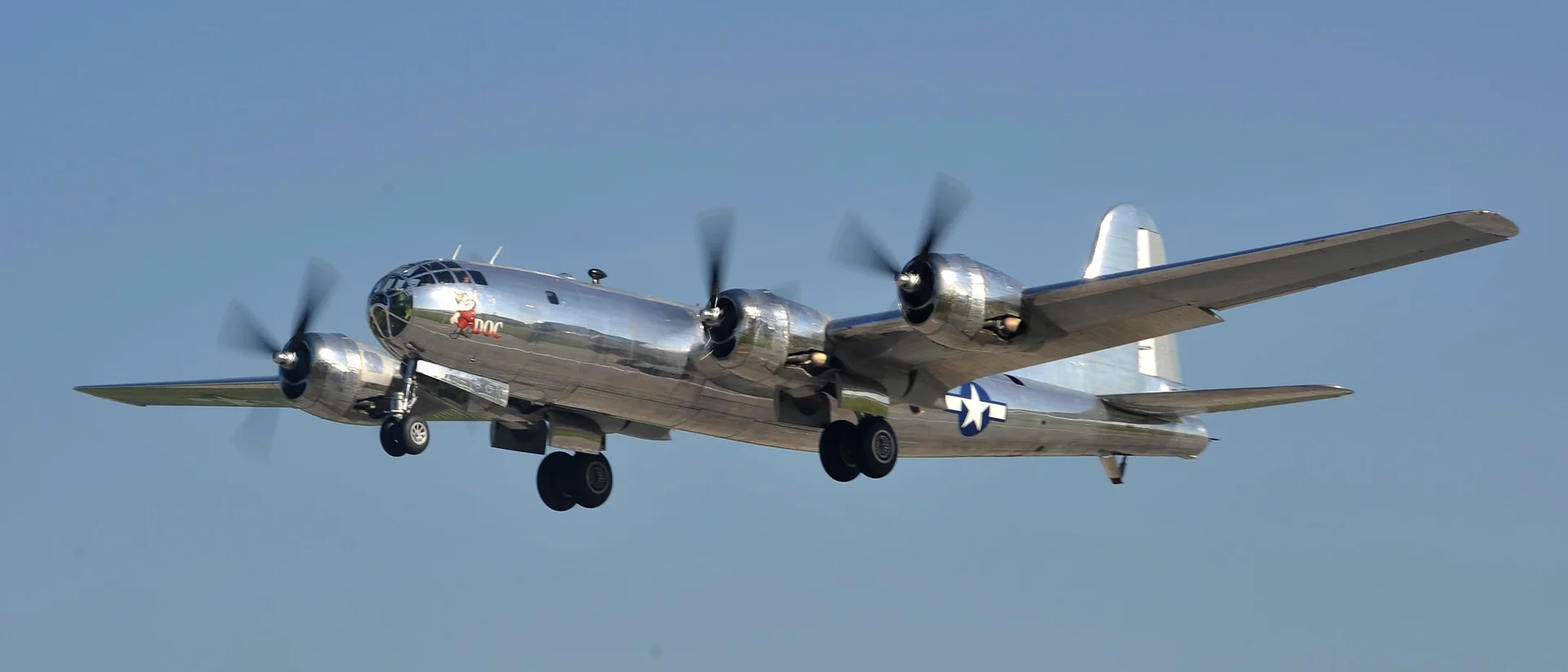
A World War II bomber named Doc sat in the Mojave for 42 years as a Navy target. An Air Force veteran spent more than eleven of those years talking the Navy into letting it go. It went home to Wichita, where 1,644 B-29s were built, and retirees from those lines helped rebuild it. Doc is one of two B-29s still flying, and it lands at airports every year so people can climb inside.
Doc: The B-29 That Spent 42 Years as a Target
Out on the Navy's range in the Mojave Desert, an airplane is not an airplane. It is a shape to aim at. A B-29 Superfortress sat out there for 42 years being aimed at, and it is now one of two B-29s in the world that still fly.
A Bomber Named After a Dwarf
The aircraft was built at Boeing's Wichita plant in 1944 and delivered to the US Army in March 1945, with the serial number 44-69972. Doc's Friends, the non-profit that owns it today, counts it as one of 1,644 B-29s built in Wichita during the war.
It never saw combat. It was converted into a radar calibration aircraft in 1951 and flew with a squadron at Griffiss Air Force Base in New York.
The crews there named their bombers after the characters in Snow White and the Seven Dwarfs. 44-69972 became Doc.
The Air Force retired it in 1956 and handed it to the Navy at China Lake, California, to be used as a target. It had spent eleven years in uniform. It would spend 42 in the desert.
Forty-Two Years of Being Shot At
Doc's Friends puts the span plainly: for 42 years, Doc sat in the Mojave Desert serving as a target for the US Navy.
In the late 1980s an Air Force veteran named Tony Mazzolini, who had gone on to work for General Electric and Continental Airlines, started asking the Navy whether any of the China Lake B-29s were left. He was told they were all gone.
He kept asking, and eventually the Navy confirmed that one remained on a distant bombing range. In 1987 he was given permission to go and look at it, and the serial number on the airframe turned out to belong to a bomber he had seen at Griffiss thirty years earlier.
Getting it out was another matter. It took him more than eleven years.
The Price Was Another Bomber
The Navy did not want cash. The naval aviation collection at Pensacola, Florida, needed a restored B-25 Mitchell, and the Navy would not release Doc until it had one.
Mazzolini found a Mitchell airframe in South America, had it shipped north and put it into restoration. What he had planned as a six-month job turned into a six-year one, including a change of workshop and a change of mind by the Navy about how the aircraft should be finished.
The trade was completed in 1998. Doc was towed off the range to nearby Inyokern Airport and taken apart for the road.
In May 2000 the pieces arrived back in Wichita on seven truckloads, at the same city that had built the aircraft 55 years earlier.
The People Who Put It Back Together
Hundreds of volunteers signed on. Doc's Friends describes them as skilled workers and retirees from Wichita's aviation industry, veterans and serving military.
Air and Space Forces Magazine put it more bluntly: the volunteers ranged from retirees who had driven rivets on B-29s in 1945 to aerospace workers still on the payroll. Some of the old hands had spent their working lives on the lines in the city that turned out those 1,644 Superfortresses.
The work ran for sixteen years in Wichita, in borrowed shop space on what was the Boeing campus and later became Spirit AeroSystems. Volunteers came and went; a core stayed.
July 17, 2016
Doc received its airworthiness certificate in June 2016. A month later, on July 17, it left the runway for the first time since 1956.
The crew flying it that day came from FIFI, the only other airworthy B-29 in the world.
Still on the Road
Doc tours the country under the banner "History Restored", flying into regional airports from mid-March to mid-November. At each stop the public can walk the ramp, climb into the cockpit and, if they want, buy a seat on a flight.
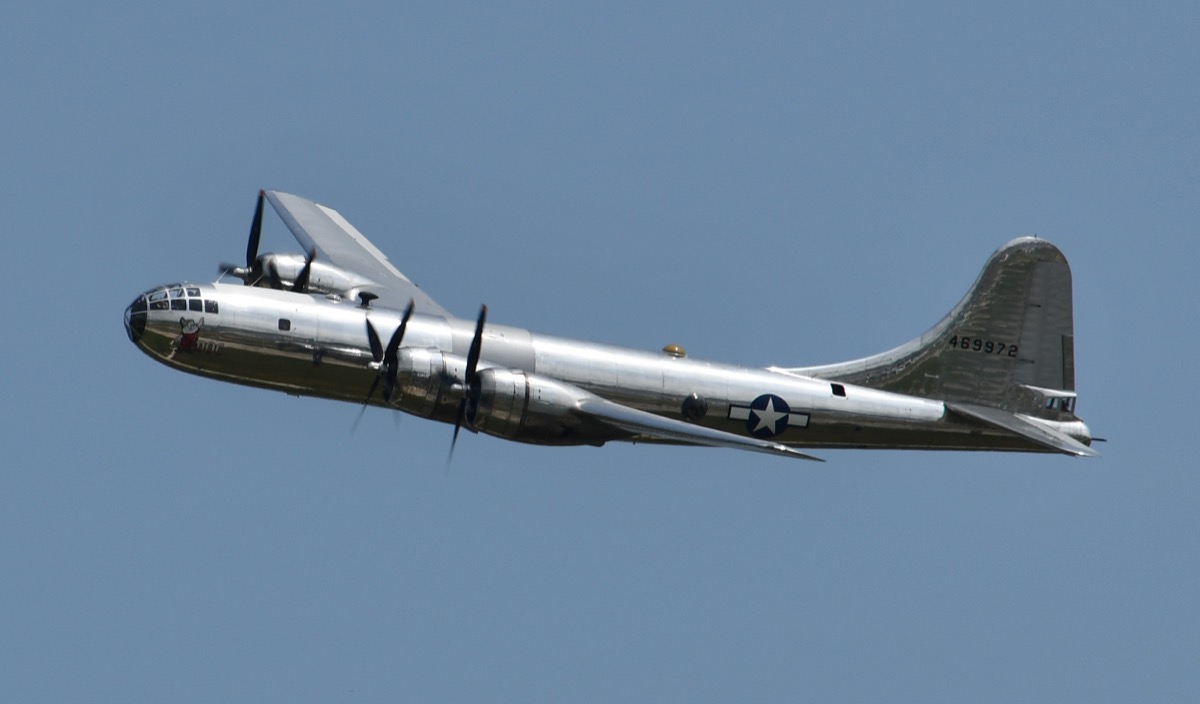
When the airplane is not travelling it lives in its own hangar at Eisenhower National Airport in Wichita, where visitors can watch the volunteers work on it.
Two B-29s in the world still fly. One of them was a target for longer than it ever was an airplane.
Enjoyed this? Get a new fact every morning.
A fascinating fact in your inbox every morning. Free. Unsubscribe anytime.
Frequently Asked Questions
How many B-29 Superfortresses are still flying?
Why was a B-29 left in the Mojave Desert?
Who found the B-29 Doc?
When did the B-29 Doc fly again?
Where was the B-29 Doc built?
Verified Fact
Verified Sep 18, 2026 · 6 sources checked
Source: Doc's FriendsShow verification details
Claims checked
- Doc sat in the Mojave Desert for 42 years as a US Navy target
- Doc is one of 1,644 B-29s built in Wichita during the war
- Tony Mazzolini was told the desert B-29s were all gone and kept asking until one was found
- Mazzolini described as an airline mechanic; he worked for GE and Continental Airlines
- Time spent getting the Navy to release it is more than eleven years (was eleven)
- Doc flew again on July 17, 2016 and is one of only two airworthy B-29s
Sources: Doc's Friends, Air and Space Forces Magazine, Wikipedia
Related Topics
More from History & Culture
View all History & Culture →