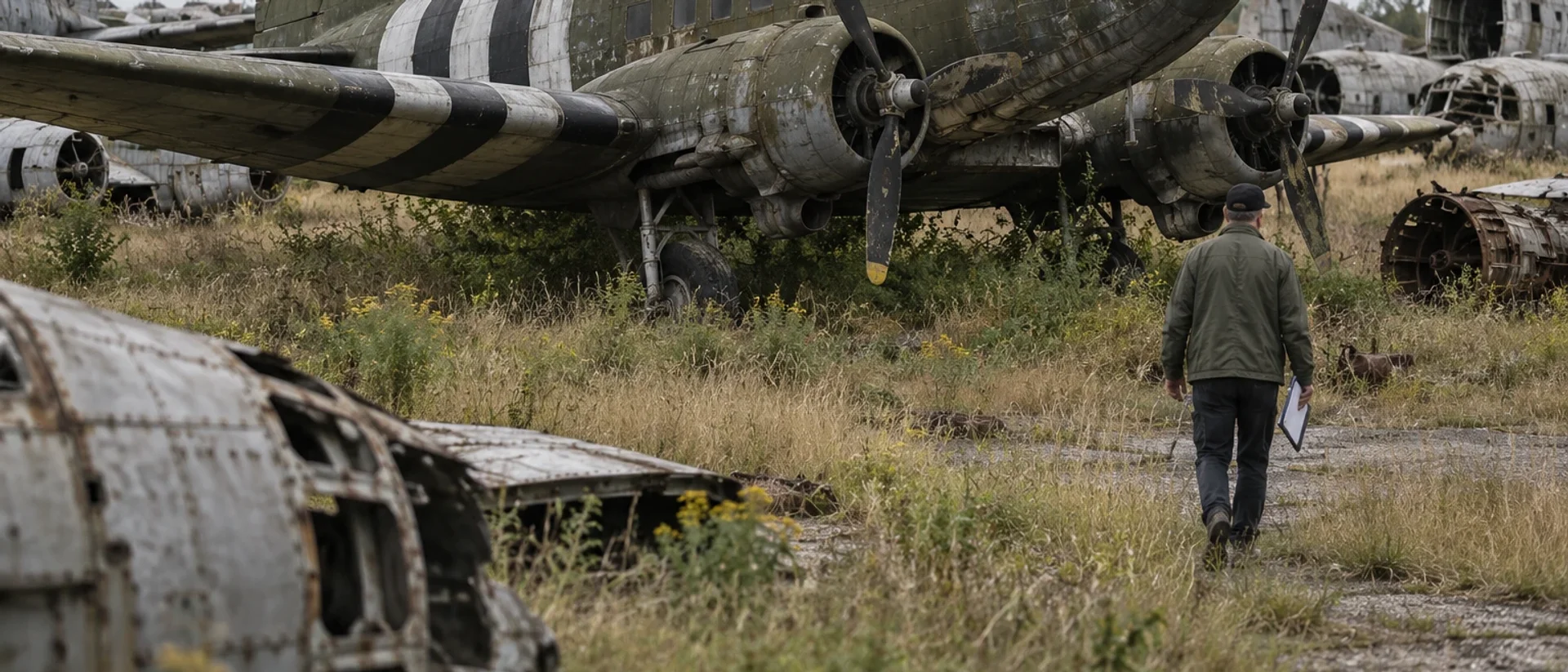
More than 800 C-47 transport planes carried over 13,000 paratroopers across the Channel before dawn on D-Day. One flew at the front. After the war it hauled freight for decades. Then it sat in a Wisconsin boneyard, next in line to be cut up and modernized. An Air Force historian chasing a serial number found it there. Passengers still board through the door the paratroopers jumped from.
The D-Day Lead Plane Found in a Scrapyard
Just after midnight on 6 June 1944, a stream of Douglas C-47s crossed the English Channel in the dark. More than 800 of them carried over 13,000 American paratroopers toward Normandy. One airplane flew at the front of the column, and seventy years later it was sitting in a Wisconsin boneyard with a number on its tail that nobody had bothered to look up.
The Rumor in the Squadron Records
Matt Scales was an Air Force historian working at the Air Force Historical Research Agency at Maxwell Air Force Base in Alabama. His Air National Guard squadron had a story it told about itself: one of its old members, Lt. Col. John Donalson, had flown the lead C-47 on D-Day.
Scales went looking for proof. He and a colleague pulled the wartime history of the 438th Troop Carrier Group, the unit that led the column that night.
Donalson was named in the records. So was the serial number of the airplane he flew that night, 42-92847.
Scales had the one detail that could tell a surviving airframe apart from the thousands of others Douglas built.
Hit, Repaired, and Back the Same Evening
The airplane dropped paratroopers of the 101st Airborne at 0048 on D-Day morning. Flak hit it on that run.
It made it back to England, and crews patched it up. That same evening it was over Normandy again, delivering a glider load of troops and equipment to the 82nd Airborne.
It went on to Market Garden, to the resupply flights into Bastogne, and to Operation Varsity in 1945. It came through all of it.
A Long Line of Owners, Then the Boneyard
After the war the airplane was sold off and went to work. Cargo outfits, a gas company, a small New England airline, a church, a string of charter and freight operators - the registry lists sixteen civilian operators over sixty years.
Every one of them flew it as a working airplane, and none of them crashed it. None of them knew what it had done.
In 2008 the airframe was bought by Basler Turbo Conversions of Oshkosh, Wisconsin. Basler takes old DC-3s and C-47s and rebuilds them as BT-67 turboprops: new engines, a stretched fuselage, modern avionics. It is a good business and a genuine second life for the type, but it does not leave a 1944 airplane behind.
The airframe went into the company's outdoor boneyard to wait its turn. Nobody at Basler knew what was parked out there.
Scales tracked it there and asked Basler whether they had ever come across serial number 42-92847. They had. It was in the yard.
22,000 Hours
The Commemorative Air Force bought the airplane in 2015 after a fundraising push backed by more than 3,000 individuals and organizations.
The corrosion alone was daunting. CAF president Bob Stenevik put the effort at more than 22,000 hours of work, and said at the time that the work was still going.
On 31 January 2018 it lifted off from Wittman Regional Airport in Oshkosh for the first time in about a decade, with Doug Rozendaal at the controls.
It Still Takes People Up
The airplane flies with the Commemorative Air Force's Central Texas Wing out of San Marcos, Texas, under the name it wore in 1944, That's All, Brother.
In 2024 it crossed the North Atlantic again and flew over the Normandy beaches for the 80th anniversary of the landings.
The rest of the year it works airshows, and it sells seats. Passengers climb in through the same door the 101st jumped out of, and it is open to anyone from about five years old up.
The 2026 fall schedule brings it home to San Marcos on 10 October for a Fly and Fun Day.
Frequently Asked Questions
What plane led the C-47 formation on D-Day?
How was the D-Day C-47 found in a Wisconsin boneyard?
Where is the C-47 That's All, Brother based today?
Can you ride in a restored C-47?
How long did the restoration of the D-Day C-47 take?
Verified Fact
Verified Sep 12, 2026 · 6 sources checked
Source: Commemorative Air ForceShow verification details
Claims checked
- More than 800 C-47s carried over 13,000 paratroopers on D-Day, and this one flew at the front
- Sixteen civilian operators flew it after the war; other accounts say twelve owners
- It sat in an aircraft boneyard in Oshkosh, Wisconsin, awaiting conversion
- An Air Force historian traced serial 42-92847 to that yard
- More than 22,000 hours of work went in; it flew again on 31 January 2018
- It still carries paying passengers, with Texas stops in October 2026
Sources: Commemorative Air Force, That's All Brother, Warbird Registry, Vintage Aviation News, Warbirds News, Wikipedia
Related Topics
More from History & Culture
View all History & Culture →