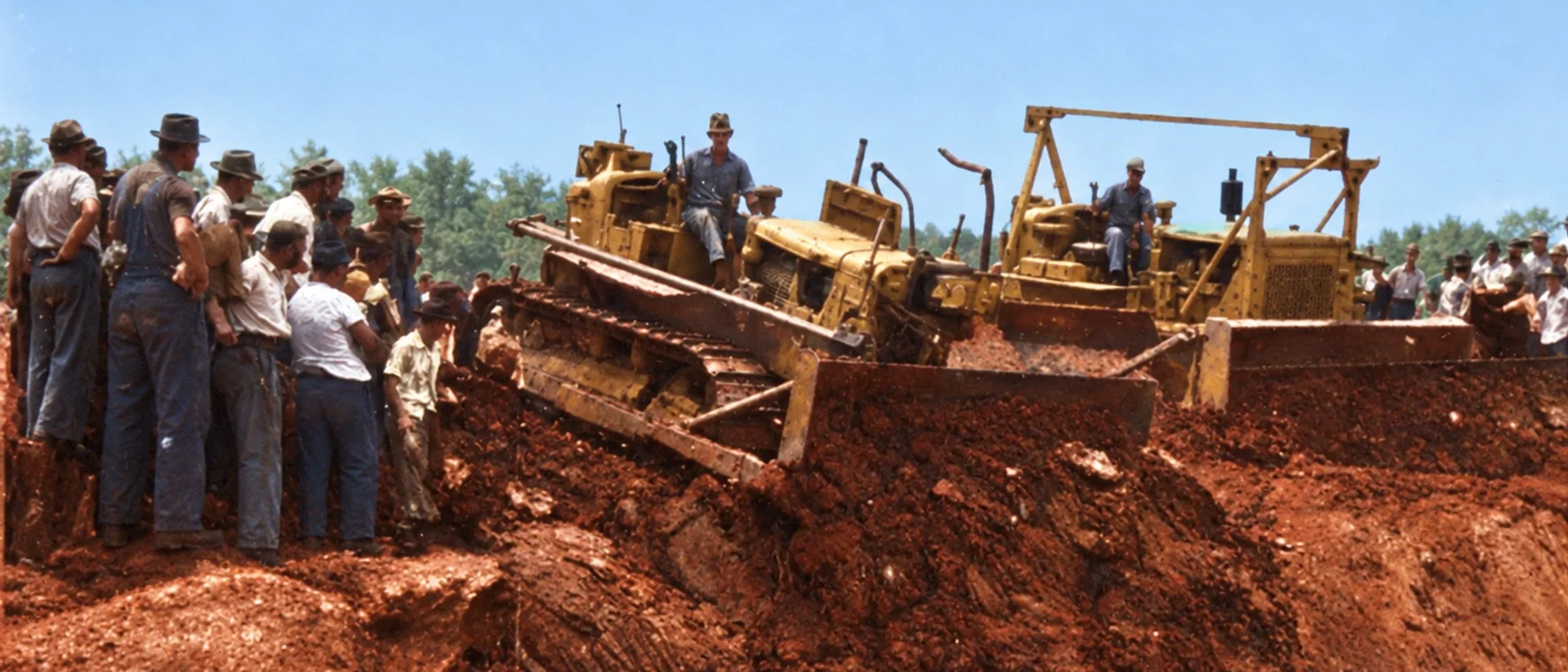
On May 12, 1948, some 700 volunteers and more than 200 machines went to work on a worn-out 168-acre farm near Winder, Georgia. Veteran Ernest Blakey was buying part of it from his uncle. In a matter of hours, to show what soil conservation could do, they filled the gullies, terraced the hills, dug a pond and built a shed. An estimated 50,000 people watched. Sixty years later, the farm still runs cattle with no erosion.
200 Machines, 700 Volunteers, One Georgia Farm
On May 12, 1948, some 700 volunteers and more than 200 bulldozers, tractors and other machines went to work on a worn-out 168-acre farm near Winder, Georgia, and set about rebuilding it in a single day. It was no surprise visit. It was a planned Master Conservation Field Day, staged so that tens of thousands of people could see what soil conservation looked like at full speed.
A Farm Worked to Death
The land belonged to Marion Carlyle and his nephew, Ernest Blakey, a World War II veteran who was buying part of it from his uncle. Observers said it had been "row-cropped to death," like much of north Georgia. A gully about 50 feet deep cut across it, and only about two acres kept any real topsoil.
Blakey's status as a veteran, his enrollment in a veterans' farm-training program, and the farm's neglect were among the reasons a local committee picked it as the demonstration site.
Six Months of Planning, One Day of Work
The Oconee River Soil Conservation District, The Atlanta Journal and the civic clubs of Winder sponsored the event. About 30 companies, including Caterpillar, International Harvester and John Deere, supplied machines and materials. Planning took six months.
The printed program listed the jobs field by field. Bulldozers would fill the big gully, crawler tractors would smooth 60 acres of pasture, crews would build terraces on another 60 acres, and dynamite would straighten a stream. A pond would be dug, fences rebuilt and seed put in the ground.
Newspapers of the day reported that more than 200 pieces of machinery, run by some 700 men, got it all done in a matter of hours. The volunteers were mostly local and included many recently returned veterans.
The Crowd That Clogged Winder
An estimated 50,000 to 60,000 spectators arrived in about 10,000 vehicles, many of them the night before. Parking for up to 14,000 cars was set aside on a neighboring farm, and the Georgia State Patrol worked the traffic.
Agricultural observers from Sweden, Peru, Chile and South Africa were reported among the onlookers. Speakers included Georgia's governor and Hugh H. Bennett, the first chief of the U.S. Soil Conservation Service.
Bennett called it one of the most impressive and encouraging sights he had ever witnessed. Public officials went further and billed it as the greatest soil show ever seen.
What Is Still There
The only building put up that day was a metal equipment shed. The terraces, ponds, rerouted water channels and fence lines remained.
Blakey told The Atlanta Journal in 1953 that the farm's yield had doubled on half the work force, and the family kept the land in pasture and hay. The farm was listed on the National Register of Historic Places in 2008. The registration form said it still operated, with cattle grazing the fields, a pond that still watered the herd and no erosion.
Enjoyed this fact?
Be the first to love this
Get a new fact every morning.
A fascinating fact in your inbox every morning. Free. Unsubscribe anytime.
Frequently Asked Questions
What happened at the Carlyle-Blakey Farm in 1948?
Who was Ernest Blakey?
Was the 1948 farm makeover a surprise?
Is the Carlyle-Blakey Farm on the National Register of Historic Places?
Verified Fact
Verified Nov 10, 2026 · 3 sources checked
Source: National Park Service (NRHP registration form)Show verification details
Claims checked
- About 700 men and more than 200 machines worked the farm on May 12, 1948
- The crew filled the gullies, terraced the hills, dug a pond and built a shed in a matter of hours
- An estimated 50,000 to 60,000 people watched, and it was a planned, sponsored event
- Ernest Blakey, a World War II veteran, was buying part of the farm from his uncle
- The farm was listed on the National Register in 2008 and still ran cattle with no erosion
Sources: National Register of Historic Places registration form, Digital Library of Georgia, Wikipedia
Related Topics
More from History & Culture
View all History & Culture →