
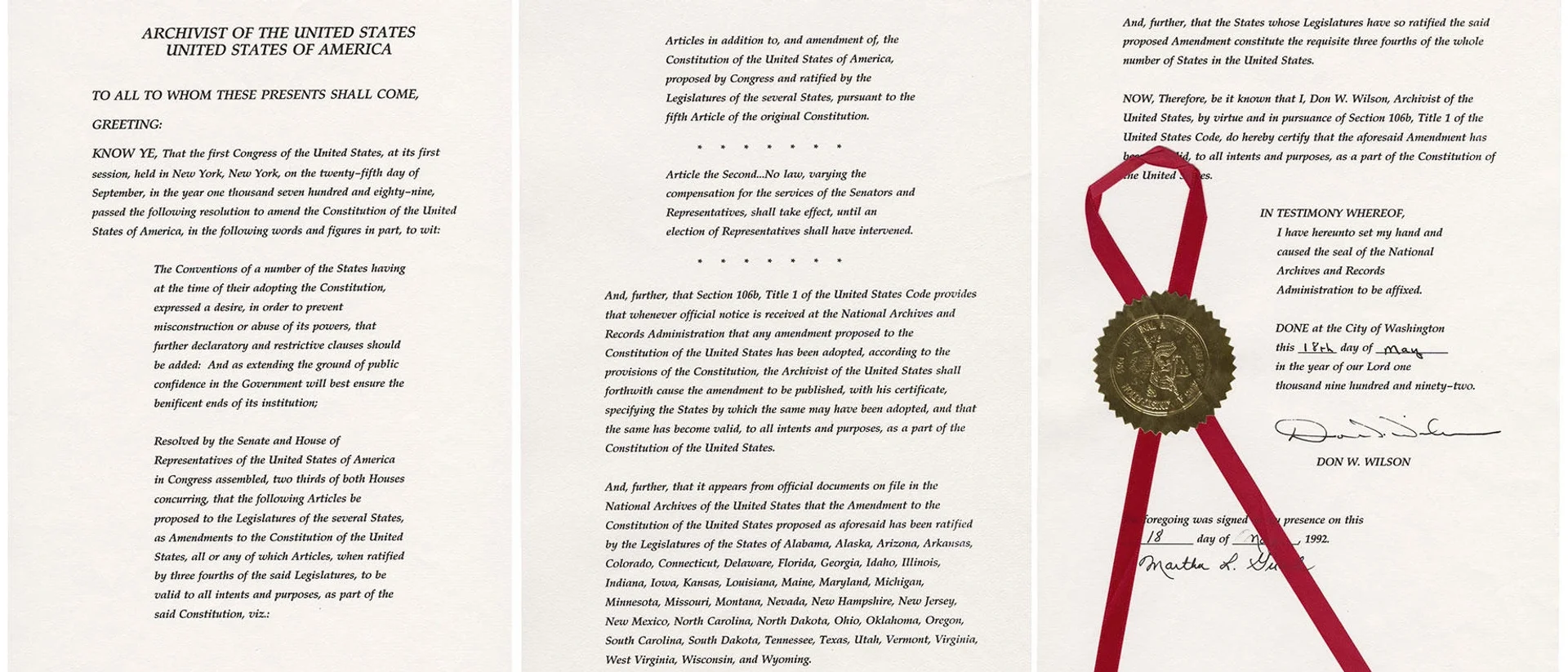
In 1982, a Texas college student named Gregory Watson got a C on a paper arguing that a 1789 amendment by James Madison had no deadline and could still pass. He spent ten years writing letters to state lawmakers, and in 1992 it became the 27th Amendment. In 2017, his professor signed off on changing his grade to an A. Madison's amendment has been in the Constitution ever since.
A C Paper, Ten Years of Letters and the 27th Amendment
In 1982, a sophomore at the University of Texas at Austin turned in a government paper arguing that an amendment written by James Madison was still alive. He got a C. Ten years later, that amendment was part of the United States Constitution, and the National Archives still lists it as the most recent amendment.
The Paper Nobody Believed
The student was Gregory Watson. His American Government class asked for a paper about a governmental process, so he went to the library and started reading about the Constitution.
In a book about amendments that Congress had sent to the states but that never won enough votes, one jumped out at him.
"I'll never forget this as long as I live," Watson told NPR. "This one just jumped right out at me."
Madison had written it in 1789, and Congress sent it to the states alongside the proposals that became the Bill of Rights. It concerns lawmakers' pay and says a change cannot take effect until after the next House election.
It fell short of the states it needed. But nobody had ever set a deadline on it, so Watson argued that it was technically still pending.
A C, and a Promise
He turned the paper in to his teaching assistant and got it back with a C.
Watson appealed to the professor, Sharon Waite. "I kind of glanced at it, but I didn't see anything that was particularly outstanding about it and I thought the C was probably fine," she later told NPR.
"So I thought right then and there, 'I'm going to get that thing ratified,'" Watson said.
Ten Years of Letters
An amendment needs the approval of 38 state legislatures. Nine had approved this one, mostly back in the 1790s, which left Watson needing 29 more.
He wrote to members of Congress asking who back home might sponsor it. Most never answered, and some who did said the amendment was too old.
Then a senator from Maine replied and passed the idea along. In 1983, Maine's legislature approved it, Watson's first success.
He started writing to every state lawmaker he thought might help. Colorado followed in 1984, then five states in 1985, three each year from 1986 to 1988, and seven in 1989 alone.
The Vote on the Phone
By 1992, 35 states had approved it. In May of that year, as Watson listened on the phone, the Michigan House of Representatives cast the vote that put it over the top, according to NPR.
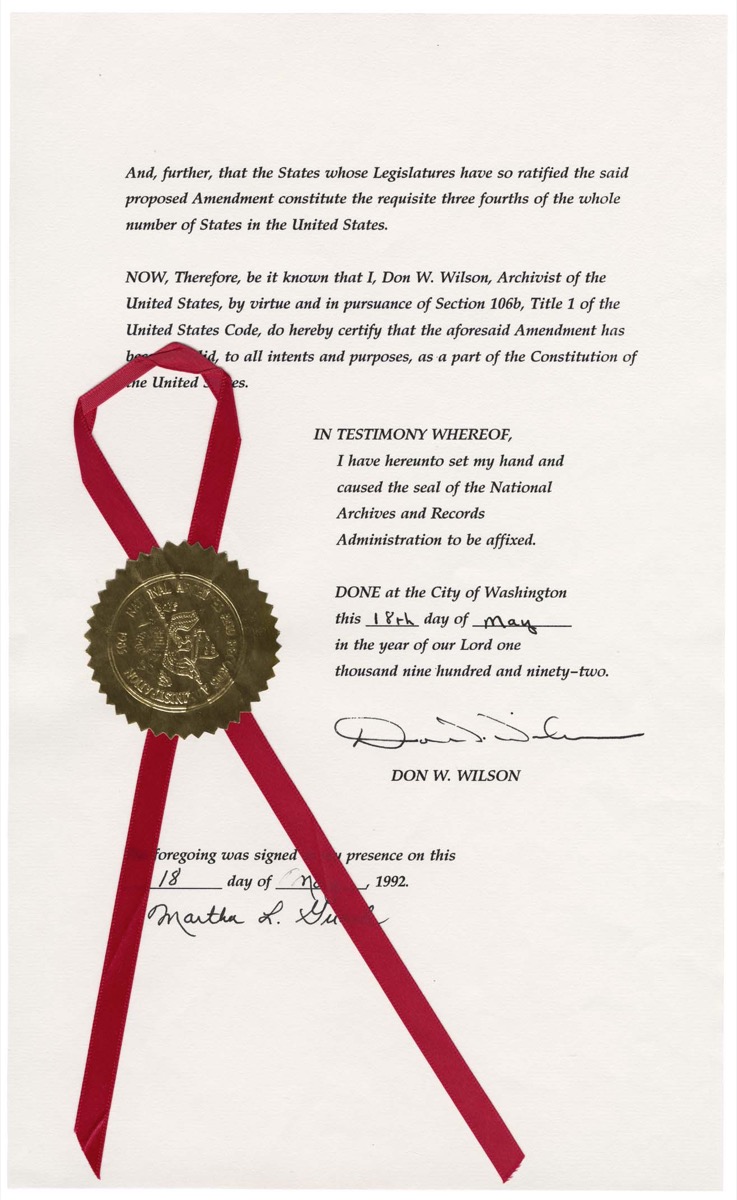
More than two centuries after Madison wrote it, it became the 27th Amendment. The National Archives lists it as ratified on May 7, 1992.
Watson's celebration was modest. "I did treat myself to a nice dinner at an expensive restaurant," he told NPR.
From C to A
Years later, Waite learned from an author researching a book on amendments that her old student had done all this because of the grade she let stand.
"Goodness, he certainly proved he knew how to work the Constitution," she told NPR. "So, yes, I think he deserves an A after that effort - A-plus!"
In 2017, 35 years after the paper, she signed the form, and the University of Texas at Austin officially changed Watson's grade in the course to an A.
No amendment has been certified since 1992, and the National Archives lists the one from his C paper as the most recent.
Source:NPR
Enjoyed this fact?
2 people loved this
Get a new fact every morning.
A fascinating fact in your inbox every morning. Free. Unsubscribe anytime.
Frequently Asked Questions
Who is Gregory Watson?
How long did it take to ratify the 27th Amendment?
What grade did Gregory Watson get on his 27th Amendment paper?
What is the most recent amendment to the US Constitution?
How many states are needed to ratify a constitutional amendment?
Verified Fact
Verified Sep 28, 2026 · 6 sources checked
Source: NPRShow verification details
Claims checked
- A Texas college student got a C on a 1982 paper arguing a 1789 James Madison amendment could still pass
- The teaching assistant gave the C and professor Sharon Waite let it stand on appeal
- He spent ten years writing to lawmakers until it was ratified in 1992 as the 27th Amendment
- The deciding state vote came while he listened on the phone
- In 2017 his grade was changed to an A after his old professor signed the form
Sources: NPR, KUT, Austin American-Statesman, National Archives, National Constitution Center, UT Austin Life and Letters
Related Topics
More from History & Culture
View all History & Culture →