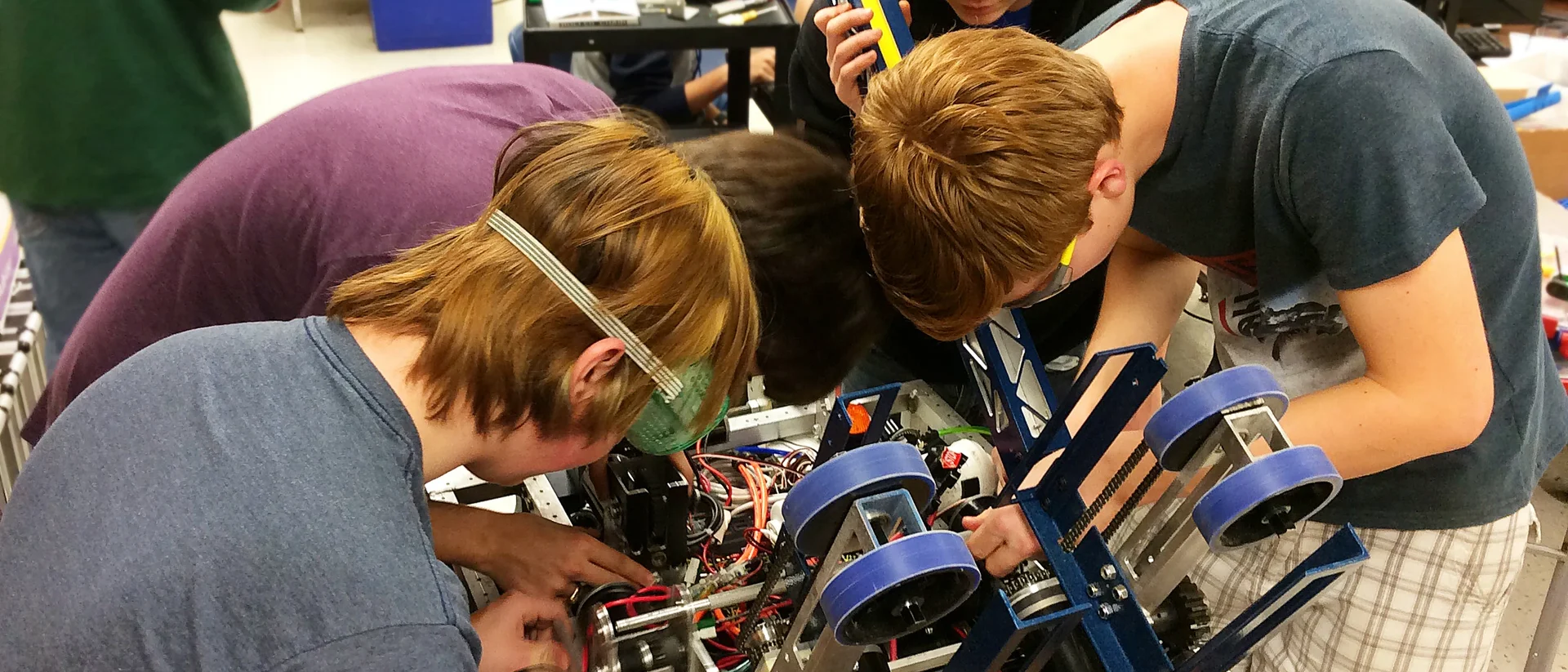
Every January, thousands of high school teams open the same box: the same kit of parts, the same rules for everyone. They get six weeks to build a working robot from scratch. It started in 1992 with 28 teams in a New Hampshire gym. More than 3,700 teams compete now, mentors giving up nights and weekends in the shop. Every year, thousands of teams still finish and put a robot on the field.
3,700 Teams, One Kit, Six Weeks to Build a Robot
Every January, more than 3,700 high school robotics teams open an identical box. Inside is the same kit of motors, wheels, and electronics, plus a rulebook nobody has seen before. From that moment, they have six weeks to build a robot that can compete on a real field, in front of a crowd, against every other team that opened the same box.
A Gym in New Hampshire
The competition is called the FIRST Robotics Competition. It began in 1992, when 28 teams of high school students gathered in a school gymnasium in Manchester, New Hampshire, to run their robots for the first time.
Inventor Dean Kamen started the event. He wanted students to feel what engineers feel: the pressure of building something that either works or doesn't, on a deadline nobody can move.
Six Weeks, No Shortcuts
Every team gets the same kit of parts and the same game rules on kickoff day. From there, the six-week build season is entirely up to them.
Students design, wire, code, and test their robot in whatever space their school can spare. Sometimes it's a cafeteria. Sometimes it's an actual machine shop.
Mentors, many of them working engineers, show up after their own jobs to help. Parents run the pit crew and keep the shop stocked with snacks and spare parts.
Whole schools reorganize their evenings around one deadline. The robot has to work by week six, or the season is over before it starts.
From 28 Teams to Thousands
The event grew from that single New Hampshire gym into a global competition. More than 3,700 teams now build a robot under the same six-week clock every season, across 30 countries.
Regional wins send teams to the FIRST Championship, where the robots that survived their own build season meet the best from everywhere else.
The Deadline Still Comes Every January
The kit changes every year. The game changes every year. The six-week deadline does not.
Every January, the same box shows up again, and thousands of teams start the clock over.
Source:FIRST (firstinspires.org)
Enjoyed this fact?
Be the first to love this
Get a new fact every morning.
A fascinating fact in your inbox every morning. Free. Unsubscribe anytime.
Frequently Asked Questions
What is the FIRST Robotics Competition?
How long do teams have to build their robot?
When did the FIRST Robotics Competition start?
How many teams compete in the FIRST Robotics Competition now?
What is the FIRST Robotics kit of parts?
Verified Fact
Verified Sep 3, 2026 · 5 sources checked
Source: FIRST (firstinspires.org)Show verification details
Claims checked
- FIRST Robotics Competition began in 1992 with 28 teams at Manchester Memorial High School in New Hampshire
- Inventor Dean Kamen founded the competition
- Teams get a shared kit of parts on a January kickoff day, then a six-week build season
- The event runs in 30 countries and regions, corrected from "more than 30 countries"
Sources: FIRST (firstinspires.org), Wikipedia, Kettering University, FRC Archive Wiki
Related Topics
More from Technology & Innovation
View all Technology & Innovation →