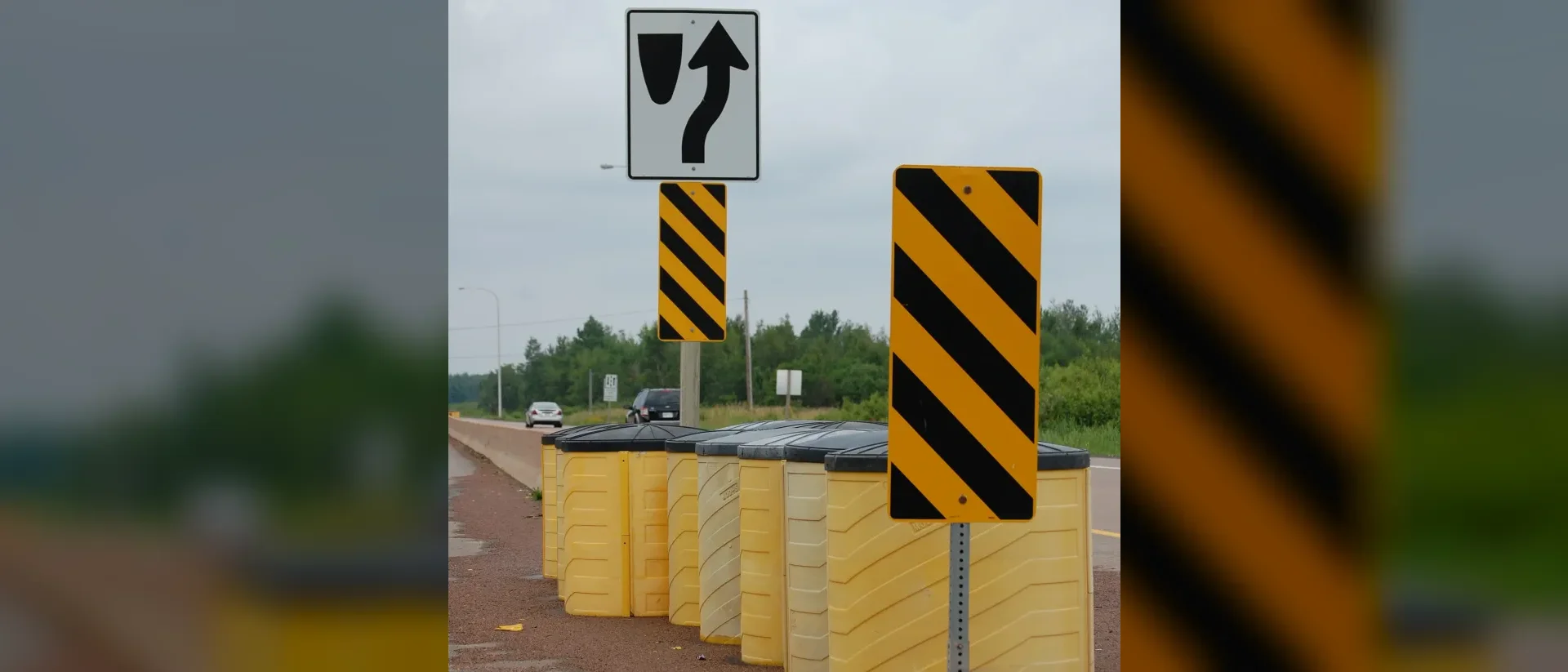
The yellow barrels at every highway exit were invented by John Fitch, a Le Mans driver who once shot down a German jet in WWII. After his co-driver died at Le Mans in 1955, Fitch filled liquor barrels with sand and crashed into them at up to 70 mph in his own driveway. He climbed out grinning every time. Highways adopted them in the late 1960s. An estimated 17,000 lives saved. Every one started in his driveway.
The Man Behind Every Yellow Highway Crash Barrel
Every driver in America has passed them without a second thought: clusters of yellow plastic barrels stacked at highway exit ramps and bridge abutments. They look like nothing more than roadside clutter. They were actually invented by a Le Mans race car driver who tested them by ramming his own driveway at 70 miles an hour, over and over, until he got it right.
A Fighter Pilot With a Knack for Danger
John Fitch was never a cautious man. During World War II he flew the A-20 Havoc bomber and the P-51 Mustang fighter, and became one of only a handful of pilots to shoot down a German Me 262, the world's first operational jet fighter.
Ground fire eventually caught up with him. Fitch was shot down and spent the final months of the war in a German prison camp.
After the war he turned to racing, driving for Briggs Cunningham's team before joining the factory Mercedes-Benz sports car squad, and built a reputation as one of America's best road-racing drivers.
The Worst Day in Motorsports
In June 1955, Fitch was racing at the 24 Hours of Le Mans as co-driver to French driver Pierre Levegh. Fitch had suited up and was ready to take over the car at the next pit stop when another driver swerved in front of Levegh's Mercedes.
Levegh's car launched into the crowd and exploded. He and more than 80 spectators were killed in what remains the deadliest crash in motorsports history.
Fitch later called it the pivotal moment of his life. He kept racing for another decade, running Chevrolet's Corvette team and driving Jaguars and Porsches, but he now spent his free time on a different problem: how to make a crash survivable.
Sand, Liquor Barrels, and a 70 MPH Test
Fitch's idea was simple: instead of a rigid guardrail or a concrete wall, give a crashing car something soft to hit, arranged so the impact drains away gradually instead of all at once.
He built his first prototypes from ordinary liquor barrels, packed with varying amounts of sand, and set them up in his own driveway.
Then he got in a car and drove into them himself, again and again, at speeds up to 70 miles an hour.
"He had these barrels arranged. It's freezing cold, and John gets the car warmed up and charges toward these barrels. At the last second he throws himself down on the floor of the car. He crashes into the barrels. Sand everywhere. Just a huge mess. And John emerges, grinning," his colleague Sam Posey recalled.
Fitch kept adjusting the barrel sizes and sand weights until the deceleration felt survivable, testing his own invention on his own body one crash at a time.
From One Driveway to Every Highway in America
The design became the Fitch Inertial Barrier, and by the late 1960s state highway departments across the country were installing it at exit ramps, gore points, and bridge abutments.
Nobody has ever counted the exact number of crashes the barrels have absorbed. The commonly cited estimate, repeated by safety engineers and Caltrans historians alike, is that they have saved somewhere around 17,000 lives since they were introduced.
The yellow barrels are still standard equipment on American highways today, essentially unchanged from the ones a grinning, sand-covered Fitch first tested in his own driveway.
Frequently Asked Questions
Who invented the yellow highway crash barrels?
How did John Fitch test his highway barriers?
How many lives have Fitch barriers saved?
Why did John Fitch decide to invent a highway safety barrier?
When were Fitch barriers adopted on US highways?
Verified Fact
Verified in any source and appears to be an invented precision
Source: Caltrans (CT News)Show verification details
Claims checked
- Yellow barrels invented by Fitch
- WWII P-51/A-20 pilot, shot down Me 262
- Shot down by ground fire, POW
- 1955 Le Mans, Levegh crash, worst crash in motorsports history
- Sam Posey quote
- Late 1960s adoption
- Fitch kept racing after 1955 (not "walked away")