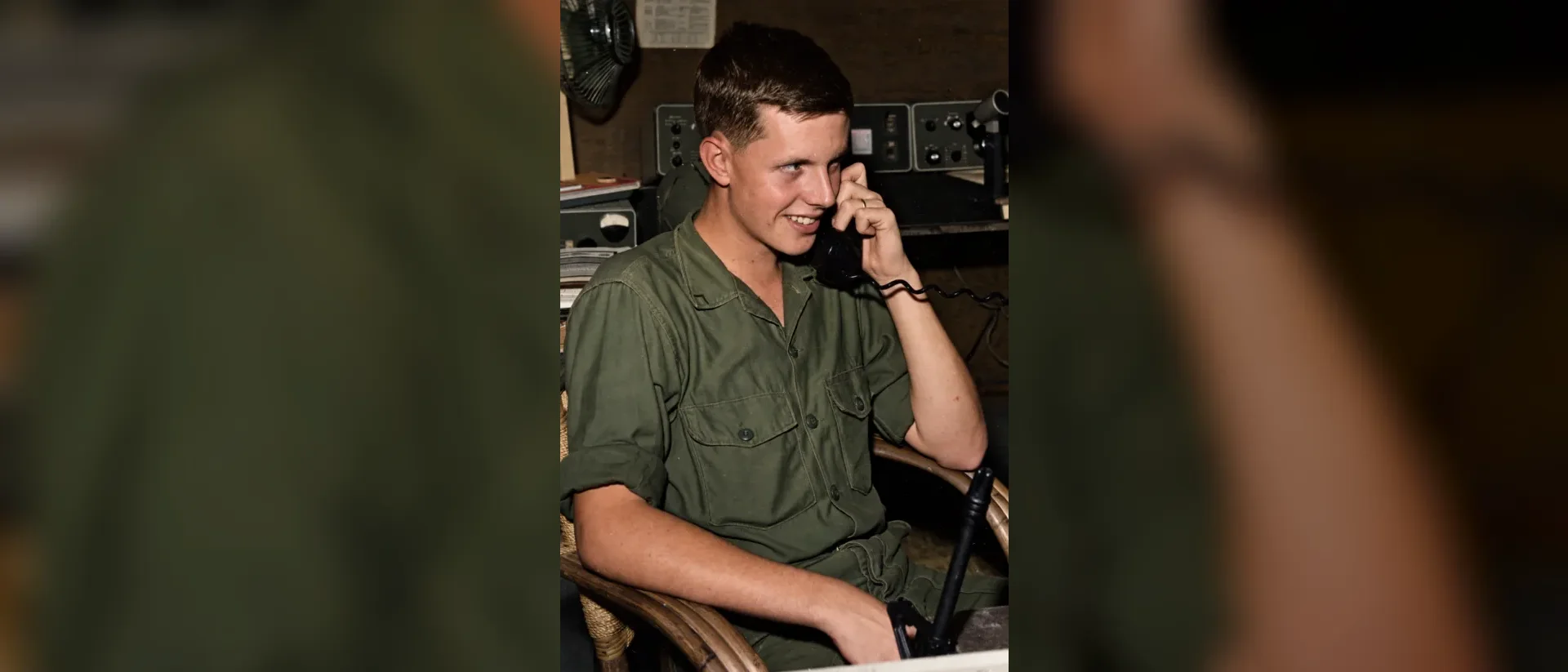
On Mother's Day 1968, PFC Kenneth W. Ruth, 20, called his wife and mother from a radio in Da Nang. Calls like his went by shortwave on MARS, a military radio network, to stateside stations, many run by volunteer hams patching them into phone lines. Air Force stations in Southeast Asia completed more than 10,000 patches a month in fiscal 1968. Air Force MARS volunteers still patch calls for military pilots.
The Mother's Day Call Home From Da Nang
On Mother's Day 1968, a 20-year-old Marine named PFC Kenneth W. Ruth sat at a radio set in Da Nang, Vietnam, and called his wife and his mother. An official Marine Corps photograph of the moment shows him grinning into the handset, a wedding ring on the hand at his ear and radio gear stacked behind him.
The photo's caption calls it a MARS radio-phone patch call. That phrase hides one of the Vietnam War's quietest home-front networks.
A Radio Linked to a Kitchen Phone
MARS, the Military Affiliate Radio System, let service members overseas talk to their families by shortwave radio. A soldier or Marine waited his turn at an overseas MARS station, and the operator there reached a stateside station on a scheduled frequency.
Once the signal was strong enough, the stateside operator dialed the family's number, sometimes as a local call and sometimes long-distance or collect. A patch device then linked the radio audio to the telephone line, so the family spoke into an ordinary phone while the man overseas heard them through a speaker or headset.
The caption in the Marine Corps Archives does not say where Ruth's call landed, so the details above describe how calls like his worked, not the route of his own.
The Volunteers on the Stateside End
Much of the stateside side of the network ran on civilian volunteers. These were experienced amateur radio operators who used private equipment, often in basements, garages, spare rooms or backyard radio shacks.
Some modified their own transceivers to operate on authorized military frequencies and put up their own antennas to reach the stations overseas.
Waiting for "Over"
Shortwave radio of that kind was half-duplex, which meant only one person could transmit at a time. If both sides talked at once, they covered each other.
Operators trained families and service members to pause, speak clearly and use a word such as "over" to signal that it was the other person's turn. A typical exchange sounded something like a soldier saying he was fine, asking if he could be heard and then saying "over" - an illustration of the format, not a recorded call.
More Than 10,000 a Month
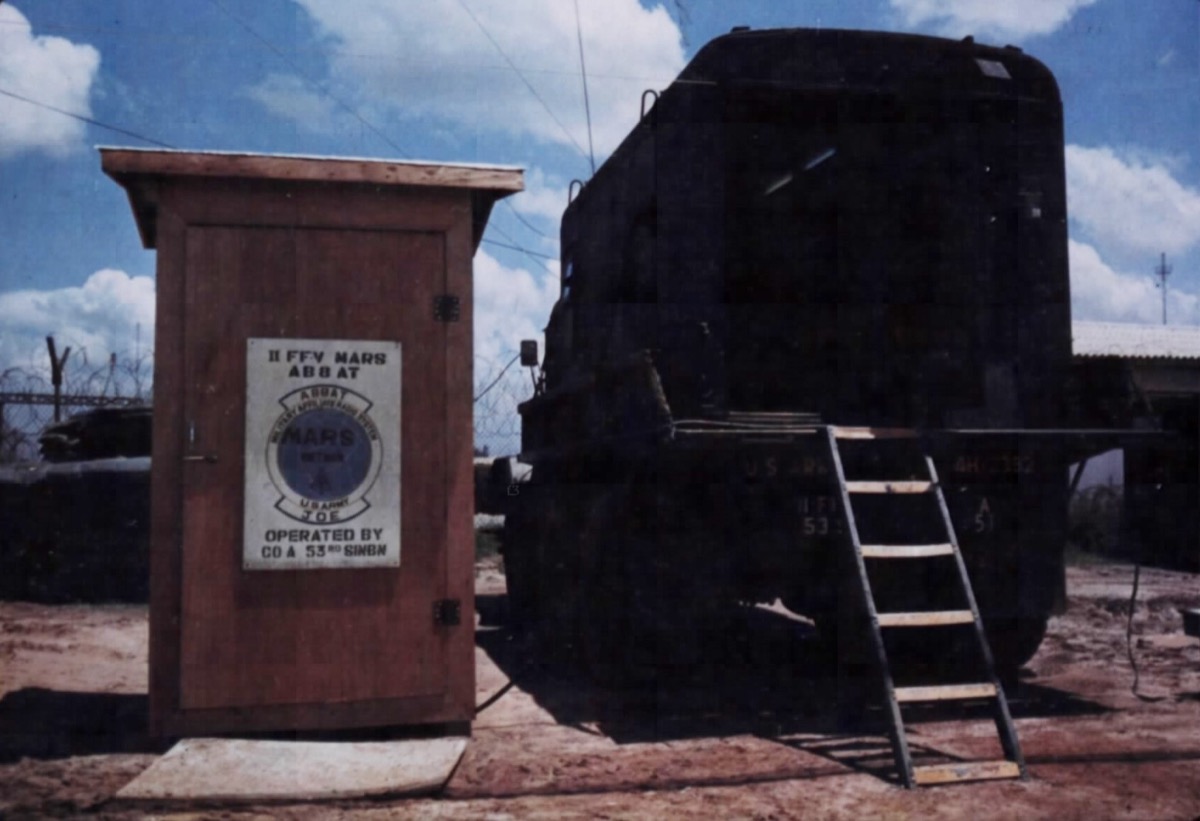
The Department of Defense put a number on the traffic. Its annual report for fiscal year 1968, in the Air Force section, said that the 19 MARS stations in Southeast Asia completed more than 10,000 phone patches each month over the past year between servicemen and their families in the United States.
That figure covers only the Air Force stations in Southeast Asia for the fiscal year that ran from July 1967 to June 1968. It does not include the Army, Navy and Marine stations, and it is not a total for the whole war.
The same report notes that in May 1968 the Air Force Communications Service took over MARS facilities at 34 Strategic Air Command bases and now managed all 450 MARS stations in the Air Force.
The photograph of Ruth, taken in May 1968, shows what calls like these looked like from the overseas end: one Marine, one radio set, a wedding ring on the hand at his ear, and a word that meant it was the other side's turn to talk.
MARS Today
MARS still exists. A 2025 Air Force report from the 375th Air Mobility Wing at Scott Air Force Base describes Air Force MARS as an auxiliary program of about 500 volunteer amateur radio operators, who patch phone calls for military pilots (about 1,000 to 1,500 patches a year) and keep a backup network running in case of disasters or outages. Those patches mostly help with radio checks and in-flight emergencies, and the report says the system also carries morale calls to family.
Enjoyed this fact?
Be the first to love this
Get a new fact every morning.
A fascinating fact in your inbox every morning. Free. Unsubscribe anytime.
Frequently Asked Questions
What was a MARS phone patch?
Why did people say 'over' on phone patch calls?
Who ran the stateside end of MARS calls from Vietnam?
How many phone patches did MARS handle during the Vietnam War?
Verified Fact
Verified Oct 7, 2026 · 6 sources checked
Source: Department of Defense Annual Report FY1968Show verification details
Claims checked
- PFC Kenneth W. Ruth, 20, made a MARS radio-phone call from Da Nang to his wife and mother on Mother's Day 1968
- 19 Air Force MARS stations in Southeast Asia completed more than 10,000 phone patches a month in fiscal 1968
- Stateside stations were often run by volunteer hams who patched radio audio into a phone line
- Each side said "over" to hand the line back
- Air Force MARS volunteers still patch phone calls for military pilots (2025 report)
Sources: DoD Annual Report FY1968, Marine Corps Archives, Army.mil, Air Force (375th Air Mobility Wing, 2025)
Related Topics
More from History & Culture
View all History & Culture →