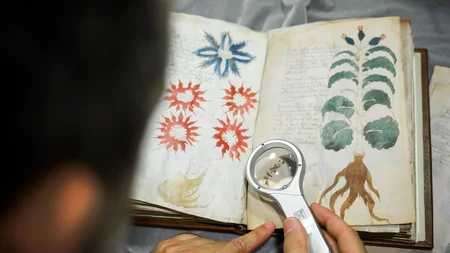
A 13th-century monk scraped away a unique manuscript containing Archimedes' mathematical works—including his Method of Mechanical Theorems—to reuse the parchment for a prayer book. This text contained concepts that anticipated integral calculus nearly 2,000 years before Newton and Leibniz.
The Monk Who Erased Mathematical History
In the 13th century, a monk in Jerusalem needed parchment. Parchment was expensive, so he did what monks commonly did—he took an old book, scraped off the ink, rotated the pages 90 degrees, and wrote over them. His prayer book was finished. The original text was essentially destroyed.
That original text? A collection of works by Archimedes, the ancient Greek mathematician who lived in the 3rd century BCE. Among them was his Method of Mechanical Theorems—a work that existed nowhere else in the world.
What Made This Manuscript Special
The Method contained something remarkable: Archimedes' actual thought process. While his other surviving works showed polished proofs, this one revealed how he discovered his theorems. He used a technique of slicing shapes into infinitely thin pieces and comparing them—a concept that wouldn't be formally developed until Newton and Leibniz invented calculus in the 17th century.
Archimedes was essentially doing integral calculus 1,900 years early.
Lost for Centuries, Found by Accident
The prayer book—called a palimpsest because it was written over earlier text—bounced around for centuries. By 1906, a Danish scholar named Johan Ludvig Heiberg heard rumors of a strange manuscript in Constantinople with mathematical text bleeding through religious writing.
He photographed what he could see. The mathematical community was stunned. But then the manuscript vanished again during World War I and the upheaval that followed.
It resurfaced in 1998 at a Christie's auction, covered in mold, damaged by fire, and with several pages obscured by forged paintings added in the 20th century. An anonymous buyer paid $2 million for it and handed it to the Walters Art Museum in Baltimore for restoration.
Modern Technology Reveals Ancient Genius
Scientists used cutting-edge imaging techniques to read what the monk had tried to erase:
- Multispectral imaging revealed text invisible to the naked eye
- X-ray fluorescence detected iron in the original ink beneath the gold-leaf forgeries
- Synchrotron radiation at Stanford's particle accelerator read pages that were otherwise illegible
What they found rewrote our understanding of ancient mathematics. Archimedes had worked with the concept of actual infinity—something mathematicians didn't embrace until the 19th century. He calculated areas using methods that were essentially integration.
What If It Had Never Been Erased?
This is where speculation gets tantalizing. If medieval scholars had access to Archimedes' methods—his intuitive approach to infinity and his proto-calculus—would the Scientific Revolution have happened earlier?
We'll never know. But the Archimedes Palimpsest stands as a haunting reminder that history's greatest ideas can vanish with a single scrape of a knife, only to resurface a millennium later under the right light.
Frequently Asked Questions
What is the Archimedes Palimpsest?
Did Archimedes invent calculus?
How was the Archimedes Palimpsest recovered?
Where is the Archimedes Palimpsest now?
What mathematical concepts did Archimedes discover?
Verified Fact
This fact has been reviewed and verified against original sources.
Show verification details
Corrected the exaggerated claims about being '100 or 1000 years more advanced' which is unprovable speculation. The core story about the Archimedes Palimpsest is fascinating and true.
Related Topics
More from History & Culture
View all History & Culture →