
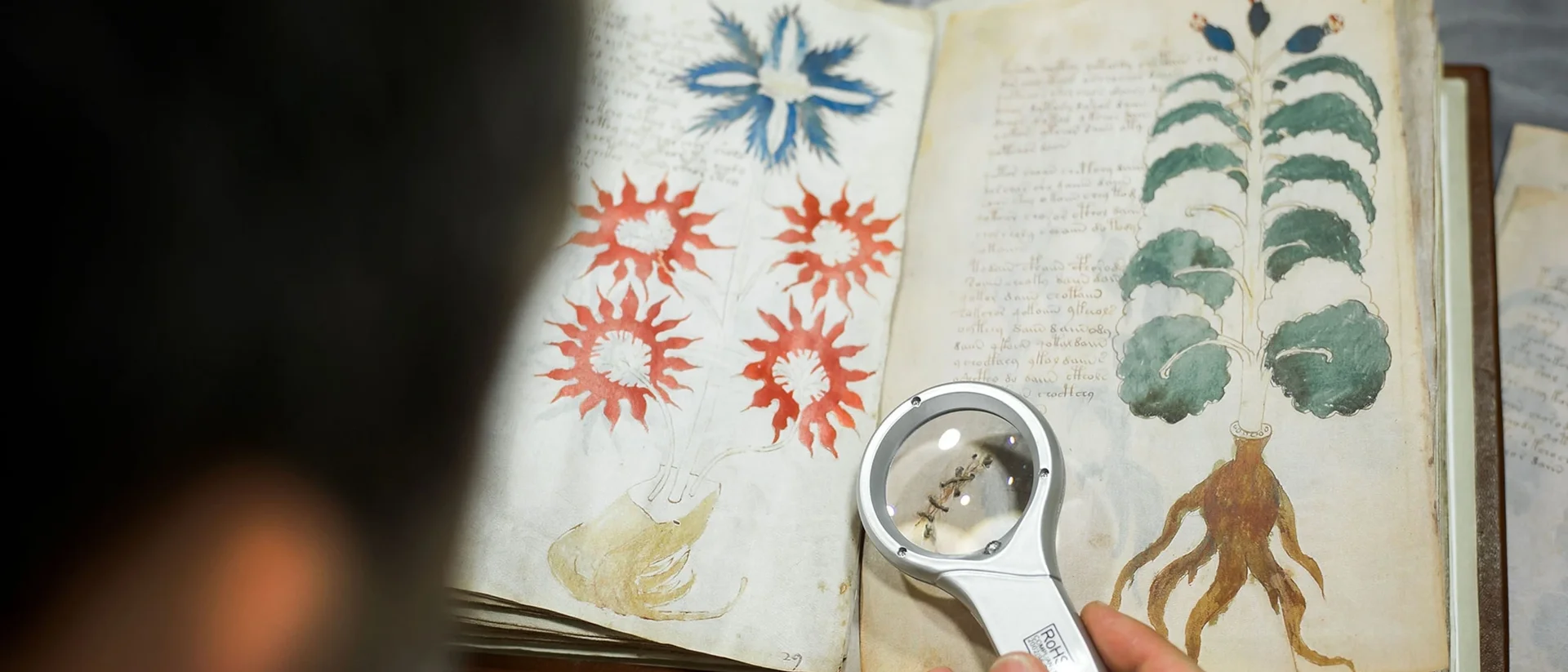
There is a 600 year old 240 paged book called the Voynich Manuscript, that’s written language is still completely unknown today.
The 600-Year-Old Book Nobody Can Read
Imagine stumbling upon a beautifully illustrated medieval book filled with strange plants, astronomical diagrams, and tiny naked women bathing in green pools—all accompanied by text in a language that doesn't match anything ever seen on Earth. That's the Voynich Manuscript, and despite being studied by top cryptographers, linguists, and even AI systems, nobody has cracked its code in over 600 years.
The manuscript gets its name from Wilfrid Voynich, a Polish book dealer who purchased it in 1912, but the book itself is much older. Radiocarbon dating of the vellum (calfskin pages) places its creation between 1404 and 1438, during the early Italian Renaissance. Its roughly 240 surviving pages are filled with intricate drawings divided into sections: botanical illustrations of plants that don't exist, astronomical charts, biological diagrams, and what appears to be pharmaceutical recipes.
A Script Like No Other
The writing system itself is bizarre. The manuscript contains about 170,000 characters using an alphabet of 20-30 letters that don't correspond to any known language—not Latin, not Arabic, not Chinese, not anything. Statistical analysis shows the text has patterns similar to natural languages: some letters appear more frequently, words follow certain structures, and there seem to be grammatical rules. But that's where the similarities end.
Cryptographers have noted odd features that make it unlike any real language. For example, there's very little repetition of letter combinations, words appear in predictable patterns, and certain "words" show up with suspicious frequency. Some experts think it might be an elaborate cipher. Others suspect it's a constructed language. A few skeptics argue it's an elaborate hoax—medieval gibberish designed to look meaningful.
Centuries of Failed Attempts
The manuscript has defeated some impressive minds. During World War II, American cryptographers who had cracked Japanese and German codes tried their hand at it—no luck. In recent years, AI algorithms and computer analysis have been thrown at it. Still nothing. In 2025, a researcher proposed a "verbose substitution cipher" that could theoretically produce text with similar properties, but even they admitted it's just a proof of concept, not a definitive answer.
What makes the Voynich Manuscript particularly frustrating is that it feels like it should make sense. The illustrations seem purposeful, the text flows naturally, and the whole thing has the structure of a genuine medieval encyclopedia or herbal guide. Yet every attempt to decode it hits a wall.
Where Is It Now?
Since 1969, the manuscript has been housed at Yale University's Beinecke Rare Book and Manuscript Library. In 2020, Yale digitized the entire thing and made it available online, allowing anyone with an internet connection to take a crack at history's most mysterious book. Thousands have tried. All have failed.
So what's actually written in those pages? Is it an ancient medical text? An alchemical recipe book? An elaborate Renaissance prank? A coded message from a lost civilization? As of today, the Voynich Manuscript remains exactly what it was 600 years ago: completely, utterly, maddeningly unreadable.
Frequently Asked Questions
Has anyone deciphered the Voynich Manuscript?
Where is the Voynich Manuscript kept?
How old is the Voynich Manuscript?
What language is the Voynich Manuscript written in?
What is inside the Voynich Manuscript?
Verified Fact
Verified or accepted by the academic community
Show verification details
The fact is accurate. The Voynich Manuscript is indeed over 600 years old (radiocarbon dated to 1404-1438), contains approximately 240 pages, and its language/writing system remains undeciphered as of 2025.