
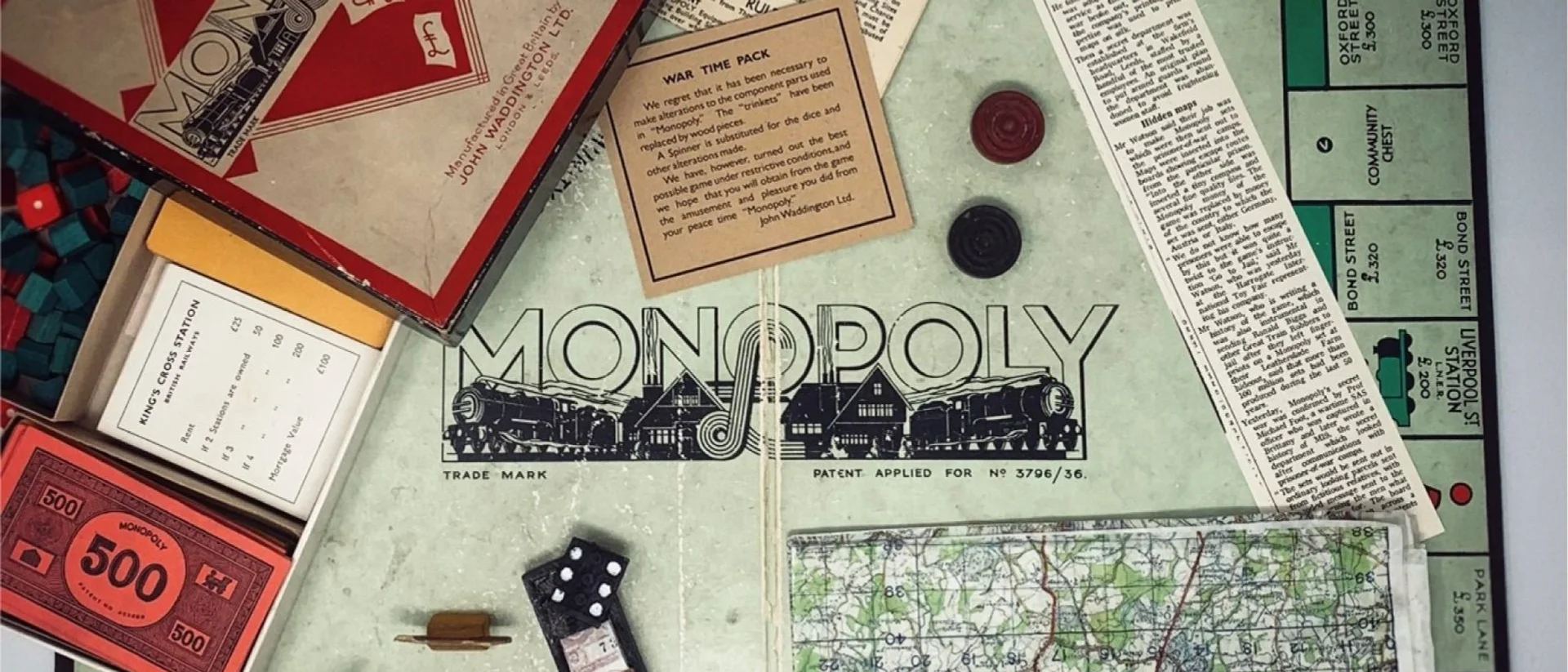
Christopher Hutton, a British MI9 spy, hid real escape kits inside Monopoly sets sent to Allied POW camps in WWII. He chose Waddingtons - the only UK firm that made Monopoly AND printed on silk - to hide silk maps, a compass, a file, and real foreign cash inside each box. A red dot on Free Parking told captured RAF pilots which sets held the tools.
The Monopoly Sets That Hid WWII Escape Kits
It looks like an ordinary board game. But for Allied prisoners of war in Nazi Germany, a specific Monopoly set could mean the difference between captivity and freedom - if you knew where to look.
The Man Behind the Plan
Christopher Clayton Hutton - nicknamed "Clutty" - was an MI9 intelligence officer whose pre-war career had taken him from the Royal Flying Corps to journalism to Hollywood publicity. His fascination with Harry Houdini, whom he had once challenged to an escape stunt, made him the ideal candidate to design tools that could get men out of places they were never meant to leave. By 1941, MI9 tasked Hutton with finding a way to smuggle escape aids into German POW camps without triggering Red Cross inspections.
Why Monopoly - and Why Waddingtons
Hutton needed a delivery vessel that guards would never question. The Geneva Convention allowed charitable organisations to send games and recreational items to prisoners - and what could be more innocent than Monopoly? He turned to John Waddington Ltd., the Leeds-based company that held the exclusive British licence to manufacture the game. Waddingtons had one additional quality that made them the only realistic partner: they were the only firm in Britain that had mastered the technique of printing on silk. That dual capability - Monopoly maker and silk printer - was the key to the entire scheme. Norman Watson, the company president, set aside a dedicated room in the factory where a small, sworn-in team worked in secrecy.
What Was Hidden Inside
Inside the hollowed-out boards and concealed beneath the stacks of printed Monopoly money, Hutton's team packed a remarkable collection of real escape tools:
- Silk maps of escape routes across occupied Europe - printed on silk because the material folds into a tiny bundle, makes no sound when opened, and does not tear when wet
- A miniature compass, often disguised as a playing token
- A metal file
- Real European currency - French francs, German marks, and Italian lire tucked beneath the fake Monopoly banknotes
The Red Dot on Free Parking
The scheme would be useless if prisoners could not tell a real kit from an ordinary set. Hutton solved this elegantly: a small red dot was printed on the Free Parking space of every doctored board. Before departing on missions, Royal Air Force and Fleet Air Arm crews received classified briefings instructing them that if captured, they should look for a Monopoly set with that red dot in any care package that arrived. The sets were shipped through fictional charitable organisations - including the Licensed Victuallers' Prisoners Relief Fund, whose letterhead featured a verse from Matthew 7: "Ask and it shall be given you; seek and ye shall find; knock and it shall be opened unto you."
After the War
The scheme ran for several years before the war ended. When it was over, nearly all records of the operation were deliberately destroyed to protect those who had been involved and to deny the enemy any intelligence about methods. The exact number of prisoners who successfully escaped using tools from these sets was never recorded. The story was not publicly acknowledged until 1985, when a declassified Associated Press report finally confirmed what Waddingtons and MI9 had quietly done. Today, examples of the silk escape maps are held in collections including the Imperial War Museum in London.
Enjoyed this? Get a new fact every morning.
A fascinating fact in your inbox every morning. Free. Unsubscribe anytime.
Frequently Asked Questions
Why were Monopoly sets chosen to smuggle escape kits to POWs?
Why were the escape maps printed on silk?
What was actually hidden inside the special Monopoly sets?
How did captured Allied soldiers know which Monopoly sets contained escape tools?
Who organised the Monopoly escape kit scheme?
Verified Fact
Verified Jun 17, 2026 · 7 sources checked
Source: War History OnlineShow verification details
Claims checked
- Christopher Hutton, MI9 officer, devised the escape-kit Monopoly scheme
- Waddingtons was the only UK firm making Monopoly and printing on silk
- Silk maps, compass, file, and real cash were hidden in the sets
- Red dot on Free Parking signaled which sets held the tools
- Company president corrected to Norman Watson (not Victor)
Sources: War History Online, Mental Floss, ABC News, HH History, Eden Camp Museum, MyLearning.org, WW2 Escape Lines Memorial Society