
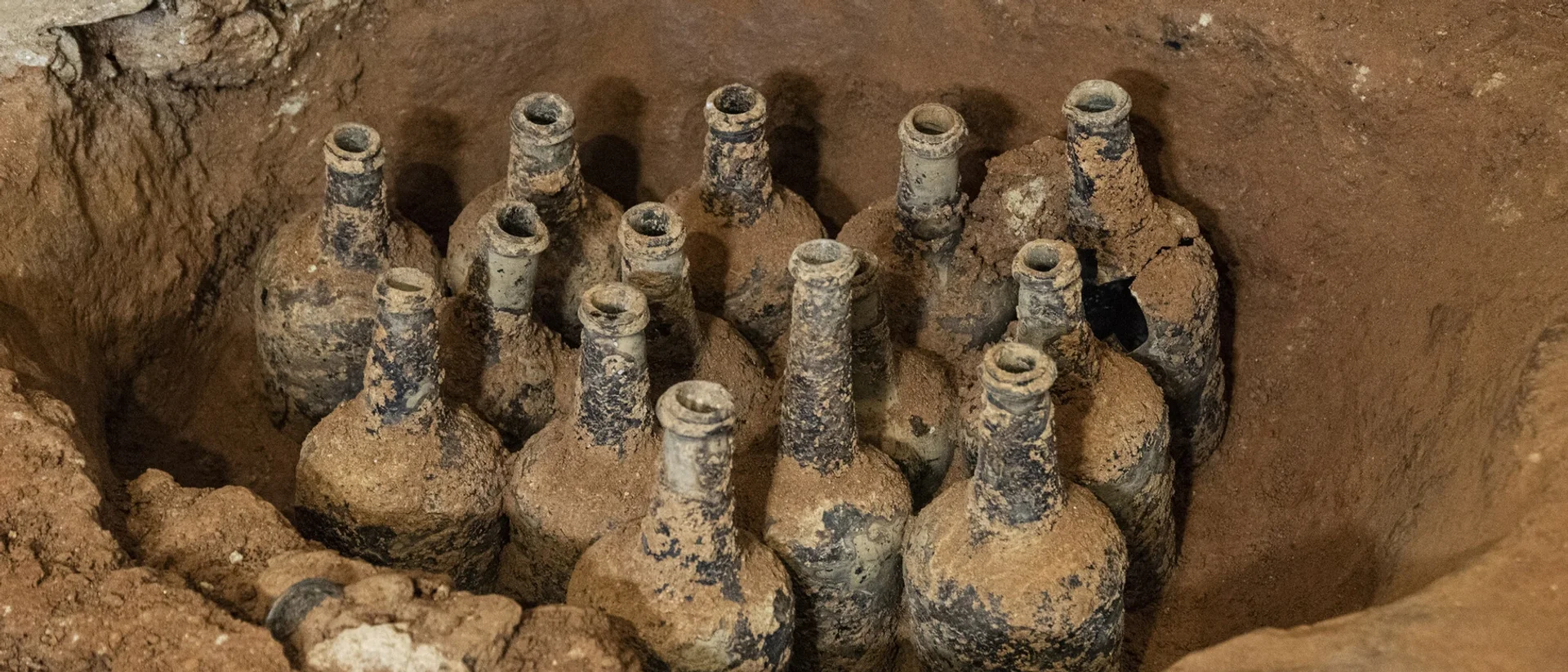
George Washington's cherry tree story is a myth invented after he died. But archaeologists just found real cherries hidden in his actual home. In 2024, workers at Mount Vernon uncovered 35 glass bottles buried in the cellar. Most still held whole cherries and berries, preserved for 250 years. When one bottle was opened, it still smelled like cherry blossoms.
The Real Cherries Found Under George Washington's House
George Washington's biographers loved a good invented story: a six-year-old George hacking down a cherry tree, then confessing to his father because he "cannot tell a lie." It never happened. But in 2024, something far stranger turned up under his actual house: real cherries, sealed in glass, untouched for roughly 250 years.
A Cellar Sealed Since Before the Revolution
The discovery happened during Mount Vernon's $40 million Mansion Revitalization Project, a multi-year effort to restore Washington's home. While excavating the cellar, archaeologists found five storage pits holding 35 sealed 18th-century glass bottles, imported from England. Twenty-nine were still intact. Officials believe the bottles were buried sometime between 1758 and 1776, likely forgotten when Washington left Mount Vernon to lead the Continental Army.
What Was Still Inside
Most of the bottles were packed with cherries and berries, probably gooseberries or currants. Early analysis turned up 54 cherry pits and 23 stems, neatly cut before bottling. When archaeologists opened one of the first bottles that spring, principal archaeologist Jason Boroughs said the smell hit them immediately: "It actually smelled like cherry blossoms when we got to the bottom."
The Kitchen Staff Who Made It Possible
Mount Vernon researchers credit the preservation work to the enslaved people who ran the estate's kitchen, particularly a cook named Doll, who joined Martha Washington's staff in 1759 and is believed to have overseen food preservation for the household. The cherries appear to be a tart variety, whose acidity likely helped keep the fruit from rotting for two and a half centuries.
The Myth vs. The Real Thing
The cherry tree confession was invented several years after Washington's 1799 death by biographer Mason Locke Weems, who added it to a later edition of his book in 1806 for a moral lesson. No contemporary account ever mentions it. Washington's own cellar, meanwhile, just produced the real thing: actual cherries, grown and bottled at his real home, that nobody knew were there.
What Happens Next
Mount Vernon partnered with the U.S. Department of Agriculture's Agricultural Research Service to study the contents further, including DNA testing on the pits to identify the exact heirloom variety and check whether any could still germinate. "Never in our wildest dreams did we imagine this spectacular archaeological discovery," said Mount Vernon President and CEO Doug Bradburn. "To our knowledge, this is an unprecedented find, and nothing of this scale and significance has ever been excavated in North America." The Mansion Revitalization Project is scheduled to finish in 2026.
Enjoyed this? Get a new fact every morning.
A fascinating fact in your inbox every morning. Free. Unsubscribe anytime.
Frequently Asked Questions
How many bottles were found at Mount Vernon?
How old are the cherries found at Mount Vernon?
Did the preserved cherries still smell like fruit?
Is the George Washington cherry tree story true?
Who likely preserved the cherries found at Mount Vernon?
Verified Fact
Verified Jul 2, 2026 · 10 sources checked
Source: Mount VernonShow verification details
Claims checked
- 35 glass bottles found in Mount Vernon cellar, 29 intact
- Bottles held cherries and berries, preserved for 250 years
- Bottles buried between 1758 and 1776, likely left when Washington joined the Continental Army
- Opened bottle smelled like cherry blossoms
- Cherry tree myth originated in 1806 Weems biography, not contemporary accounts
Sources: Mount Vernon, PRNewswire, CBS News, CNN, NPR, Archaeology Magazine, Washington Times, Mount Vernon Digital Encyclopedia, Colonial Williamsburg, Wikipedia