📝Updated for accuracy
Some details in this fact have been corrected based on our review of primary sources.
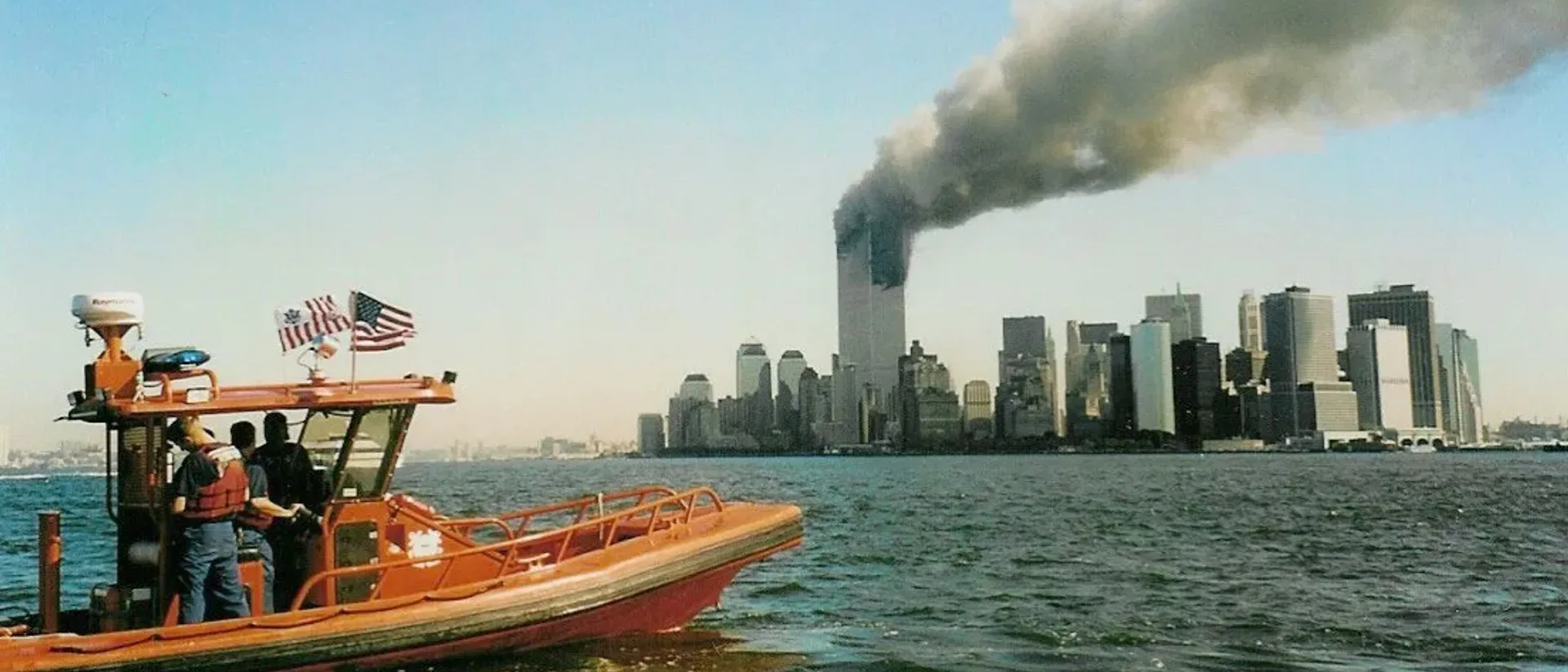
When the towers fell on September 11, the Coast Guard put out one call on marine radio: all available boats. Ferry captains turned mid-route. Tugboat operators dropped everything. Fishing boats, private yachts, dinner cruises - hundreds showed up. In nine hours, they evacuated nearly 500,000 people by water. The largest maritime evacuation in history. Larger than Dunkirk, which took nine days.
When Every Bridge and Tunnel Was Closed, the Boats Just Showed Up.
At 8:46 a.m. on September 11, 2001, American Airlines Flight 11 struck the North Tower of the World Trade Center. Seventeen minutes later, a second plane hit the South Tower. Within the hour, the city shut down every bridge and tunnel to vehicle traffic. Half a million people in Lower Manhattan had one way off the island: the water.
All Available Boats
The first boats came on their own. NY Waterway ferry captain Rick Thornton saw the second plane hit and turned his ferry around without asking anyone. "I just pulled a U-turn," he said. "I didn't call anybody. I just kind of stole the ferry."
Then the Coast Guard made it official. At roughly 10:30 a.m., Lt. Michael Day broadcast on VHF marine radio: "All available boats. This is the United States Coast Guard. Anyone available to help with the evacuation of Lower Manhattan, report to Governor's Island."
Day had been heading to a meeting at the World Trade Center that morning when the first plane struck. He grabbed an old naval event plan that happened to contain ambulance staging areas and evacuation points, commandeered a 100-foot pilot boat, hoisted a Coast Guard ensign on it, and started directing the response.
The Waterfront
When the South Tower collapsed at 9:59 a.m., a wall of pulverized concrete and ash rolled over Lower Manhattan like a tidal wave. Evacuees emerged from the cloud coated head to toe in grey dust. Captain Warren Ihde described them as "ghostly looking."
At Battery Park and along the Hudson River piers, none of these locations were designed as ferry docks. Boats nosed up against seawalls not built for boarding. In places, the deck of a vessel sat seven feet below the top of the wall. Dockhands physically lowered passengers over railings, holding their arms as they climbed down. Tug crews spray-painted bedsheets and hung them as improvised signs to direct the crowds.
Captain Gordon Young of the Seastreak Liberty navigated by radar alone - visibility was down to five feet. "If I had pulled in with a rubber raft," he said, "those people would have jumped on it."
The Fleet
Roughly 150 vessels and more than 800 mariners participated. Ferry captains, tugboat operators, fishing boats, private yachts, dinner cruise ships, even a decommissioned fireboat. The retired FDNY fireboat John J. Harvey - crewed by museum volunteers - was pressed back into service. It evacuated passengers and pumped harbour water directly to firefighters' hoses after the city's water mains beneath the towers were destroyed.
Captain John Parese of the Staten Island Ferry Samuel I. Newhouse carried nearly 6,000 people on a single trip - far beyond normal capacity. His mate Brian Walsh kept telling evacuees: "It's going to be okay. You're safe."
Vincent Ardolino, a Brooklyn fisherman with no official role, called his wife before heading out in his boat, the Amberjack V. "I've got to go do something," he told her. "Even if I rescue one person, that's one person less that will suffer or die."
Nine Hours
The evacuation ran from roughly 10:30 a.m. until 8:00 p.m. In nine hours, nearly 500,000 people were moved off the island by water. It was the largest maritime evacuation in history - larger than Dunkirk, which evacuated 338,000 soldiers over nine days.
Despite the chaos, not a single person was lost on the water. Pete Johansen of NY Waterway, who was managing crowds at the terminal when the first plane hit, marvelled at the order: "People were great. They were very cooperative."
Remarkably, no vessels were damaged. No major accidents occurred. Coast Guard Chief Brandon Brewer noted that the operation appeared "perfectly planned, even though everyone was just winging it."
Aftermath
The boatlift went largely unreported for nearly a decade. The world's attention was on the towers, the death toll, the wars that followed. In 2011, filmmaker Eddie Rosenstein released a short documentary called Boatlift, narrated by Tom Hanks, that brought the maritime rescue to public attention for the first time.
The health cost came later. The toxic dust that coated every vessel and every person at the waterfront contained asbestos and heavy metals. At least 120 ferry captains and deckhands are registered with the federal World Trade Center Health Program. Of those, 53% have at least one illness attributed to that day. Captain Thomas Phelan, who helped evacuate passengers on a Statue of Liberty ferry, later became an FDNY marine firefighter and died of 9/11-related lung cancer in 2018. He was 45.
Ardolino, the Brooklyn fisherman, died years later. His closing words in the Boatlift documentary became the film's defining line: "Never go through life saying you should have. If you want to do something - you do it."
Enjoyed this? Get a new fact every morning.
A fascinating fact in your inbox every morning. Free. Unsubscribe anytime.