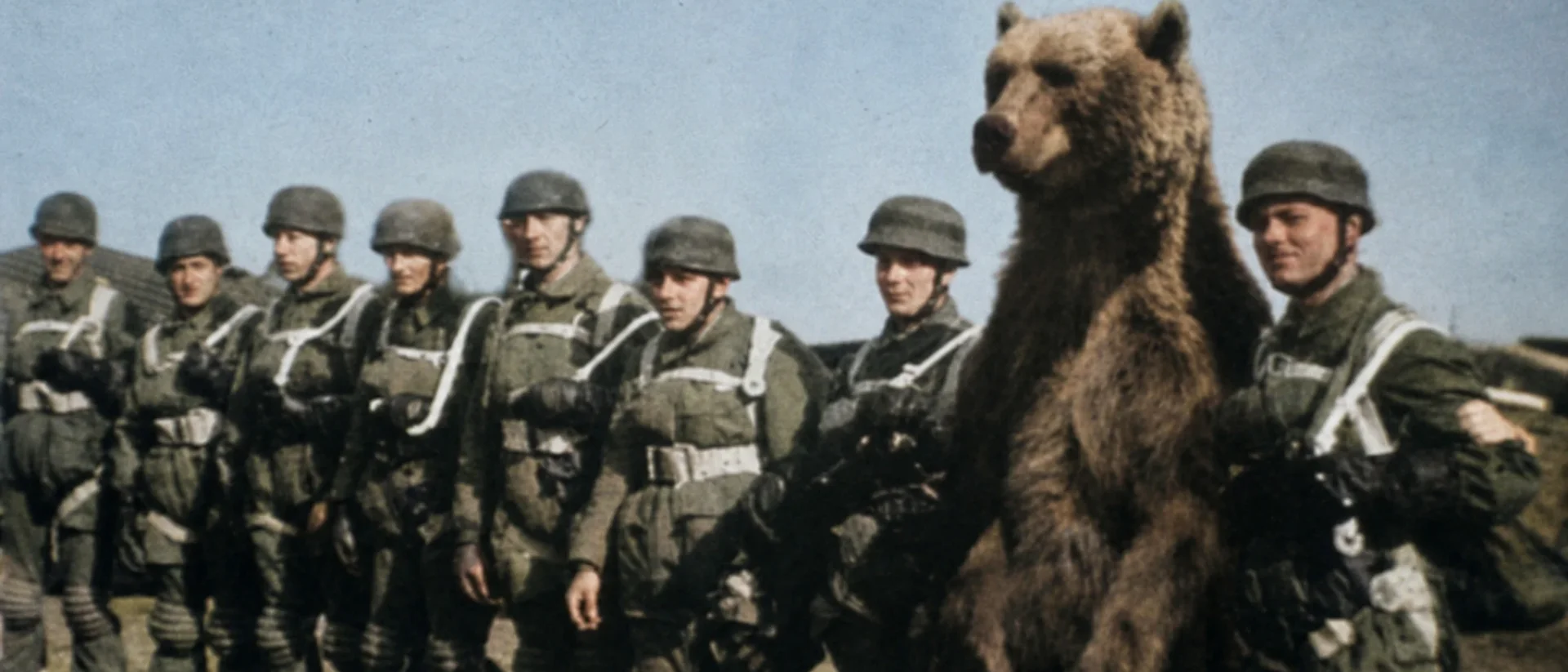
In 1943, Polish soldiers in Iran bought a bear cub from a young boy, bottle-fed him on condensed milk, named him Wojtek, and enrolled him in the army. At Monte Cassino in 1944, he carried 100-lb artillery shells to the guns without dropping one. The 22nd Artillery Supply Company still uses a bear carrying a shell as its official emblem.
The Bear Who Was Drafted Into the Polish Army
The Polish soldiers crossing Iran in 1943 had already survived Soviet prison camps and a desert march through Uzbekistan and Persia. What they had not planned for was a bear. A young boy on a road near Hamadan offered them a bear cub whose mother had been shot by hunters. They bought him for a few tins of food.
Private Wojtek, Serial Number 253
The cub was named Wojtek - "happy warrior" in Polish. Soldiers bottle-fed him on condensed milk, then tinned fruit, then honey, then beer, which became his lifelong favourite. He slept in the men's tents, wrestled with the troops for entertainment, and learned to carry objects on command. When the 22nd Artillery Supply Company of the 2nd Polish Corps needed to board a British transport ship to Italy, regulations forbade pets and mascots. The solution was characteristically Polish: they formally enlisted him. Wojtek was registered as a private with serial number 253, issued a paybook, and put on rations. He boarded the ship as a soldier.
What Happened at Monte Cassino
The Battle of Monte Cassino in May 1944 was one of the bloodiest engagements of the entire Italian campaign. As German artillery pounded Polish positions, the supply chain keeping the guns firing became a desperate problem. Wojtek, watching the men at work, began doing what he had always done - mimicking them. He picked up ammunition crates. He carried them on his hind legs to the gun positions, walking through the chaos as if it were another wrestling match with a friend.
Witnesses said he never dropped a crate. The shells weighed 25 pounds each. He was promoted to corporal after the battle. The 22nd Artillery Supply Company then changed their official unit emblem to show a bear carrying an artillery shell - an image that remains part of Polish military heraldry to this day.
The Part Nobody Warned Him About
When the war ended, the Polish soldiers who had fought alongside the British could not go home. Soviet-occupied Poland had no welcome for men who had served the London government-in-exile. Most settled in Scotland. Wojtek settled with them - at Edinburgh Zoo from 1947, where he grew from roughly 90 kilograms at Monte Cassino to nearly 500 kilograms (1,100 lbs) by the end of his life.
His former comrades visited regularly for the next sixteen years. They stood at the edge of his enclosure and spoke Polish to him. Wojtek became animated, recognising the language even a decade after the war. Veterans threw lit cigarettes and open bottles of beer into the enclosure - the same habits from the barracks. Some jumped in to wrestle him, alarming zoo staff considerably.
He Died on 2 December 1963
Wojtek died at Edinburgh Zoo at the age of 21. His story inspired statues in Edinburgh (2015), Krakow (2014), and Cassino, Italy (2019) - near the battlefield where he carried shells. Commemorative plaques stand at the Imperial War Museum in London and the Canadian War Museum in Ottawa.
He is the only bear known to have been officially enlisted in a military unit and to have participated in a named battle. His unit's emblem has never been changed back.
Enjoyed this? Get a new fact every morning.
A fascinating fact in your inbox every morning. Free. Unsubscribe anytime.
Frequently Asked Questions
Was Wojtek the bear a real soldier?
Did Wojtek really carry artillery shells at Monte Cassino?
What happened to Wojtek after World War II?
How big did Wojtek the bear get?
Where are the Wojtek the bear statues?
Verified Fact
Verified Aug 26, 2026 · 3 sources checked
Source: British LibraryShow verification details
Claims checked
- Wojtek the bear was bought and bottle-fed on condensed milk in Iran in 1943
- At Monte Cassino in 1944, Wojtek carried artillery shells to the guns
- Wojtek was in the 22nd Artillery Supply Company, not Transport Company
- The 22nd Artillery Supply Company still uses a bear with a shell as its emblem
Sources: British Library, Britannica, Wikipedia
Related Topics
More from History & Culture
View all History & Culture →