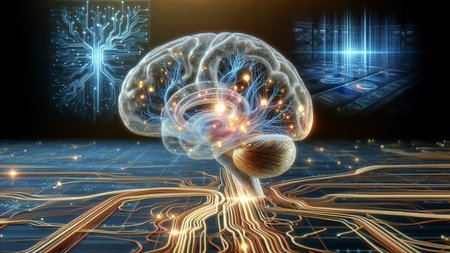
We forget why we have entered a room because passing through doors creates an ‘event boundary’ causing the brain to file away what we were just thinking about.
Why Walking Through Doorways Makes You Forget Things
You're walking to the kitchen with purpose. You know exactly what you need. Then you cross the threshold and—blank. Total mind wipe. You stand there like a confused NPC, wondering if you've developed early-onset amnesia.
Relax. You're experiencing the doorway effect, and it's completely normal.
Your Brain Treats Doorways Like Chapter Breaks
Researchers at the University of Notre Dame discovered that doorways aren't just physical boundaries—they're mental ones. When you walk through a doorway, your brain interprets it as an event boundary, essentially hitting the save button on whatever you were just thinking about and filing it away.
Think of your brain like a filing system. When you're in one room focused on a task, all that information is in your active working memory—right there on your mental desk. But cross through a doorway? Your brain assumes that chapter is over, archives those thoughts, and clears space for whatever's happening in the new room.
The Science Behind the Forgetting
Psychologist Gabriel Radvansky conducted experiments using both virtual and real-world environments. Participants performed memory tasks while moving around, and the results were consistent: people forgot significantly more after passing through doorways compared to walking the same distance within a single room.
The brain uses spatial and environmental cues to organize memories into distinct episodes. Doorways signal a change in context, so your brain compartmentalizes:
- Information before the doorway gets tagged as "previous location"
- Working memory gets updated for the new space
- Retrieving that filed-away thought requires extra mental effort
It's not that the memory is gone—it's just been moved from your mental desktop to a drawer. You can still access it, but it takes conscious effort to remember what you were doing before you entered the room.
Not All Doorways Are Created Equal
Recent research has added nuance to the effect. A 2024 study found that the doorway effect doesn't always occur—context matters. In some virtual reality experiments, doorways had no impact on memory at all, suggesting that factors like how we move through space (walking vs. teleporting) and how distinct the rooms are might influence whether the effect kicks in.
The stronger the environmental change, the stronger the boundary. Walking from your living room into a nearly identical hallway might not trigger the effect as much as going from a bright kitchen into a dark bedroom.
The Upside of Event Boundaries
Before you curse your brain for this annoying quirk, consider the alternative. Event boundaries aren't a bug—they're a feature. This same mechanism helps you:
- Organize memories into coherent episodes instead of one overwhelming stream
- Let go of irrelevant information so you're not constantly distracted by what you were doing five rooms ago
- Adapt to new contexts quickly by clearing mental clutter
Imagine if your brain didn't segment experiences. You'd be carrying every thought from every room around with you, unable to focus on what's actually relevant to your current environment. Event boundaries give you a fresh start.
How to Beat the Doorway Effect
The easiest hack? Say it out loud. Verbally repeating what you need as you walk—"Get the phone charger, get the phone charger"—keeps it in active memory instead of letting your brain file it away. You can also retrace your steps back through the doorway, which often helps your brain retrieve the archived thought.
Or just accept that sometimes you'll wander into rooms for mysterious reasons, shrug, and wander back out. Your brain is doing its job.
Frequently Asked Questions
Why do I forget things when I walk into a room?
What is the doorway effect in psychology?
How can I stop forgetting why I entered a room?
Does the doorway effect happen in all situations?
Is the doorway effect a sign of memory problems?
Verified Fact
This fact has been reviewed and verified against original sources.
Show verification details
This fact is scientifically accurate. The phenomenon is well-documented through research by Gabriel Radvansky at Notre Dame and others.
Related Topics
More from People & Mind
View all People & Mind →