Grady-White has built offshore fishing boats in Greenville, North Carolina since 1959. Eddie Smith was 26 when he bought the near-bankrupt shop in 1968. Buyers later offered him more than $400 million. He turned them down and gave the company away: voting control to a trust, the profits to a charity. Then he paid every worker a bonus scaled to years of service. The hulls are still laid up by hand.
The Boat Company Nobody Can Ever Buy
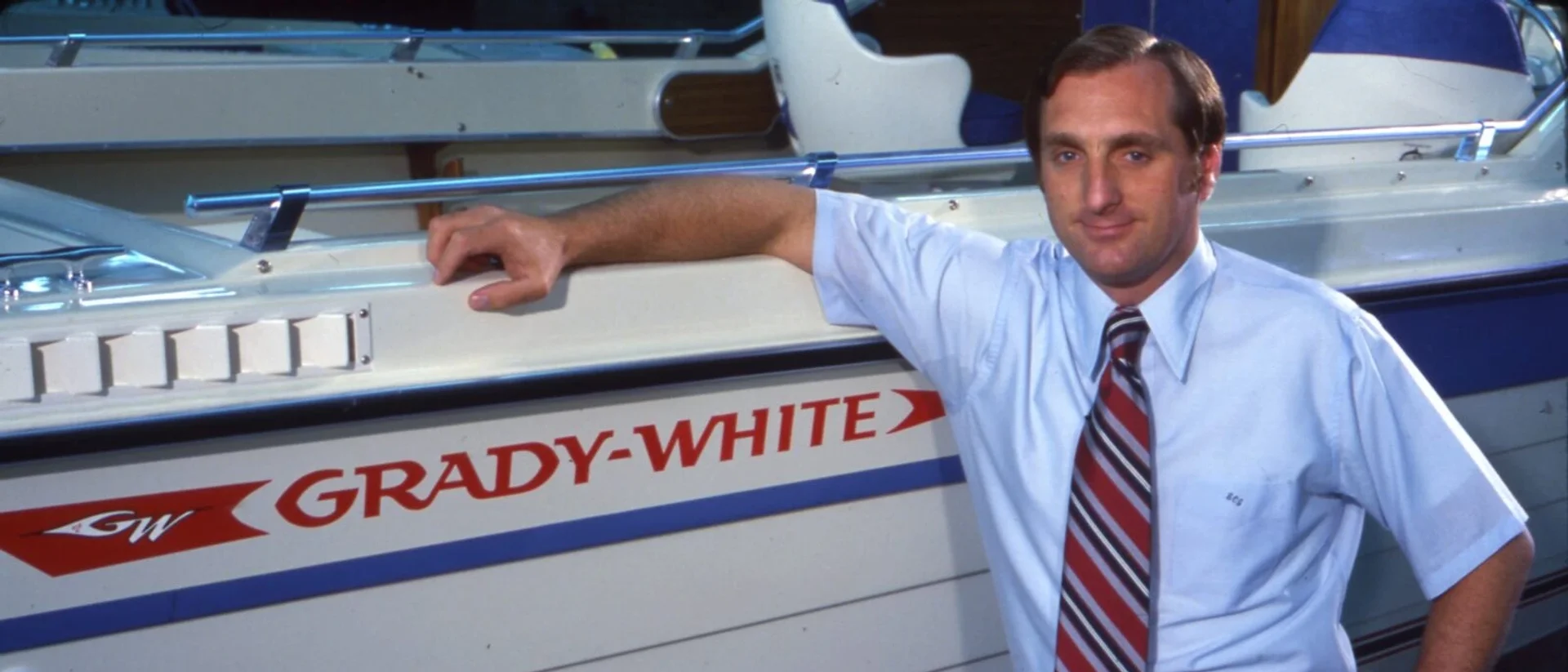
In 1968 a 26-year-old named Eddie Smith Jr. bought a small, nearly bankrupt boat shop in Greenville, North Carolina. Fifty-six years later the offers came in, more than $400 million for what it had become, and he turned every one of them down.
A Shop That Was Nearly Gone
Grady-White had been founded in Greenville in 1959. By the time Smith bought it, the company was close to collapse.
He spent the next six decades building it into one of the most decorated names in American boatbuilding. The company's SeaV2 hull became the thing offshore fishermen argued about at the ramp, and Grady-White collected 24 consecutive NMMA Customer Satisfaction Index awards.
The Offers Came, and He Said No
Smith is 83. About two years before the announcement, the buyers started calling, and the company says the offers were for over $400 million.
Smith turned them all down. He could not be sure a buyer would keep running the place on the values he had spent a lifetime installing: profit sharing with employees, a hard line on build quality, and steady support for Greenville.
He also gave up any personal claim to profits from a future sale of the company, along with any tax benefit for donating his stock.
A Trust Built to Hold It
In July 2026 Grady-White announced the structure Smith had chosen instead.
The voting stock went into the Grady-White Boats Perpetual Purpose Trust. The trust oversees the management of the company: keeping it in Greenville, keeping Smith's principles in operation, looking after employees, customers, dealers and the community, and continuing to build the boats.
The non-voting shares, the ones that carry the economics, went to a newly formed 501(c)(4) nonprofit. It is expected to give away tens of millions of dollars a year to education, health care, conservation and the Greenville community.
Both entities are run by independent boards. Smith sits on neither. He moved to a non-operational chief executive emeritus role as an adviser and brand ambassador, and Kris Carroll, a 50-year Grady-White veteran, stayed on as president and CEO.
Purpose-trust ownership is still rare in the United States, with around 81 companies having made the switch, up from seven in 2018. Grady-White is the first in the marine industry. Smith modelled the move on Patagonia founder Yvon Chouinard, who put his own company into a trust and a nonprofit in 2022.
He Paid the Builders First
Before any of the profits started flowing to charity, Smith paid the people who make the boats.
Every current employee received a bonus. The amounts were set in levels based on years of service and craftsman level, and the company says the total ran into the millions of dollars.
More than 350 employees were in the room when the announcement was made. The company says there were plenty of tears, happy ones.
Every Hull, Still by Hand
Nothing about the day-to-day changed. The boats are still built on the same floor in Greenville.
Grady-White says every one of its hulls and decks is 100% hand laid, with the fiberglass placed by people rather than sprayed by machine. "Human hearts and hands are the most important part of our boat building process," the company writes.
Every boat passes more than 150 quality checkpoints before it leaves the plant, and the company's own line on it is blunt: the best way to learn how a Grady-White is built is to come to Greenville and watch.
Source:Grady-White Boats
Enjoyed this fact?
Be the first to love this
Get a new fact every morning.
A fascinating fact in your inbox every morning. Free. Unsubscribe anytime.
Frequently Asked Questions
Who owns Grady-White Boats now?
Why did Eddie Smith turn down $400 million for Grady-White?
What is a perpetual purpose trust?
Are Grady-White boats still made by hand?
Did Grady-White employees get anything out of the deal?
Verified Fact
Verified Sep 13, 2026 · 5 sources checked
Source: Grady-White BoatsShow verification details
Claims checked
- Eddie Smith bought the near-bankrupt Grady-White in 1968, aged 26
- Offers of more than $400 million, turned down about two years before the July 2026 announcement
- Control gifted to the Grady-White Boats Perpetual Purpose Trust, with non-voting shares to a nonprofit that will grant the profits
- Claim that the trust can never sell the company reworded, as no source says a sale is impossible
- Every current employee got a bonus set by years of service and craftsman level
Sources: Grady-White Boats, On The Water, Marlin, CBS Evening News
Related Topics
More from People & Mind
View all People & Mind →