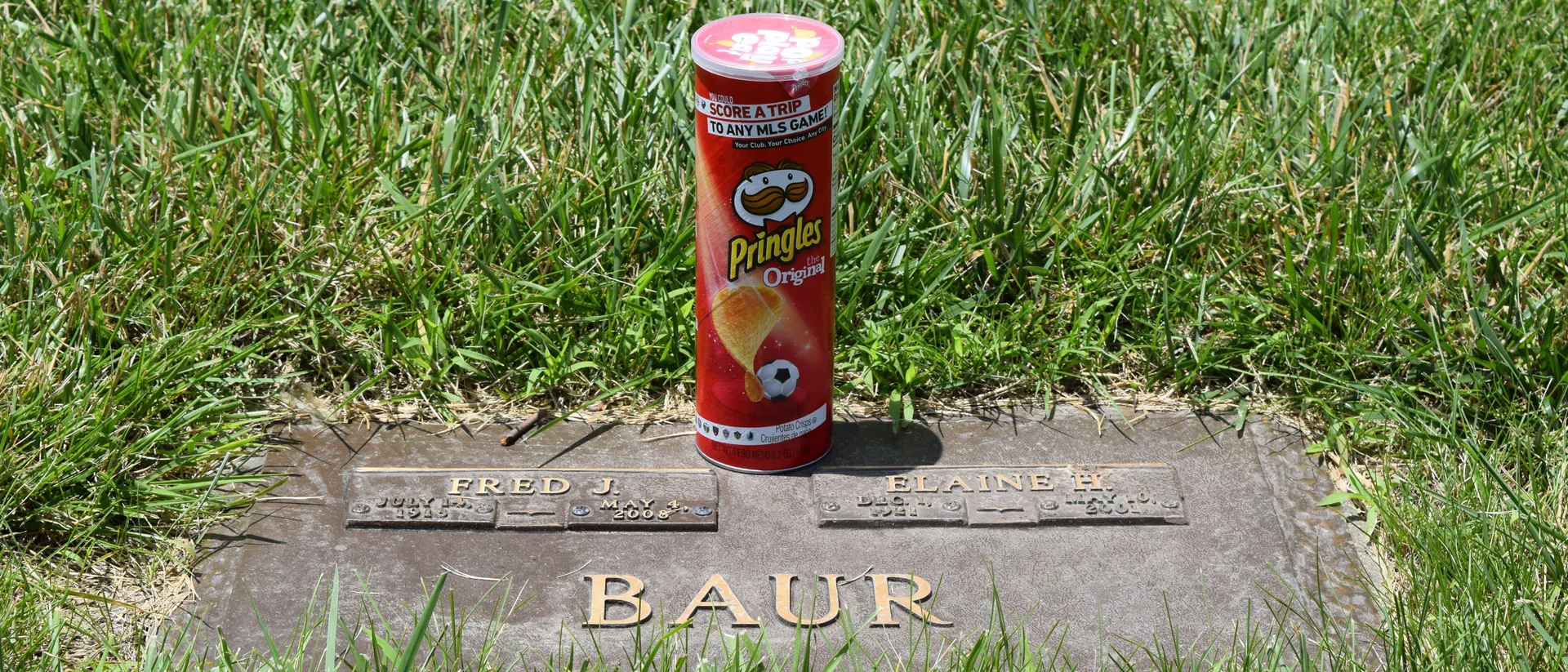
The inventor of the Pringles can is buried in one. Fredric Baur was so proud of his creation that he requested part of his ashes be stored in a Pringles container after his death in 2008.
The Pringles Inventor Who Took His Creation to the Grave
When Fredric Baur passed away in 2008 at the age of 89, his family honored one of the most unusual final requests ever made: they buried part of his cremated remains inside a Pringles can. But this wasn't just a quirky last wish from a snack food enthusiast—Baur had every right to take his invention to the grave. He was the man who designed the revolutionary tubular container that changed how the world stores potato chips.
The Man Behind the Can
Fredric John Baur wasn't a chef or a food scientist—he was a chemist and organic storage technician working for Procter & Gamble in the 1960s. At the time, potato chips came in bags that left them stale, broken, and crushed. Baur's mission was to solve this problem, and his solution was brilliantly simple: stack the chips uniformly and store them in a rigid, cylindrical container.
The design was ingenious. The tubular shape protected the chips from being crushed during shipping and storage, while the stackable, saddle-shaped chips (which Baur also helped develop) fit perfectly inside. The airtight seal kept them fresh far longer than traditional bags. In 1970, Baur received a patent for the Pringles can design, and his creation became one of the most recognizable packages in the world.
A Legacy Worth Remembering
Decades after inventing the Pringles can, Baur remained proud of his contribution to packaging innovation. So proud, in fact, that he made his unusual burial request known to his children long before his death. When he passed away on May 4, 2008, his family knew exactly what to do.
After Baur's cremation, his children stopped at a Walgreens to buy a can of Pringles. They debated which flavor to choose—ultimately selecting original flavor—and then divided their father's ashes. Some went into a traditional urn for burial at Arlington Memorial Gardens in Cincinnati, Ohio. The rest were placed inside the Pringles can, which was buried alongside the urn.
The Walgreens Debate
According to Baur's son Larry, the family had a lighthearted moment in the Walgreens parking lot, trying to decide which Pringles flavor was most appropriate for their father's final resting place. While original seemed like the safe choice, they briefly considered whether he would have preferred something more adventurous. It was a moment of levity during a difficult time—exactly the kind of humor that Fredric Baur himself might have appreciated.
More Than Just a Chip Container
Baur's Pringles can represented a fundamental shift in food packaging philosophy. Before Pringles, chip manufacturers focused primarily on the product itself, treating the package as an afterthought. Baur reversed this thinking: he designed the package first, then worked with food scientists to create a chip that would fit the container perfectly.
This approach led to Pringles' unique composition. Technically, they're only about 42% potato—the rest is a mixture of wheat starch, corn flour, rice flour, and various seasonings, pressed into their distinctive saddle shape (called a "hyperbolic paraboloid" in mathematical terms). This recipe wasn't just about taste; it was engineered to create uniform chips that would stack consistently inside Baur's cylindrical design.
The Can That Changed Snacking
Today, Pringles are sold in over 140 countries, with annual sales exceeding $1.5 billion. The can has become so iconic that it's instantly recognizable even without branding. Competitors have tried to replicate the design, but none have achieved the same cultural penetration. From college dorm rooms to vending machines to camping trips, the Pringles can has become synonymous with portable, stackable snacking.
Fredric Baur lived to see his invention become a global phenomenon, though he retired from Procter & Gamble long before Pringles reached their current heights. He spent his later years in Cincinnati, occasionally sharing stories about his famous creation with family and friends, always with a sense of pride and satisfaction.
His decision to be buried in a Pringles can wasn't macabre or strange—it was a final celebration of creativity, innovation, and the lasting impact one person can have on everyday life. Every time someone pops open that familiar cylindrical lid, they're using Fredric Baur's invention, a testament to his ingenuity that will outlive us all.
Enjoyed this? Get a new fact every morning.
A fascinating fact in your inbox every morning. Free. Unsubscribe anytime.
Frequently Asked Questions
Which flavor of Pringles was Fredric Baur buried in?
Did Fredric Baur invent Pringles chips or just the can?
Were all of Fredric Baur's ashes buried in a Pringles can?
Are Pringles actually potato chips?
When did Fredric Baur die and request to be buried in a Pringles can?
Verified Fact
This fact has been reviewed and verified against original sources.
Source: View sourceShow verification details
Confirmed through multiple sources including Cincinnati Enquirer, family interviews, and patent records. Fredric Baur held U.S. Patent 3,498,798 for the Pringles container design.
Related Topics
More from People & Mind
View all People & Mind →