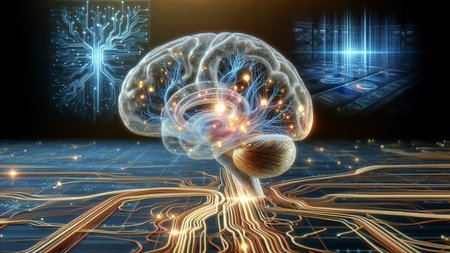
The human brain contains roughly 86 billion neurons connected by approximately 100 trillion synaptic connections—far more connections than there are stars in the Milky Way galaxy.
Your Brain Has More Connections Than the Milky Way Has Stars
For years, people have compared the human brain to the cosmos, claiming we have more neurons than there are stars in the Milky Way. But here's the twist: that comparison is backwards. Our galaxy contains an estimated 200 to 400 billion stars, while the average human brain has about 86 billion neurons. The Milky Way wins that contest handily.
But don't sell your brain short.
The Real Mind-Blower: Synaptic Connections
While neurons get all the glory, the true measure of your brain's complexity lies in how those neurons connect. Each of the 86 billion neurons in your brain forms thousands of connections with other neurons through structures called synapses. The average neuron makes about 7,000 synaptic connections, though some form as many as 10,000.
Do the math, and you get roughly 100 trillion synapses—with some estimates ranging as high as 1,000 trillion. That's 100,000,000,000,000 connections firing, adapting, and rewiring themselves as you read this sentence. Even using the conservative estimate, your brain's synaptic network contains 250 to 500 times more connections than the Milky Way has stars.
Why This Matters
These aren't static connections. Your synapses constantly strengthen, weaken, form, and dissolve based on your experiences—a process called neuroplasticity. When you learn to play guitar, fall in love, or finally understand calculus, you're physically rewiring trillions of these connections.
The sheer number of possible neural pathways in your brain exceeds the number of atoms in the observable universe. You're essentially carrying a network more intricate than the galaxy itself, wrapped in three pounds of tissue.
The Myth's Origin
The neuron-to-star comparison likely emerged from older estimates that placed both figures around 100 billion. But as measurement techniques improved, we refined our count of neurons downward to 86 billion (thanks to neuroscientist Suzana Herculano-Houzel's 2009 breakthrough), while estimates of Milky Way stars climbed upward to 200-400 billion.
The comparison failed—but it pointed us toward something even more extraordinary: the incomprehensible web of connections that makes you you.
Frequently Asked Questions
How many neurons are in the human brain?
How many synaptic connections does the brain have?
Are there more neurons or stars in the Milky Way?
What are synaptic connections in the brain?
How does brain complexity compare to the universe?
Verified Fact
This fact has been reviewed and verified against original sources.
Show verification details
Corrected the comparison - the original claim reversed the numbers. The Milky Way has MORE stars (200-400B) than the brain has neurons (86B). Fixed to highlight the truly impressive metric: synaptic connections (~100 trillion).