Those giant wooden castle playgrounds from the 1980s and 90s were designed by kids. Architect Bob Leathers visited local schools, collected children's drawings, and turned them into blueprints. Then the town's own parents and volunteers built it by hand, usually in about five days. He did this in more than 2,000 communities.
Kids Designed Those Giant Wooden Castle Playgrounds
If you grew up in the United States in the 1980s or 90s, there is a good chance you spent afternoons climbing through a sprawling wooden fortress with towers, tunnels and rope bridges at a park that looked like nowhere else in the country. What almost nobody realized at the time is that kids had designed the whole thing themselves.
A Design Day at the School
The man behind most of these castles was an architect named Robert "Bob" Leathers, based in Ithaca, New York.
Leathers built his first community playground in 1970 at his son's elementary school in Ithaca. He founded Leathers and Associates in the early 1980s and spent the next two decades repeating the same idea in towns across the country.
Before any lumber was cut, Leathers or a member of his team would visit the local school for what the company called a "design day." Children were asked to draw and describe their dream playground.
Those drawings, full of towers, drawbridges, secret tunnels and dragons, became the starting point for a real architectural blueprint.
A Modern-Day Barn Raising
Once the design was locked in, the town took over. Parents sawed boards and hammered nails, local businesses donated lumber and tools, and volunteers organized food for the crew.
"The basis of the success of these projects is to involve the children from the beginning all the way through to when it is built," Leathers told The New York Times in 1989.
A single build usually took about five days of long shifts and could pull in thousands of volunteers from one town. In Chehalis, Washington, roughly 2,000 volunteers built the town's Penny Playground in five days flat in 1993.
The Castle That Named Itself
In Chehalis, local schoolchildren even named their own playground. They chose "Penny Playground" after a school penny drive helped raise money for construction, and Chehalis Middle School students pitched in their own fundraising toward the project.
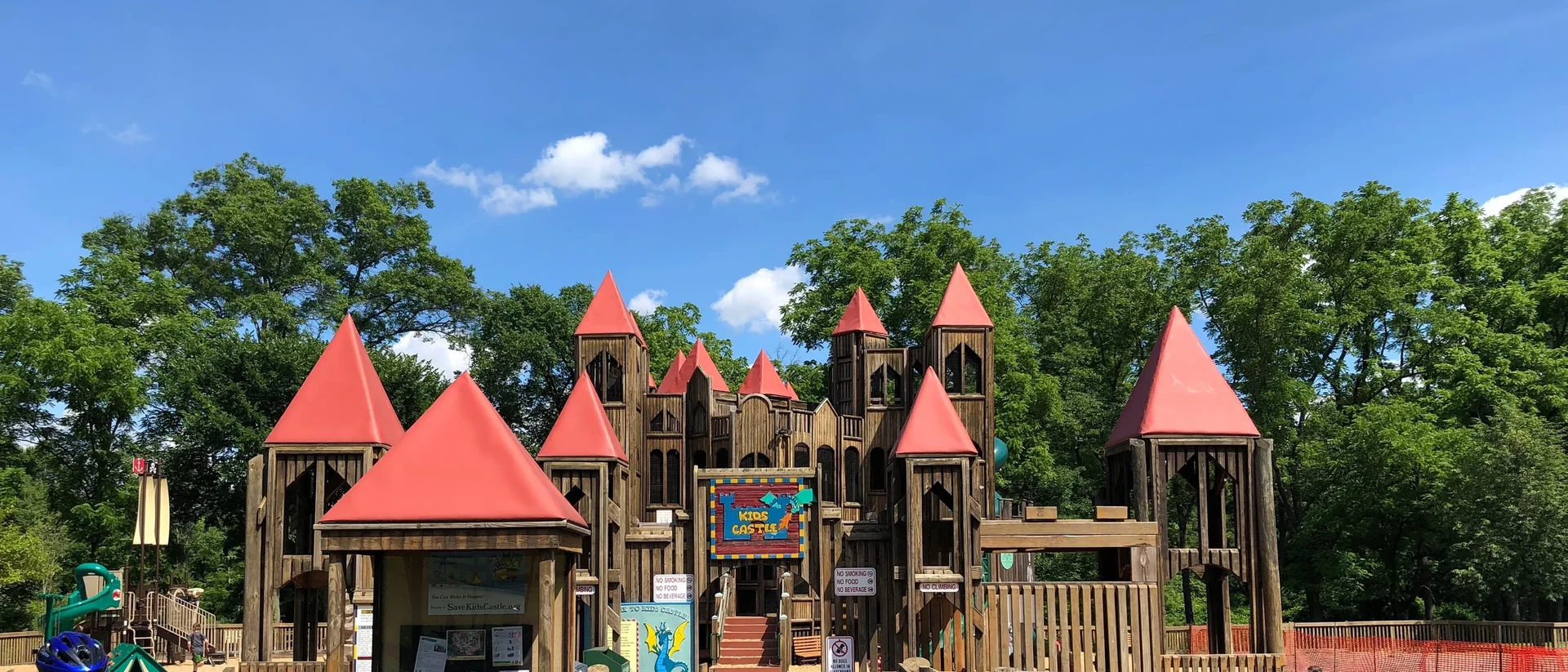
The pattern repeated itself in towns of every size. In Doylestown, Pennsylvania, a team of local architects and Central Bucks schoolkids helped shape a design that Leathers was brought in to refine. It opened in 1997 as Kids Castle and still stands in the town's Central Park today.
Still Standing
The idea spread far beyond any one town. In 1986, two separate Leathers-built playgrounds were featured on the PBS children's shows Mister Rogers' Neighborhood and Sesame Street. By 1989, the Chicago Tribune was calling Leathers "the guru of contemporary playground design."
By the company's own count, Leathers and Associates has now completed 3,346 projects with the help of more than 3 million volunteers since 1971. Independent reporting puts the more conservative figure at over 2,000 playgrounds built across the United States, plus projects in Israel and Australia.
Leathers himself has estimated that of the more than 2,000 playgrounds his company built, about 1,500 are still standing today, still holding the shape of drawings a bunch of second graders handed him decades ago.
Frequently Asked Questions
Who designed the giant wooden castle playgrounds from the 1980s and 90s?
How did kids actually help design the playgrounds?
How long did it take to build one of these playgrounds?
How many wooden castle playgrounds did Leathers and Associates build?
Was a Leathers playground ever on TV?
Verified Fact
Verified identical after stripping bold markers
Source: Hopes & FearsShow verification details
fact-verifier audit 2026-08-09. Independently re-traced every claim against primary sources (WebFetch/curl, WebSearch dead this session). Primary source (source_url): Hopes & Fears "If you remember this playground, your childhood was awesome" by Sophie Weiner, Dec 29 2015, via Wayback (live site dead) - fetched and read in full. CONFIRMS: design-day school visits collecting kids drawings/ideas; builds "generally require about five days of ten-hour shifts"; company built "well over 2,000 playgrounds" in US/Israel/Australia; Leathers estimates ~1,500 of 2,000+ still standing; a Sebastopol CA playground photo/meme had "over 76,000" Facebook likes (matches engine_note, not used in public copy per instruction); confirms 1986 Mister Rogers Neighborhood tie-in (source phrases it loosely as a Leathers cameo - our copy correctly follows the more precise Wikipedia/PBS episode-citation framing: the PLAYGROUND was featured on the episode, not that Rogers visited a build or Leathers appeared - no reversed agency). Cross-checked: Wikipedia "Leathers and Associates" (fetched) - confirms over 2,000 playgrounds, founded early 1980s Ithaca NY, 1982 WaPo four-day typical build, 1986 PBS feature on Mister Rogers Neighborhood (episode 1560 "Making and Creating," Feb 7 1986, cited to PBS) and Sesame Street, 1989 Chicago Tribune guru quote. NYT archived text (fetched via Wayback) - CONFIRMS exact quote "The basis of the success of these projects is to involve the children from the beginning all the way through to when it is built" and "four and a half days of construction" and "Youngsters drew pictures of their ideal playgrounds" (drawings, not crayon - confirmed). Wikipedia "Doylestown Central Park" (fetched) - CONFIRMS Kids Castle opened June 22 1997, design was an effort by local architects AND Central Bucks School District students, Bob Leathers hired to refine the design - matches article exactly. Wikipedia "Recreation Park Complex (Chehalis, Washington)" (fetched) - CONFIRMS Penny Playground 1993, volunteer workgroup of 2,000 people, built in 5 days, designer Robert S. Leathers & Associates, name chosen from schoolchildren submissions tied to penny fundraising drive, Chehalis Middle School students contributed $1,200 (source has a dollar figure/cost - correctly omitted from our copy per no-dollar-figures brand guidance). playgroundsbyleathers.com company site (fetched) - CONFIRMS running totals verbatim: 3,346 Projects Completed, 3,105,846 Volunteers Who Have Helped, Family Owned and Operated Since 1971 - matches article, correctly attributed by the companys own count vs independent reporting more-conservative 2,000+ figure. Numeric coherence: all instances of "more than 2,000 communities/playgrounds" (text, social_text, caption, article, FAQ) reconcile; 3,346/3.1M figures appear only in article+FAQ, both explicitly attributed to the company self-report, never conflated with the independent 2,000+ figure; five-day duration is consistent across text/social_text/caption/article, with the 1982 four-day and 1989 four-and-a-half-day variants correctly confined to this notes field, not asserted as the headline duration. Citation fidelity: source_url (Hopes & Fears Wayback) directly supports the headline mechanism, the 2,000+ figure, the five-day build, and the still-standing estimate - passes. text/social_text sync: verified identical after stripping bold markers (346 chars social_text, well within 280-420 target). Correction made: social_caption opening line contained an unsourced invented detail ("showed up ... with a sketchpad") - no source specifies the medium Leathers or the schools used to collect the drawings. Removed "with a sketchpad"; rest of caption unchanged. No image/scheduled_posts existed yet (pre-imaging), so no cascade (cancellation/image-null) was needed. Reversed-agency check: passed - Leathers/his team visited schools and collected from kids; the PBS playground feature is the playground being shown, not Rogers visiting a build; no arsenic/CCA/teardown-era content or dollar figures anywhere in public copy (source material does mention arsenic-treated wood degradation but this is correctly and deliberately omitted per brand-tone guidance). Engine/novelty: engine=1 reasoned as an object/format-recognition case (the wooden castle playground silhouette itself is the meme-proven recognizable element, evidenced by the 76,000-like Facebook photo in the primary source), not a face-recognition case - Leathers himself is not a public face. This is a defensible non-celebrity Engine-1 case (recognizable format/brand, akin to iconic-place precedent), left as-is. mainstream_novelty=2 accepted - the specific Leathers/design-mechanism story is not a chronically-recirculated FB meme fact like Wojtek/Sully, even though the playground FORMAT itself is nostalgically familiar. Discrepancies found: none material. Confidence: HIGH - primary source read in full via WebFetch/curl, all claims cross-checked against Wikipedia + NYT archived text + Chehalis/Doylestown Wikipedia pages + company site, one minor invented-detail correction made in social_caption.
Related Topics
More from Places & Culture
View all Places & Culture →