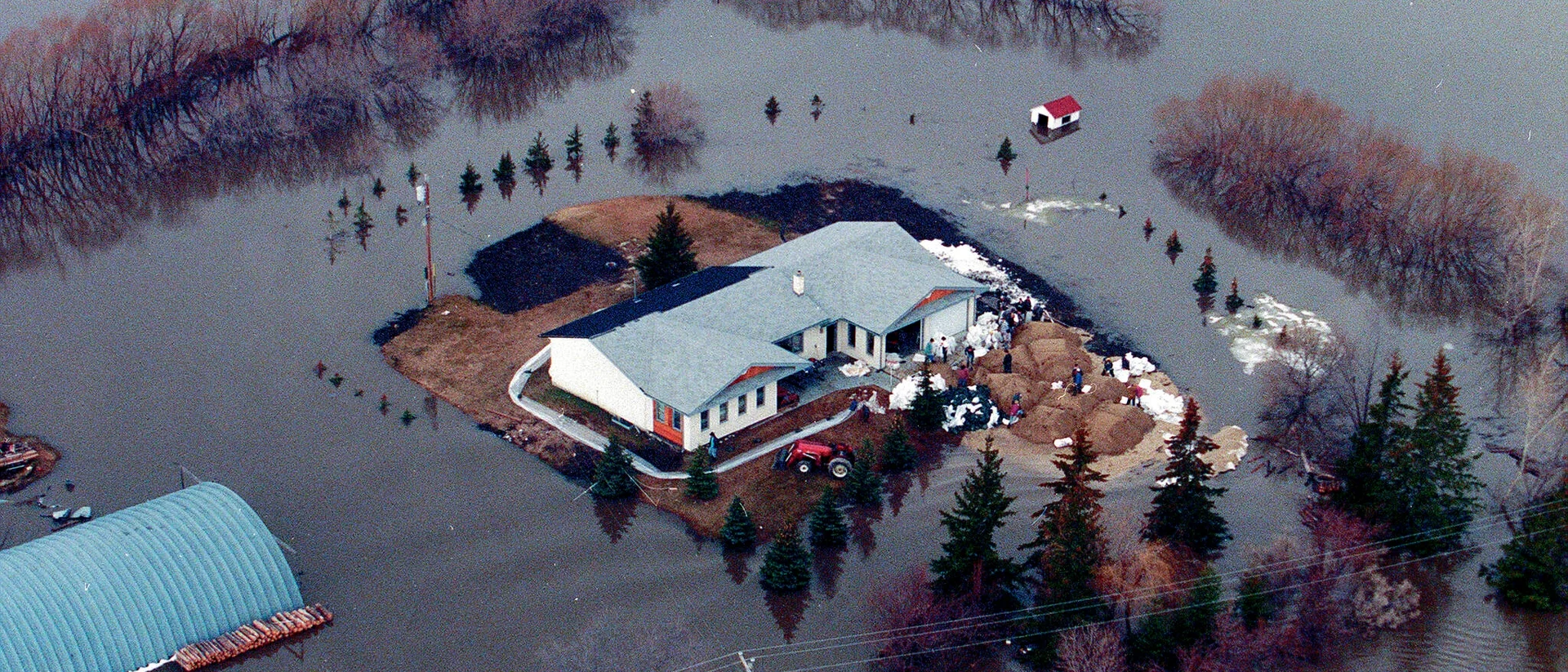
Winnipeg was about to disappear under floodwater in the spring of 1997. Tens of thousands of volunteers, including students bused from their classrooms, filled more than 8 million sandbags by hand. Crews then raced to build a 26-mile wall of earth and sandbags across open farmland in just four days. The wall held, and the city stayed dry.
The City That Built an 8-Million-Sandbag Wall to Survive
In the spring of 1997, a wall of water that was later called the "Flood of the Century" bore down on the Canadian province of Manitoba. The only thing standing between the rising Red River and the city of Winnipeg was an army of ordinary people with shovels, sand, and empty bags.
A River Turns Into an Inland Sea
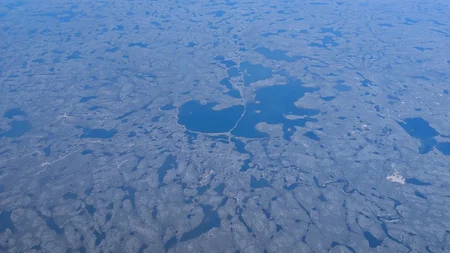
Heavy snowmelt and spring rain pushed the Red River far past its banks in April 1997. At its peak, floodwater covered roughly 1,840 square kilometers of southern Manitoba, an area close to the size of Prince Edward Island.
Nearly 28,000 people were evacuated from the region, and damage across the province eventually topped $500 million.
An Army of Volunteers
With the river climbing by the hour, Manitoba put out an urgent call for help. Tens of thousands of volunteers answered, and schools across the province sent busloads of students straight from their classrooms to the sandbag lines.
Day and night, crews formed human assembly lines, scooping sand, tying bags, and stacking them into makeshift walls around homes, farms, and pumping stations. By the time the water finally receded, more than 8 million sandbags had been filled across the city, enough that laid end to end they would stretch roughly from Winnipeg to Vancouver.

The Wall Built in Four Days
Partway through the crisis, provincial engineers realized Winnipeg faced a second threat: if the Red River backed up into a smaller river to the west, it could flood the city from a direction its existing defenses never covered. The answer was the Brunkild "Z-dike," a zigzagging, 26-mile wall of earth, crushed rock, and giant sandbags built across open farmland between the towns of Domain and Brunkild.
Crews worked around the clock, some nights lit by flares dropped from aircraft, moving roughly 750,000 cubic meters of earth in a matter of days. It cost about $10 million to build.
The Wall Held
The Brunkild dike went up just in time. Combined with the sandbag lines built by volunteers across the city, it kept the Red River out of Winnipeg and protected hundreds of thousands of people.
Once the danger had passed, the province dismantled the temporary dike, and the millions of donated sandbags were slowly hauled away.
The Same Flood Hit Both Sides of the Border
The Red River flows north out of the United States, and the same 1997 flood devastated Grand Forks, North Dakota, just upstream. More than 50,000 residents, nearly the entire population of the city, were forced from their homes, and a fire tore through downtown Grand Forks even as the streets sat underwater.
Across the whole Red River Valley, the flood caused an estimated $3.5 billion in damage.
Nearly three decades later, the 1997 flood is still the benchmark Manitoba and North Dakota measure every spring thaw against, and the image of tens of thousands of strangers filling sandbags side by side remains one of the province's defining memories.
Frequently Asked Questions
How many sandbags were used in the 1997 Winnipeg flood?
What was the Brunkild Z-dike?
How many people were evacuated during the 1997 Red River flood?
Did the 1997 Red River flood also hit the United States?
Why is the 1997 flood called the Flood of the Century?
Verified Fact
Verified Jul 21, 2026 · 8 sources checked
Source: Global NewsShow verification details
Verified 2026-07-21. Independent audit, 8 sources checked (Global News globalnews.ca/news/5216176 [source_url, matches headline 8.1M sandbag figure explicitly attributed by GN to City of Winnipeg + Winnipeg-to-Vancouver comparison]; Wikipedia 1997 Red River flood + 1997 Red River flood in the United States; Manitoba gov gov.mb.ca/mti/wms/rrf/historical_1997.html; Valour Canada; CBC Z-dike retrospective; tandfonline peer-reviewed Canadian Water Resources Journal Z-dike engineering paper; CBC/Baptist Press on Adam Young death).\nClaims checked:\n- 8M+ sandbags: CONFIRMED, source_url explicitly attributes 8.1M to City of Winnipeg with same Winnipeg-Vancouver comparison used in copy -- no conflation with the separate 6.5-6.6M figure circulating elsewhere (different retelling of the same City figure, not a different scope). Fact correctly rounds down to more than 8 million.\n- Brunkild Z-dike 26mi/42km, ~4 days, ~M CAD, 750,000 cubic metres, 400 pieces of equipment, night work under aircraft flares: CONFIRMED via Wikipedia + Valour Canada (four days) + tandfonline peer-reviewed paper (main work within 5 days, 400 pieces of earth-moving equipment, 750,000 m3, flares dropped from aircraft) + CBC (42km, Domain-to-Brunkild, dollar10M, dismantled after). One CBC retrospective phrase called the overall hasty construction three weeks -- read in context as the broader effort (approach work, later reinforcement with straw/buses/sandbags, dismantling) vs the core race-to-complete-the-earthworks window that two independent sources (Valour Canada military history + peer-reviewed hydrology journal) put at 4-5 days. Four days is adequately sourced and not overprecise.\n- Evacuations: nearly 28,000 Manitoba-wide (Wikipedia) vs Manitoba govs own 25,450 (gov.mb.ca) -- genuine source variance, correctly disclosed as such by creator, appropriately hedged with nearly.\n- Grand Forks ND: more than 50,000 evacuated, downtown fire, 3.5B dollar regional damage: ALL CONFIRMED via Wikipedia.\n- 1,840 sq km peak flooded area, most severe since 1826: CONFIRMED via Wikipedia.\n- No invented student headcount: CONFIRMED, copy stays qualitative (tens of thousands, no exact number).\n- No zero-casualty claim: CONFIRMED, copy never claims no deaths; one flood death (Adam Young, 14) is documented elsewhere and the copy does not contradict it, it only says the dike/wall held and the city stayed dry (accurate -- Winnipeg itself was not flooded).\n- students bused from their classrooms: qualitative detail, corroborated directionally (whole classes pulled from school to sandbag, school buses documented at the flood site) though exact word bused vs walked could not be pinned to one primary source -- soft claim, not a numeric or reversed-agency issue, left as is.\nNumeric coherence: all figures in social_text/caption/article/FAQs internally consistent and reconcile with the article; no arithmetic contradictions.\nCitation fidelity: source_url (Global News) directly supports the headline 8M+ sandbag figure and Winnipeg-Vancouver comparison used in copy -- PASS.\nReversed-agency: none found (students to sandbag lines, crew builds dike to protect city, kids/crew roles all correctly attributed).\nengine=1 sanity-checked: correctly anonymous mass-volunteer/exceptional-scale story (not recognizable name/face/brand), not inflated to engine=2, not claimed prime-eligible.\naffinity_pool=1 sanity-checked: correctly graded as regional (Manitoba/Upper-Midwest) flood memory, not inflated to 2 (mass US household name) despite being a large historic event.\nGemini CLI dead -- substituted manual sentence-by-sentence trace of fact/article/social fields against primary source texts (Global News, Wikipedia, Valour Canada, tandfonline, gov.mb.ca) pulled via WebFetch/WebSearch. No discrepancies requiring correction.\nConfidence: high.