📝Updated for accuracy
Some details in this fact have been corrected based on our review of primary sources.
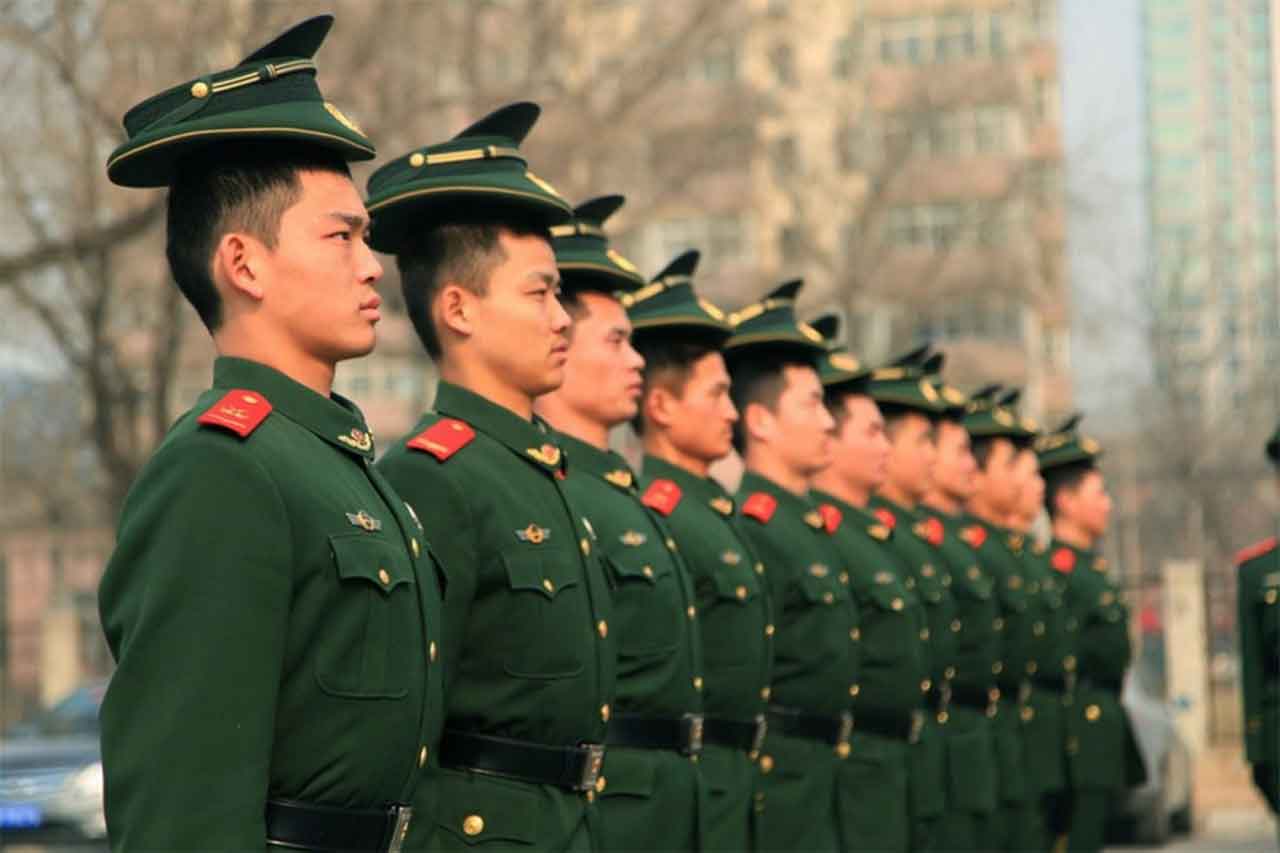
Some Chinese paramilitary police learn their 'perfect posture' with pins in their collar.
Chinese Police Train With Pins In Their Collars
In the precision-obsessed world of Chinese paramilitary training, there's a technique so extreme it sounds like something out of a dystopian novel. New recruits in units like the People's Armed Police sometimes learn to stand at attention with straight pins stuck through their collars, pointed directly at their necks and chins.
Yes, you read that right. Actual pins, positioned so the tip presses into the skin the moment a soldier's posture slips.
Why Would Anyone Do This?
The goal is brutally simple: perfect military posture. These elite units perform ceremonial duties at major government events, stand guard at important sites, and represent Chinese discipline to the world. A drooping head or hunched shoulders isn't just sloppy, it's considered a national embarrassment.
The pins create instant negative feedback. Relax your neck? You get stabbed. Let your chin drift downward? Stabbed again. It's classical conditioning at its most painful, turning correct posture from a conscious effort into a fear-driven reflex.
The Full Arsenal of Posture Torture
Collar pins are just one tool in a nightmare toolkit of training methods:
- Chopsticks behind the knees to prevent leg bending during attention stance
- Books or bricks balanced on heads for hours-long sessions
- Boards strapped to backs to eliminate any hint of spinal curve
- Standing on nails or sharp stones to teach weight distribution
This isn't a rumor: Getty Images photographed the technique in Hefei, Anhui province in 2009, and again in Beijing in 2012 as officers prepared for the National People's Congress. The New York Times separately reported on similar posture drills ahead of a National Day parade through Tiananmen Square.
Does It Actually Work?
According to Xinhua reporting cited by the New York Times, recruits build up to standing motionless for a full hour, then avoid swaying through a second hour, then hold for a third without collapsing. That's the kind of stillness that shows up in parades and honor-guard duty.
The pins are a shortcut, not a mystery: a single sharp reminder corrects a slouching recruit faster than months of drilling alone. It isn't a method every recruit is put through, either: reporting on the photographed cases describes it as a corrective used on soldiers whose posture wasn't yet up to standard, not a universal rite of passage.
The Bigger Picture
This training philosophy reflects a broader cultural attitude in Chinese military tradition: the body must be conquered through suffering. Comfort is weakness. Pain is the path to discipline. The individual's physical wellbeing matters less than the collective's flawless presentation.
Western military academies pursue similar posture goals - think of West Point cadets or British Royal Guards - but typically use repetition, muscle conditioning, and corrective exercises rather than a pin in the collar. The pin method compresses months of muscle memory into a single sharp lesson.
So next time you see footage of Chinese honor guards standing impossibly still during a hours-long ceremony, remember: that perfection wasn't achieved through gentle coaching alone. Some of those soldiers learned their posture with a sharp metal reminder that any deviation from perfect would literally hurt.