
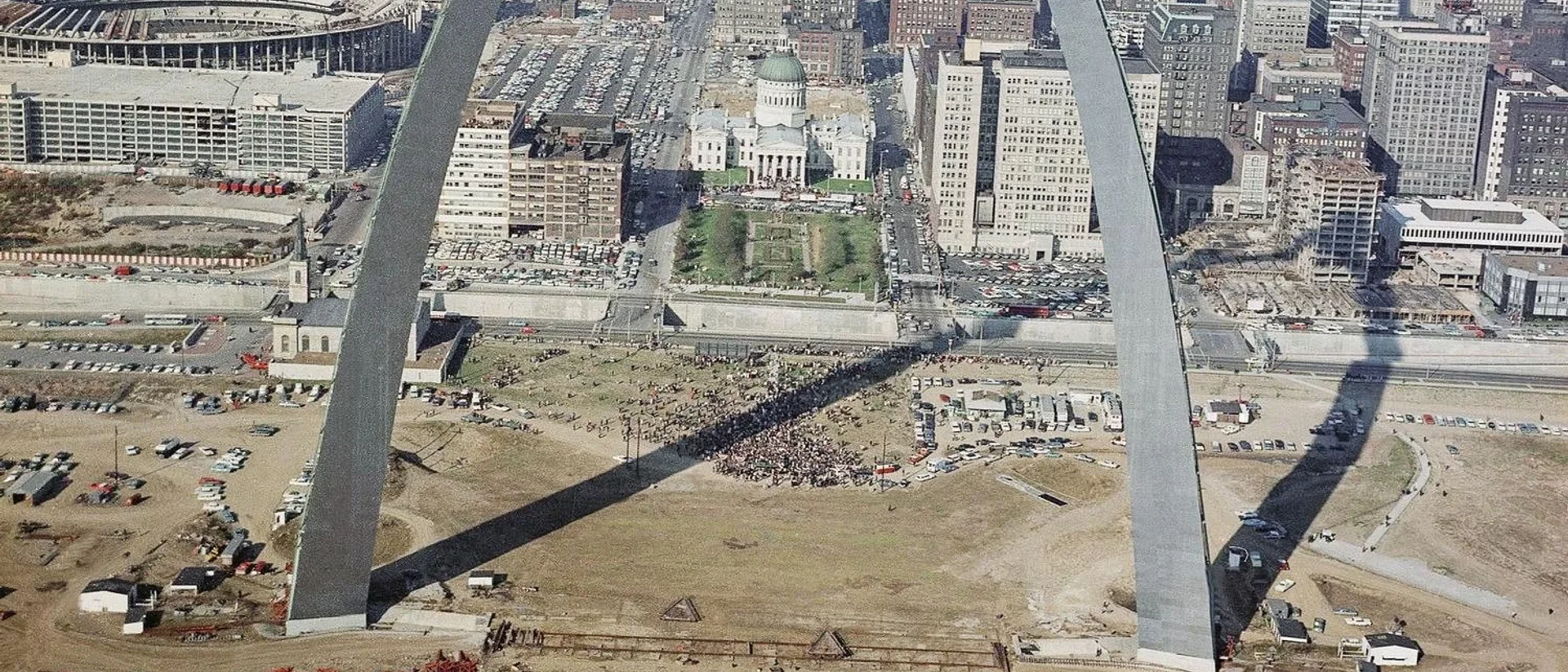
The Gateway Arch was built as two separate legs measured to meet precisely at the top. On October 28, 1965, the morning sun expanded the south leg. The last piece would not fit. Workers ran fire hoses to the top and soaked the steel until it shrank. Hydraulic jacks applied 450 tons of force, and the final section slid in.
The Gateway Arch Almost Didn't Close
The Gateway Arch in St. Louis stands 630 feet tall and is the tallest monument in the United States. What most visitors never learn is how close the project came to failing on its very last day.
Two Legs, One Shot at the Top
Construction began in February 1963. Workers built two separate legs simultaneously, rising toward each other from opposite sides of the Jefferson National Expansion Memorial grounds. Each triangular steel section was stacked and welded onto the one below. Measurements were taken at night to avoid the distortion caused by sunlight heating the steel - any error at the base would compound with every section added, so precision was everything.
The Morning Everything Went Wrong
On October 28, 1965, ironworkers arrived to fit the final piece - a 10-ton, eight-foot-long triangular keystone section at the very top. The problem: the south leg had absorbed the morning sun and expanded. The gap between the two legs was now too narrow for the keystone to fit. Thermal expansion had constricted the 8.5-foot gap by 5 inches - just enough to stop the section sliding home.
Fire Hoses at the Top
Workers ran fire hoses to the top of the south leg, with fire trucks on the ground pumping a steady stream of cold water up to them. They soaked the south leg until the steel contracted enough to open the gap again.
450 Tons of Force
Cooling the leg alone was not enough. Hydraulic jacks applied roughly 450 tons of force to push the two legs apart to the required 8.5 feet. Fifteen ironworkers guided the keystone into place. It took just 13 minutes. Vice President Hubert Humphrey watched the whole thing from a helicopter overhead.
A Monument Built on Precision and a Garden Hose
The Gateway Arch opened to visitors in 1967 and today attracts millions each year. The structure is designed to flex up to 18 inches in high winds. But on the day it all came together, a cold-water hose and 450 tons of hydraulic force was what stood between an engineering masterpiece and an unfinished arch.
Frequently Asked Questions
How tall is the Gateway Arch?
When was the Gateway Arch completed?
Why did workers spray water on the Gateway Arch during construction?
How accurate was the Gateway Arch construction?
Who designed the Gateway Arch?
Verified Fact
Verified Jun 8, 2026 · 6 sources checked
Source: Wikipedia - Gateway ArchShow verification details
Claims checked
- Last section installed Oct 28, 1965 after thermal expansion blocked it
- Fire hoses and hydraulic jacks (roughly 450 tons) used to fit keystone
- Expansion was 5 inches, not nearly a foot
- Arch is a catenary curve, not a perfect catenary
- 630 feet tall, 630 feet wide, Saarinen design, built 1963-1965
Sources: Wikipedia, UPI, National Park Service, gatewayarch.com, Designing Buildings