Joseph Strauss spent $130,000 on a safety net under the Golden Gate Bridge during construction - the most expensive safety device ever built for a bridge at the time. It saved 19 men who fell from the deck. Those survivors formed a club: the Halfway to Hell Club.
The Golden Gate Bridge's Halfway to Hell Club
When construction began on the Golden Gate Bridge in 1933, the industry had a grim rule of thumb: expect one worker to die for every million dollars spent. With a $35 million price tag, the bridge was statistically owed around 35 lives. Chief engineer Joseph Strauss refused to accept that math.
The $130,000 Bet on Human Life
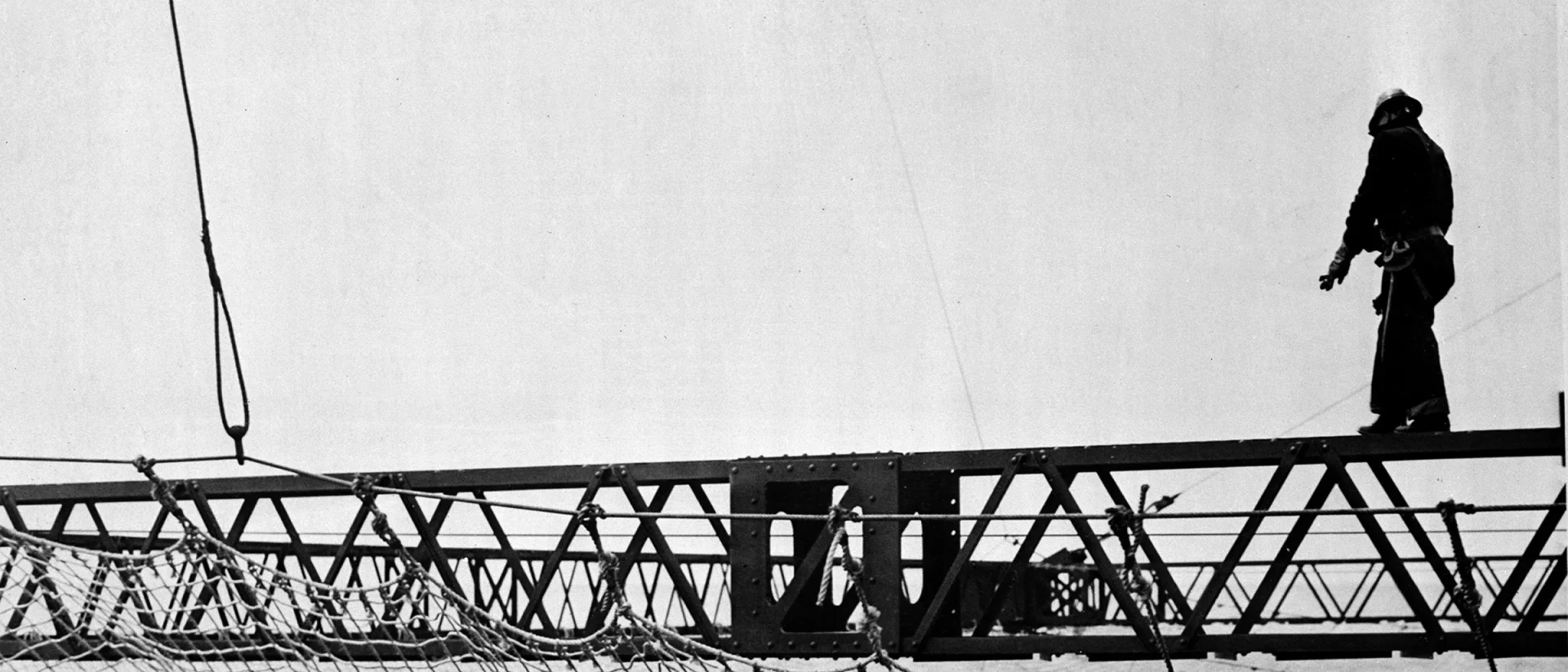
Strauss spent $130,000 - an enormous sum during the Great Depression - on a custom safety net strung below the entire length of the bridge deck. The net measured 3,000 feet long and 25 feet wide, made from half-inch manila rope in six-inch squares, suspended 15 feet below the roadway and extending 10 feet beyond each side. No bridge project had attempted anything on this scale before. Strauss also made the Golden Gate site the first construction project in America to require hard hats, partnering with a manufacturer to adapt mining helmets for bridge work.
The Club Nobody Wanted to Join
The net worked. As construction of the roadway progressed in 1936, workers fell - and the net caught them. Nineteen men survived falls that would have killed them on any other major bridge project of the era. While recovering at St. Luke's Hospital in San Francisco, the survivors gave themselves a name: the Half Way to Hell Club. The logic was simple: when a bridge worker fell to his death, coworkers said he had "gone to hell." The men in that net had only made it halfway. Ironworker Al Zampa, who fell in October 1936, became one of the club's best-known members and its unofficial spokesman.
The Day the Net Wasn't Enough
On February 17, 1937 - weeks before the bridge opened - a five-ton scaffold platform broke loose and punched through the net, dragging ten men to their deaths in the water 220 feet below. Two men survived. It was the single deadliest day of construction, and it brought the total death toll to 11 - still far below the 35 the old benchmark predicted.
A Blueprint for the Industry
The Golden Gate finished with 11 fatalities on a $35 million project. Strauss's safety net also proved itself in another way: workers moved faster knowing a net was there. As one ironworker put it: there was no doubt the work went faster because of the net. The 19 men who survived remembered it with a name that said everything: they had fallen halfway, and someone had the foresight to catch them.
Frequently Asked Questions
What was the Halfway to Hell Club at the Golden Gate Bridge?
How much did the Golden Gate Bridge safety net cost?
How many people died building the Golden Gate Bridge?
Who was Al Zampa?
Was the Golden Gate Bridge the first to use a construction safety net?
Verified Fact
Verified Jun 15, 2026 · 8 sources checked
Source: HISTORYShow verification details
Claims checked
- Safety net cost $130,000, saved 19 men
- Survivors formed the Halfway to Hell Club
- 11 workers died during construction
- Feb 17, 1937 scaffold collapse killed 10
- First US site to mandate hard hats
- Al Zampa fell in October 1936, was a charter member
Sources: History.com, PBS, Smithsonian Magazine, Wikipedia, goldengate.org, ABC7
Related Topics
More from Places & Culture
View all Places & Culture →