
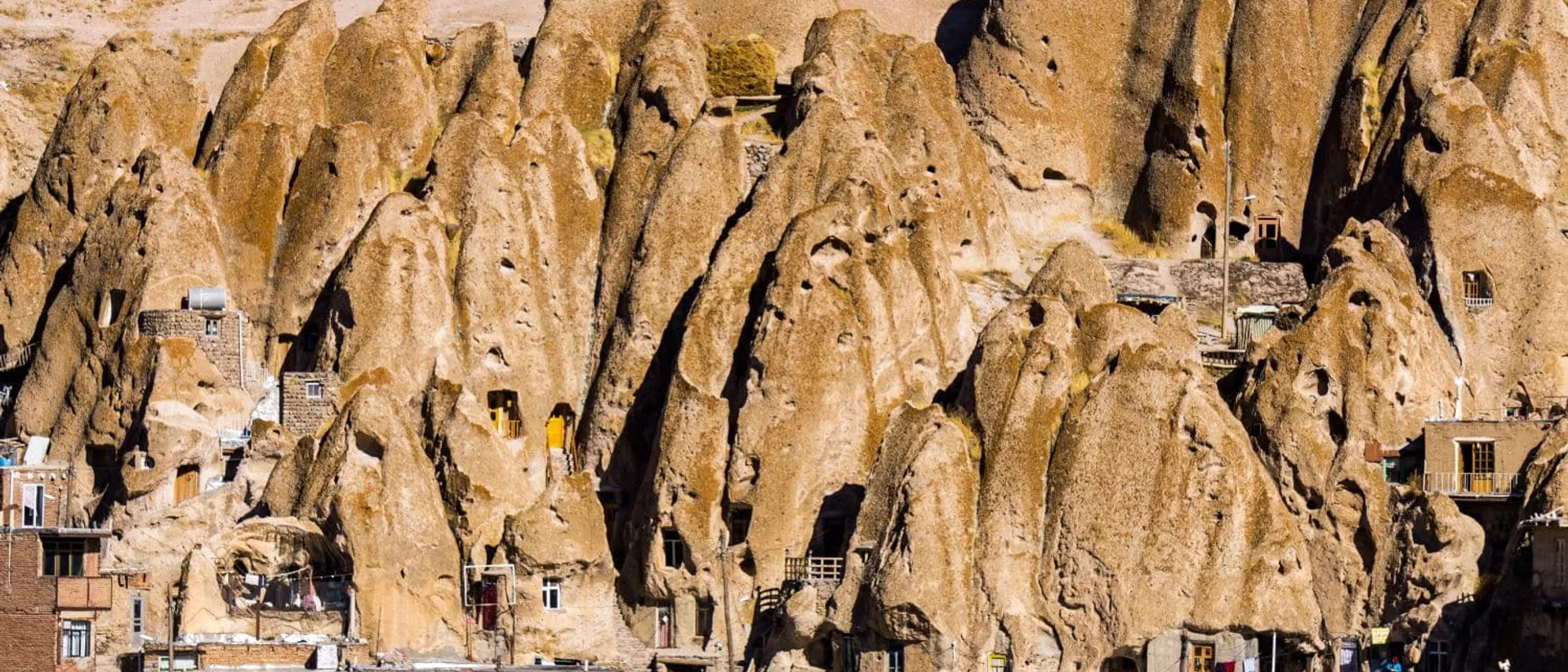
Kandovan’s cone-shaped homes are carved from volcanic rock—and people still live inside them.
Inside Iran’s 700-Year-Old Beehive Village
From a distance, Kandovan looks like a hillside of stone beehives. Up close, those "hives" have windows, doors, and stairways - because they're homes.
A Village Carved by Hand
Kandovan sits in northwestern Iran, about 60 kilometers southwest of Tabriz, on the flanks of Mount Sahand - a long-dormant volcano. The village's houses aren't built with bricks or timber. They're carved directly into cone-shaped formations of volcanic rock called "tuff," created by ancient eruptions that deposited layers of ash and lava over thousands of years. The name Kandovan likely comes from the Persian word kandoo, meaning beehive - a fitting description for the honeycomb-like clusters dotting the hillside.
Built to Last
Each rock cone rises as high as 40 meters and contains two to four stories. The ground floor traditionally housed livestock. The upper levels served as living quarters, kitchens, and guest rooms. The topmost level was used for food storage - keeping supplies cool and dry without refrigeration. Families expanded their homes by simply carving new rooms deeper into the rock as needed.
Why People Still Live There
These rock homes aren't just photogenic - they're practical. The thick volcanic stone stays cool in summer and warm in winter, a natural temperature control system that has worked for centuries. Today, roughly 800 residents still call Kandovan home, speaking Azerbaijani Turkish and living much as their ancestors did, though modern amenities like electricity and plumbing have been added.
Older Than You Think
Most sources date the village's current settlement to the 13th or 14th century, when Mongol invasions drove people into remote mountain areas for safety. The impenetrable volcanic formations made ideal shelters. But the broader region has been inhabited far longer - some estimates push the earliest use of these caves back to the 7th century.
The Only One Left
Kandovan is often compared to Cappadocia in Turkey, which has similar volcanic cone dwellings. But there's one critical difference: Cappadocia's cave homes are a tourist attraction. Kandovan's are still occupied. It's considered the only inhabited cliff-carved village of its kind in the world - a place where "ancient" doesn't mean "empty." It means "still home."
Enjoyed this? Get a new fact every morning.
A fascinating fact in your inbox every morning. Free. Unsubscribe anytime.
Frequently Asked Questions
Where is Kandovan?
Are the homes still inhabited?
Why are the homes cone-shaped?
Verified Fact
This fact has been reviewed and verified against original sources.
Source: WikipediaShow verification details
Sources checked: - Wikipedia (Kandovan, Osku) — describes the village’s still‑inhabited troglodyte homes carved into volcanic rock. - CNBCtv18 travel feature — describes 700+ year old cone-shaped homes still inhabited.
