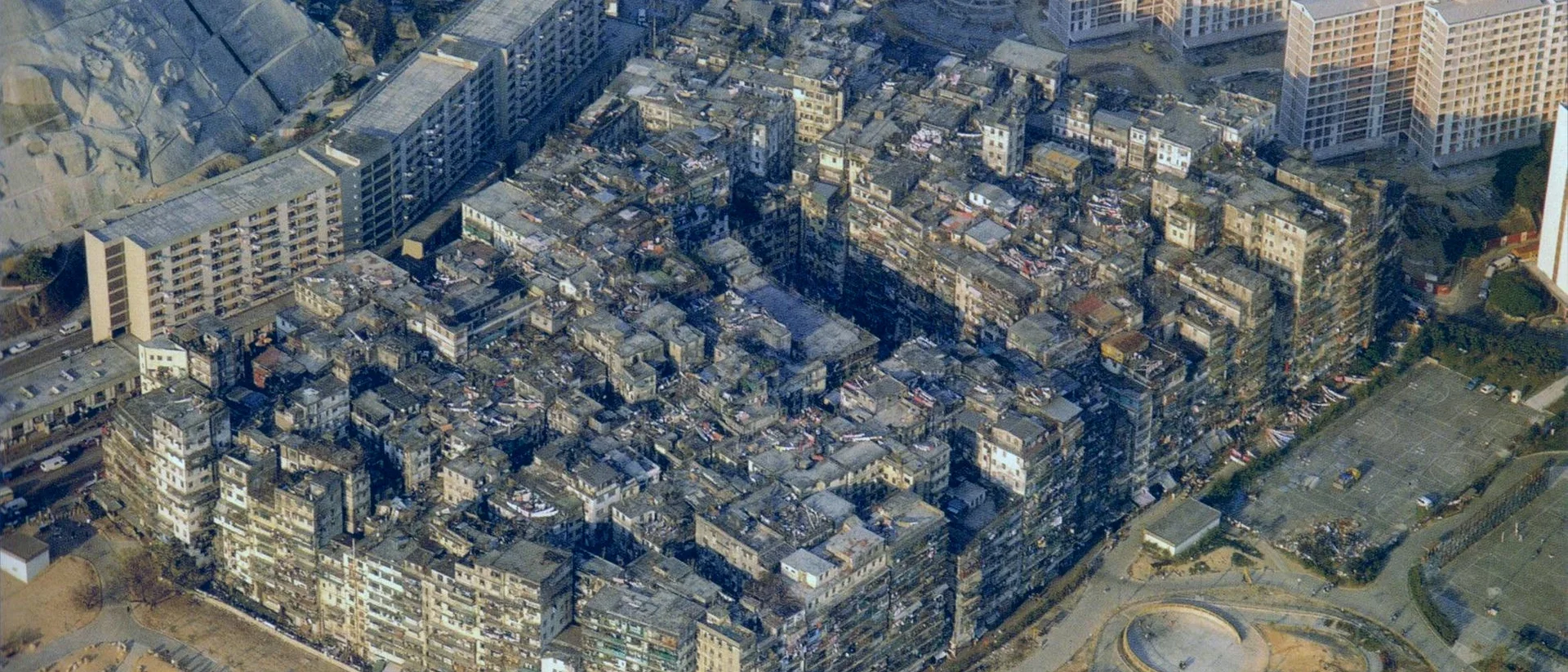
Kowloon Walled City crammed 33,000 people into just 6.4 acres - one city block. That made it the densest place in recorded human history. About 300 towers rose 14 storeys high, packed so close that sunlight never reached the alleys. Neither Britain nor China governed it, so residents built their own unlicensed economy. It was demolished in 1993-1994. The site is now a park.
The Most Crowded Place That Ever Existed
In Hong Kong, there was once a single city block that held more people per square kilometre than anywhere else in recorded human history. Kowloon Walled City was not a slum. It was not a refugee camp. It was a fully functioning community - with doctors, dentists, restaurants, factories, and schools - that happened to exist in total legal limbo for nearly five decades.
One Block, 33,000 People
The Walled City sat on just 2.6 hectares (6.4 acres) of land in the Kowloon district. At its peak in the late 1980s, an estimated 33,000 people lived there - a density of approximately 1.2 million people per square kilometre, or about three million per square mile. To put that in perspective: Manhattan today runs at around 27,000 people per square kilometre. Kowloon Walled City was roughly 45 times denser.
Why Nobody Was in Charge
The odd governance story began in 1898, when Britain leased the New Territories from China but specifically excluded the small military garrison at Kowloon from the lease. China nominally retained jurisdiction. Britain later claimed the area but adopted a hands-off policy. For decades, neither government actually policed or regulated it. This legal ambiguity meant no building codes, no licensing requirements, and no city planning. Residents and landlords simply built - upward, sideways, and inward - without architects or official approval.
300 Towers With No Sky
About 300 interconnected high-rises rose 10 to 14 storeys, capped in height only by their proximity to the runway at Kai Tak Airport. The buildings were so tightly packed that sunlight never reached the lower alleyways - the streets below were lit by bare bulbs around the clock. Residents navigated a dripping, lightless labyrinth of passages as narrow as one metre wide. The only open sky was above: the rooftops became playgrounds, laundry drying areas, and gathering spaces, with jets from Kai Tak thundering low overhead.
A Real Community
Despite the chaos, researchers who spent years documenting the Walled City found something unexpected: strong community bonds, affordable housing, and a quality of life that Western media rarely depicted. Unlicensed dentists and doctors operated openly, and their fees were far lower than regulated clinics outside. Food factories - making fish balls, noodles, and roasted meats - supplied restaurants across Hong Kong. Residents looked out for one another in ways that surprised every outside observer who spent real time there.
Demolished, Then Turned Into a Park
The Hong Kong and Chinese governments agreed to clear the site in 1987. Residents were relocated over several years with compensation packages. Demolition began on 23 March 1993 and was completed in April 1994. The cleared land became Kowloon Walled City Park, a traditional Chinese garden that opened in December 1995. Archaeologists uncovered the original Qing Dynasty fort walls during excavation, and these are preserved within the park today. A detailed Japanese cross-section illustration by Kazumi Terasawa's research team documents every stairway, water tank, and alley as they actually existed.
Frequently Asked Questions
How many people lived in Kowloon Walled City?
Why was Kowloon Walled City ungoverned?
When was Kowloon Walled City demolished?
What replaced Kowloon Walled City?
How big was Kowloon Walled City?
Verified Fact
Verified Jun 14, 2026 · 3 sources checked
Source: Wikipedia - Kowloon Walled CityShow verification details
Claims checked
- Population of 33,000 in the late 1980s
- Area of 6.4 acres, making it the densest place in recorded history
- About 300 towers up to 14 storeys, sunlight never reaching alleys
- Neither Britain nor China governed it, with a resident-run unlicensed economy
- Demolished 1993-1994, site is now a park
Sources: Wikipedia, documentary sources, web search corroboration
Related Topics
More from Places & Culture
View all Places & Culture →