Miners in Mexico found a hidden cave in 2000 with the largest crystals on Earth. The crystals were white gypsum beams up to 37 feet long and 3 feet wide. The heat inside hit 136 degrees with near-total humidity. Without a cooling suit, a person can die within about 10 minutes. In 2015, the mine flooded and sealed the cave shut.
The Crystal Cave That Sealed Itself From the World
A thousand feet below the Chihuahuan Desert in northern Mexico, two miners broke through into a chamber in April 2000 that no one had ever seen - and that, in geological terms, no one may ever see again.
A Room That Shouldn't Exist
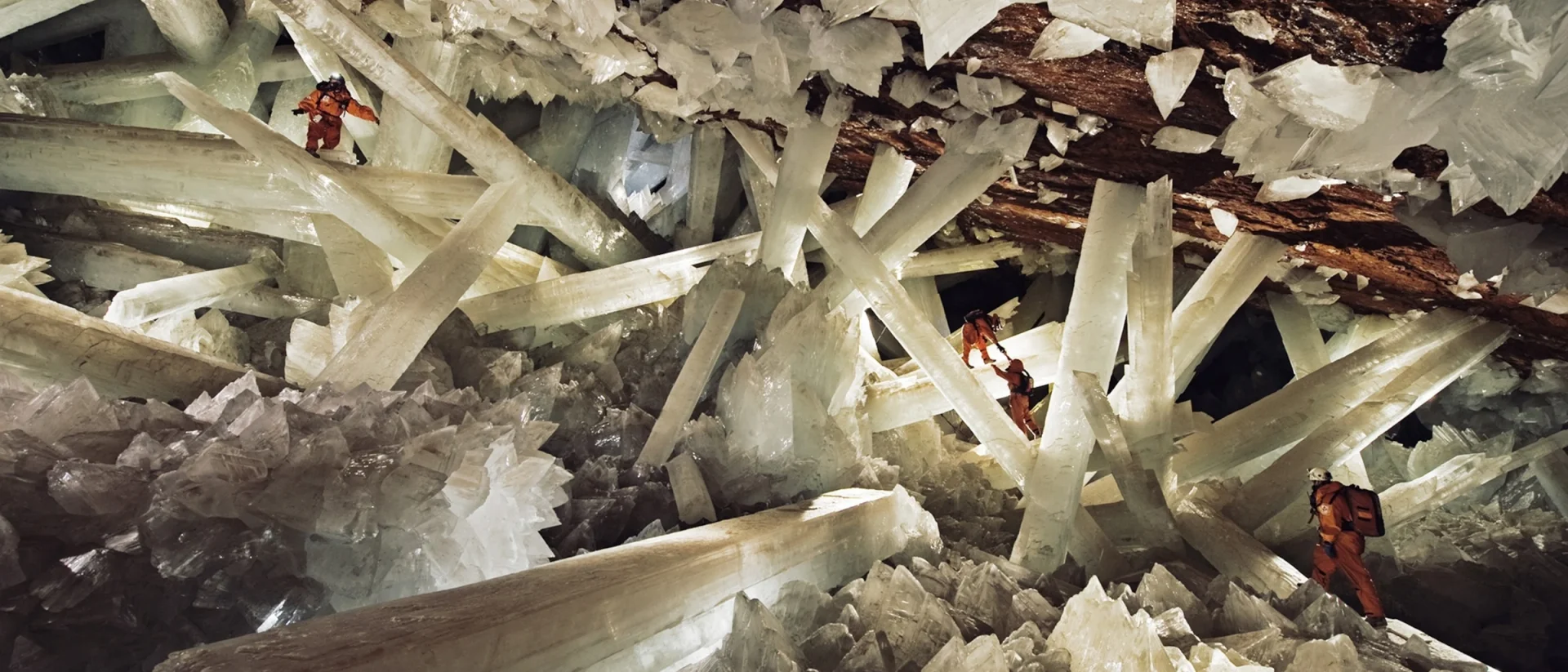
Juan and Pedro Sanchez were excavating a new tunnel for the Industrias Penoles mining company near Naica, Chihuahua, when their drill punched into empty space. The brothers climbed through and found themselves standing among the largest natural crystals ever discovered: translucent white selenite beams up to 37 feet (11.4 meters) long and about 3 feet (1 meter) wide. The cave itself stretched about 90 feet long and 30 feet wide - roughly the size of a basketball court - but every surface was buried under interlocking crystal columns. Geologist Juan Manuel Garcia-Ruiz of Spain's National Research Council later called it "the Sistine Chapel of crystals."
Why You Can't Just Walk In
The cave sits deep inside Naica Mountain, where volcanic heat has kept the rock at a constant 136 degrees Fahrenheit (58 degrees Celsius) for millions of years. The air carries 90 to 99 percent humidity. This combination creates a "wet heat" that blocks the human body's ability to cool itself through sweating. Without a refrigerated suit, a person would suffer fatal hyperthermia in under 10 minutes. Even scientists wearing ice-packed cooling suits could only stay inside for roughly 20 to 30 minutes per visit before the risk became critical.
A Million Years in the Making
The crystals took approximately 1 million years to grow to their current size. The process required mineral-rich groundwater held at a near-constant temperature just below 58 degrees Celsius for hundreds of thousands of years - the exact point where the mineral anhydrite dissolves and deposits as gypsum crystal. A fraction of a degree too warm or too cold, and the crystals would have stopped. The Naica mine had already found a smaller version of this cave - the Cave of Swords - in 1910 at a shallower depth, with crystals up to about 8 feet long. Nobody suspected a far larger chamber existed a thousand feet further down.
Sealed in 2015
For 15 years, scientists from Spain, the US, Italy, and Norway made carefully timed visits. They mapped the cave, dated the crystals, and sampled the mineral water. Researchers also reported finding dormant microbes that appeared to have been sealed inside the crystal lattice for tens of thousands of years. Then in October 2015, the mining company ceased pumping operations. The cave flooded completely within weeks. The crystals are once again submerged in the hot mineral water that built them. No pumping operation is currently planned, and many scientists argue the cave should stay sealed - allowing the crystals to grow again, slowly, in the dark.
Frequently Asked Questions
Where is the Naica Cave of Crystals?
Why can people not visit the Naica Crystal Cave?
How big are the crystals in the Naica Cave?
Who discovered the Naica Crystal Cave?
Will the Naica Cave of Crystals ever reopen?
Verified Fact
Verified Aug 26, 2026 · 5 sources checked
Source: Wikipedia / Cave of the CrystalsShow verification details
Claims checked
- Largest crystals on Earth found in Mexico
- Gypsum beams up to 37 feet long, about 3 feet wide (width corrected from 4 feet)
- Heat of 136°F and near-total humidity
- Unprotected exposure can be fatal within about 10 minutes
- Cave flooded and sealed in October 2015
Sources: Wikipedia, National Geographic, Live Science, Chemical & Engineering News