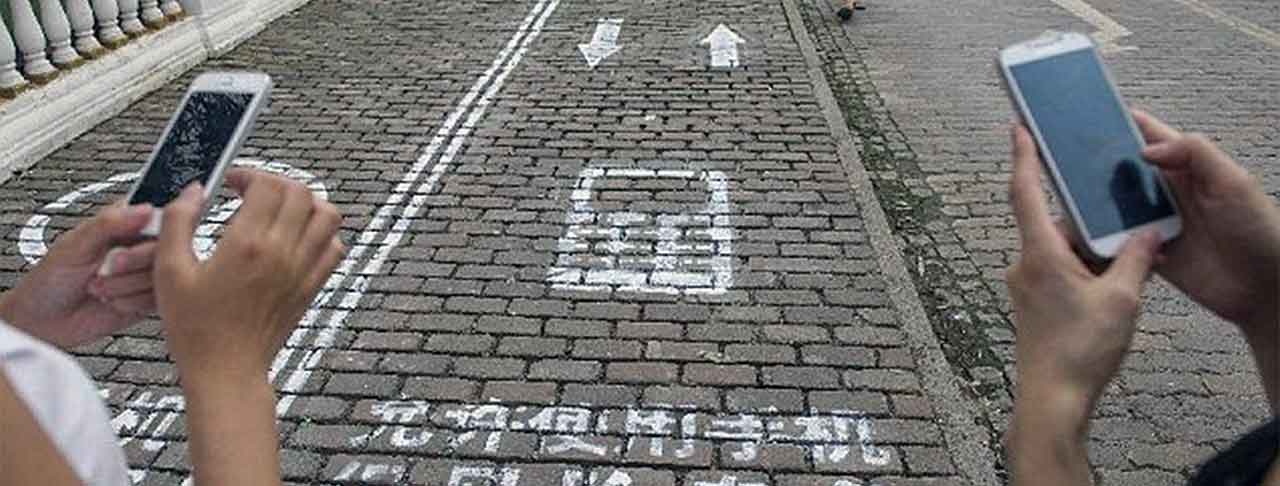
The Chinese city of Chongqing created a 50-meter dedicated pavement lane for mobile phone users in 2014—though it was meant as a satirical reminder of the dangers of texting while walking, not serious infrastructure.
Chongqing's Satirical Phone Lane for Distracted Walkers
Picture a sidewalk split down the middle: one lane marked with a phone icon and the warning "walk at your own risk," the other declaring "no cell phones." In September 2014, this became reality on a street in Chongqing, China—though not for the reasons you might think.
The 50-meter stretch appeared on Yangren Jie, or "Foreigner Street," a quirky tourist district known for its Western-style architecture and offbeat attractions. The area's property management company, Meixin Group, painted the lanes as satire, not a serious solution.
A Joke Nobody Got
"There are lots of elderly people and children in our street, and walking with your cellphone may cause unnecessary collisions here," explained Nong Cheng, a Meixin marketing official. The tongue-in-cheek message was clear: if you need a dedicated lane just to walk and text, maybe put the phone down.
The irony was immediate and beautiful. Pedestrians did stop at the lanes—not to use them properly, but to take photos of the signs. The very people the lanes were mocking became too distracted photographing the joke to watch where they were going.
Not Actually First
Despite headlines claiming Chongqing pioneered the concept, National Geographic beat them to it. Two months earlier, in July 2014, the TV network created identical phone lanes on a Washington D.C. sidewalk as a behavioral experiment. Chongqing openly admitted the American stunt inspired their version.
The concept has since popped up elsewhere:
- Antwerp, Belgium – A mobile repair shop installed "Text Walking Lanes" (with obvious self-interest in broken phones)
- Philadelphia, USA – Created an "E-lane" as an April Fools' prank
- Britain – In 2008, some cities wrapped lamp posts in padding to protect distracted texters
The Real Problem
China's smartphone addiction is no joke. A 2014 survey of 10,000 white-collar workers found 80% admitted to "severe addiction" to their phones. The phenomenon even has a name in Chinese: dī tóu zú, meaning "head-down tribe."
University at Buffalo research from that same year found something alarming: injuries from distracted walking actually outnumbered those from distracted driving. People have walked into fountains, fallen off piers, and stepped into traffic—all while staring at screens.
Lasting Legacy
Chongqing's phone lane quietly faded, but the problem it mocked has only intensified. Cities worldwide now experiment with ground-level traffic signals for "smartphone zombies" who never look up. Some crosswalks in Germany, the Netherlands, and South Korea embed LED lights in the pavement.
The irony of needing infrastructure changes because people won't stop scrolling isn't lost on urban planners. But as one Chongqing resident put it when asked about the phone lane: "Those using their cellphones of course have not heeded the markings. They don't notice them."
Which, of course, was the whole point.
Frequently Asked Questions
Did Chongqing really have a phone lane for pedestrians?
Was China the first to create a phone lane?
Did the Chongqing phone lane actually work?
Why do cities create phone lanes for pedestrians?
What is 'head-down tribe' in China?
Verified Fact
This fact has been reviewed and verified against original sources.
Show verification details
Corrected 'world's first' claim - Washington D.C. created a similar phone lane two months earlier (July 2014) as a National Geographic experiment. Chongqing's version (September 2014) was inspired by the D.C. experiment.