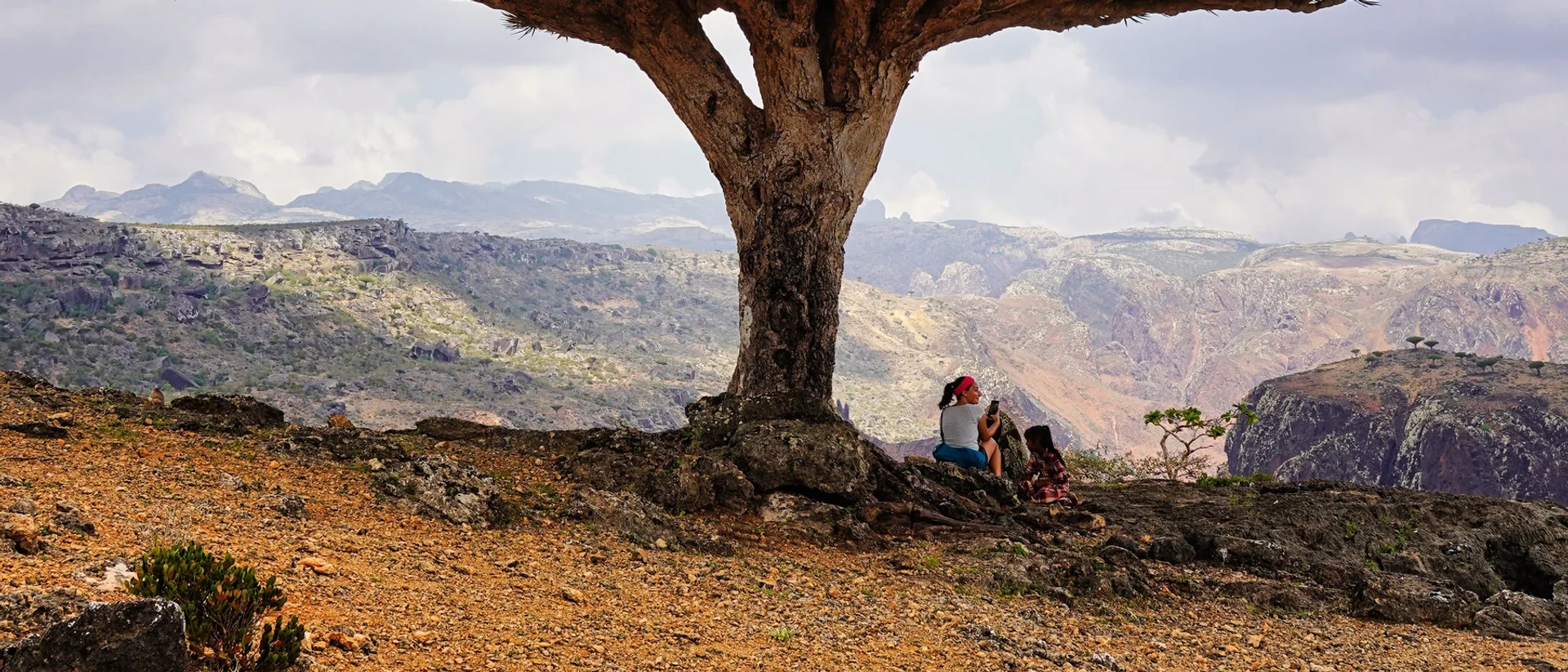
There is a real island in the Arabian Sea that looks like another planet. Socotra split from the supercontinent Gondwana about 20 million years ago and drifted into isolation, so its life evolved on its own. Of its 825 plant species, around a third grow nowhere else on Earth - including the dragon blood tree, whose mushroom-shaped canopy bleeds red resin. National Geographic calls it the Galapagos of the Indian Ocean.
Socotra: The Island That Looks Like Another Planet
There is a real island in the Arabian Sea that looks like the set of a science-fiction film. Its trees hold mushroom-shaped canopies above the sand. Others bulge at the trunk like giant water balloons. One bleeds red. Socotra is not CGI - it is one of the most isolated scraps of land on the planet, and isolation is exactly why it looks so strange.
Torn from a Supercontinent
About 20 million years ago, the landmass that would become Socotra split from the ancient supercontinent of Gondwana as the Gulf of Aden began to open. The island drifted into the Arabian Sea and the seas closed around it. With no land bridge back to Africa or Arabia, its plants and animals were left to evolve entirely on their own. The result is a place that National Geographic has called the "Galapagos of the Indian Ocean" - a living laboratory of evolution, frozen in its own time.
A Third of Its Plants Grow Nowhere Else
Socotra has 825 vascular plant species. Roughly 37 percent of them - around 307 species - are endemic, meaning they exist on these islands and nowhere else on Earth. The rates are even more extreme for animals: 90 percent of reptiles and 95 percent of land snails on the island are found nowhere else. Endemism at this scale - across plants, reptiles, and molluscs simultaneously - is extraordinarily rare and places Socotra among the most ecologically isolated places on the planet.
The Tree That Bleeds Red
The most famous resident is the dragon's blood tree (Dracaena cinnabari). Its dense, flat canopy spreads wide like an inside-out umbrella - an adaptation that funnels sea mist down to its shallow roots. When the bark is cut, the tree oozes a deep crimson resin. Ancient Romans, Greeks, and Egyptians all traded for this red sap. They used it as medicine, as dye, to varnish wood and colour pottery, and even as theatrical stage blood. Today the resin still appears in natural cosmetics and art restoration products. The dragon's blood tree is increasingly rare, threatened by overgrazing goats that eat the seedlings before they mature.
Other Oddities: Cucumber Trees and Desert Roses
The dragon's blood tree has equally strange neighbours. The cucumber tree (Dendrosicyos socotranus) is the only tree in the entire cucumber family - a squat, swollen trunk topped by sparse branches, looking more like a cartoon than a plant. The desert rose (Adenium obesum) inflates its lower trunk into a fat bulb to store water, then erupts in pink flowers. Both exist only on Socotra. The island also hosts frankincense-producing Boswellia trees and six bird species found nowhere else.
UNESCO Recognition and Growing Threats
UNESCO designated the Socotra Archipelago a World Heritage Site in 2008, covering about 75 percent of the landmass. The listing recognised the island's biodiversity as globally significant. But Socotra faces serious pressure. Cyclones, once rare, have hit the island repeatedly in recent years - they strip the thin soil and knock over old trees. Yemen's civil conflict has blocked conservation funding and kept many scientists away. The creatures that took 20 million years to evolve are running out of time.
Frequently Asked Questions
Why does Socotra look so alien?
What is the dragon's blood tree?
Is Socotra a UNESCO World Heritage Site?
Where is Socotra and which country does it belong to?
Is Socotra under threat?
Verified Fact
Verified Jun 15, 2026 · 4 sources checked
Source: View sourceShow verification details
Claims checked
- 825 plant species on Socotra, about 37 percent endemic
- Socotra has extraordinary endemism across multiple species groups
- About 20 million years since breaking from Gondwana
- Called the Galapagos of the Indian Ocean by National Geographic
- UNESCO recognized the island in 2008, covering about 75 percent of its landmass
Sources: National Geographic, Wikipedia, Royal Botanic Garden Edinburgh, UNEP/UNESCO
Related Topics
More from Places & Culture
View all Places & Culture →