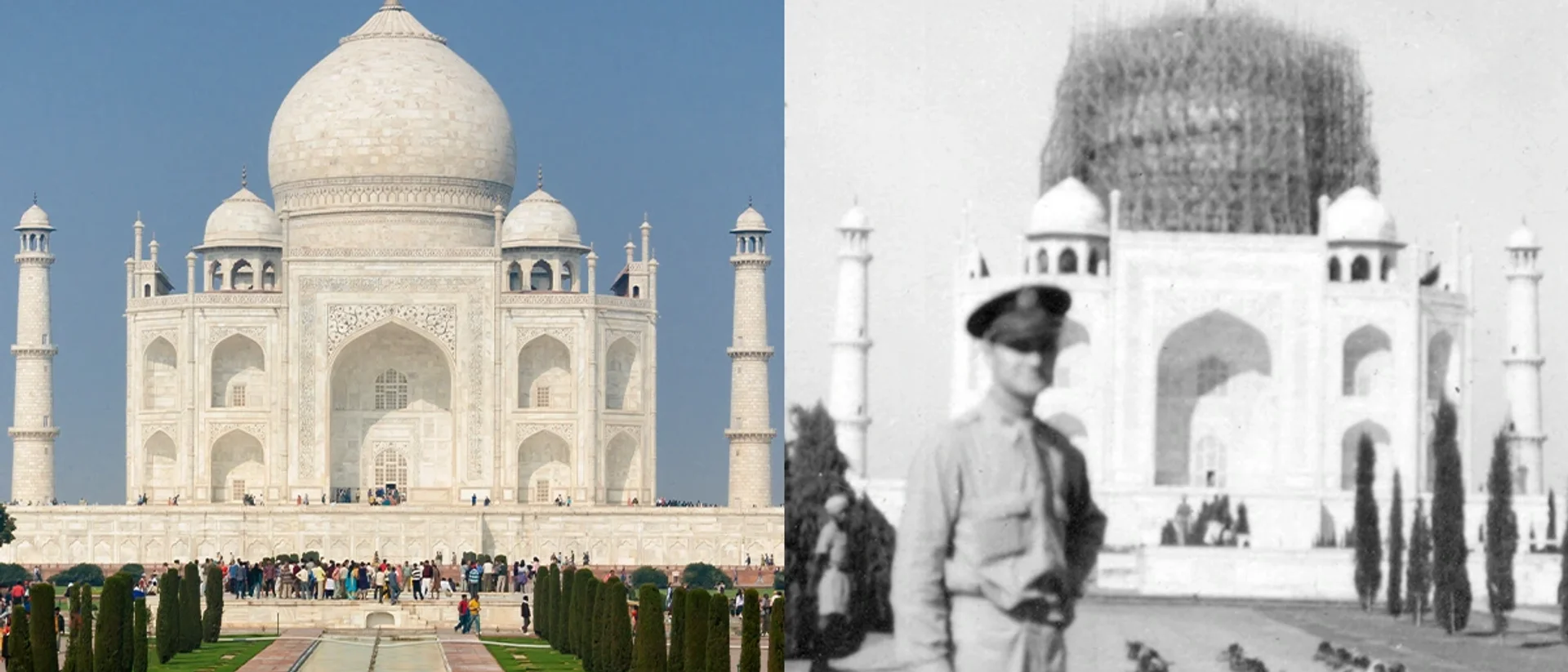
The Taj Mahal was disguised three times to protect it from bombers. In 1942, British engineers wrapped the dome in bamboo scaffolding. Without GPS, it looked like a building site from the air. India used the same trick in 1965 and 1971. In 1971, over 18,000 lbs of green jute were draped over the marble. Not one bomb ever fell.
The Taj Mahal Was Hidden From Bombers - Three Times
The Taj Mahal is one of the most recognizable buildings on Earth. Its white marble dome and four minarets are visible for miles - and at night the marble reflects moonlight like a lantern. In wartime, that made it a target. So authorities did something extraordinary: they made it disappear.
The 1942 Bamboo Plan
In 1942, with Japanese forces advancing through Burma and Germany bombing Allied targets across Asia, British military engineer James Fletcher Watson was handed an unusual assignment. He devised a plan to cover the Taj Mahal's dome in bamboo scaffolding - thousands of poles lashed into a structure so dense that from altitude, the famous silhouette vanished beneath what looked like a pile of building material. At the time, enemy aircraft relied entirely on visual navigation. Without GPS or radar mapping, pilots could only identify targets by sight. The disguise worked. Photographs from that year show Allied officers - including diplomats from the United States and China - standing before the partially covered dome. The Indian government later banned photographers from returning to document the finished covering.
Hidden Again: 1965 and 1971
The camouflage was repeated when war returned. During the 1965 Indo-Pakistani War, the monument was covered once more. Then in December 1971, Pakistani aircraft struck the airbase at Agra - just miles from the Taj. Within 24 hours, the Archaeological Survey of India began draping the entire structure in green jute tarpaulins weighing over 18,000 lbs. Workers used nearly 600 kg of nails and 63 heavy sewing needles to secure the covers. Foliage was placed across the minarets, and sand was scattered over the marble floors to eliminate any reflection. For 15 days, the Taj Mahal vanished from the sky.
Why It Was Worth Hiding
The white marble dome is not just beautiful - it is a navigational beacon. Indian intelligence in 1971 reportedly learned that Pakistani military planners had identified the Taj Mahal as a target partly because tourism made it a major source of hard currency for India. The decision to disguise it rather than defend it with force proved correct in every conflict. Not one bomb ever fell on the monument.
A Monument That Has Survived Everything
Built between 1632 and 1653, the Taj Mahal has outlasted sieges, colonial rule, and three wartime disguises. Each time the scaffolding came down, the marble re-emerged unmarked. The 1942 photographs - among the strangest images in the monument's history - show one of the world's greatest buildings reduced to an anonymous heap of bamboo by necessity. No image of the fully completed covering was ever publicly released.
Frequently Asked Questions
Was the Taj Mahal ever bombed or damaged in wartime?
How was the Taj Mahal hidden during World War II?
How was the Taj Mahal camouflaged during the 1971 war?
Why was the Taj Mahal a military target?
Who designed the WWII camouflage for the Taj Mahal?
Verified Fact
Verified Jun 21, 2026 · 6 sources checked
Source: Outlook TravellerShow verification details
Claims checked
- Three disguisings 1942/1965/1971
- 1942 bamboo scaffolding by British engineers
- James Fletcher Watson as 1942 engineer
- 18,000+ lbs green jute (18,700 lbs / 8,482 kg)
- 598 kg nails / nearly 600 kg
- 63 sewing needles
- 15 days covered
- Pakistani aircraft struck Kheria Airbase Agra Dec 3 1971
- ASI launched within 24 hours (engagement comment)
- Tourism/hard currency targeting reason
- Not one bomb fell
- Photo ban / no image of completed covering released
- Diplomatic figures photographed 1942
- Article says diplomats from US and China