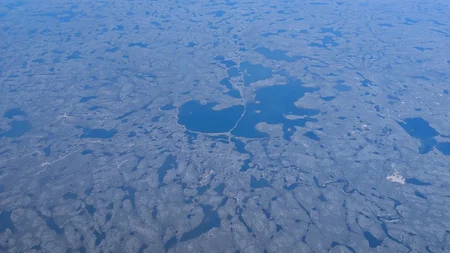
There's a lake under Antarctica that is 15-25 million years old called Lake Vostok.
The Ancient Lake Trapped Beneath Antarctica's Ice
Imagine a lake the size of Lake Ontario, completely cut off from sunlight, air, and the outside world for millions of years. That's Lake Vostok, Antarctica's largest subglacial lake and one of the most extreme environments on Earth.
Buried beneath 2.5 miles of ice, this ancient body of water has remained sealed from the atmosphere for an estimated 15-25 million years. The pressure from the ice above keeps the water liquid despite temperatures around -3°C (27°F). It's essentially a time capsule from before humans existed.
A Lake Nobody Knew Existed
Russian scientists first suspected something was beneath their Vostok research station in the 1960s, but it wasn't until 1996 that the lake's full extent was confirmed using radar and satellite imagery. The discovery was staggering: a freshwater lake roughly 160 miles long and 30 miles wide, containing about 1,300 cubic miles of water.
The Vostok station sits directly above the lake and holds the record for the coldest naturally occurring temperature ever recorded on Earth: -89.2°C (-128.6°F).
What's Living Down There?
This is where things get fascinating. In 2012, Russian scientists drilled through the ice sheet and reached the lake's surface. Analysis of refrozen lake water found in the borehole revealed:
- DNA from thousands of bacterial species
- Sequences suggesting fungi and multicellular organisms
- Possible thermophiles (heat-loving microbes) that shouldn't exist in such cold water
The findings remain controversial. Some researchers argue the samples were contaminated by drilling fluid. Others believe the lake could harbor an entirely unique ecosystem, isolated from all other life on Earth for millions of years.
Why Scientists Are So Excited
Lake Vostok isn't just interesting because it's old and hidden. It's a practice run for space exploration. Jupiter's moon Europa and Saturn's moon Enceladus both have liquid water oceans beneath icy shells. If life can survive in Lake Vostok's pitch-black, high-pressure, nutrient-poor environment, it increases the odds that life could exist on those moons.
The lake also contains a unique record of Earth's climate history. Gas bubbles trapped in the ice above the lake provide data on atmospheric conditions going back hundreds of thousands of years.
The Debate Continues
Accessing Lake Vostok without contaminating it is extraordinarily difficult. The Russian drilling project faced international criticism over concerns that kerosene-based drilling fluid could pollute this pristine environment. Future expeditions aim to use cleaner methods, but for now, the lake's deepest secrets remain just out of reach.
Somewhere beneath the ice, in total darkness, Lake Vostok waits—holding clues about life's resilience that we're only beginning to understand.
Frequently Asked Questions
How old is Lake Vostok?
How deep is Lake Vostok buried under ice?
Is there life in Lake Vostok?
How big is Lake Vostok compared to other lakes?
Why is Lake Vostok important for space exploration?
Verified Fact
This fact has been reviewed and verified against original sources.
Show verification details
Age estimate corrected from 25 million to 15-25 million years (the range used in scientific literature). Core claim is accurate.