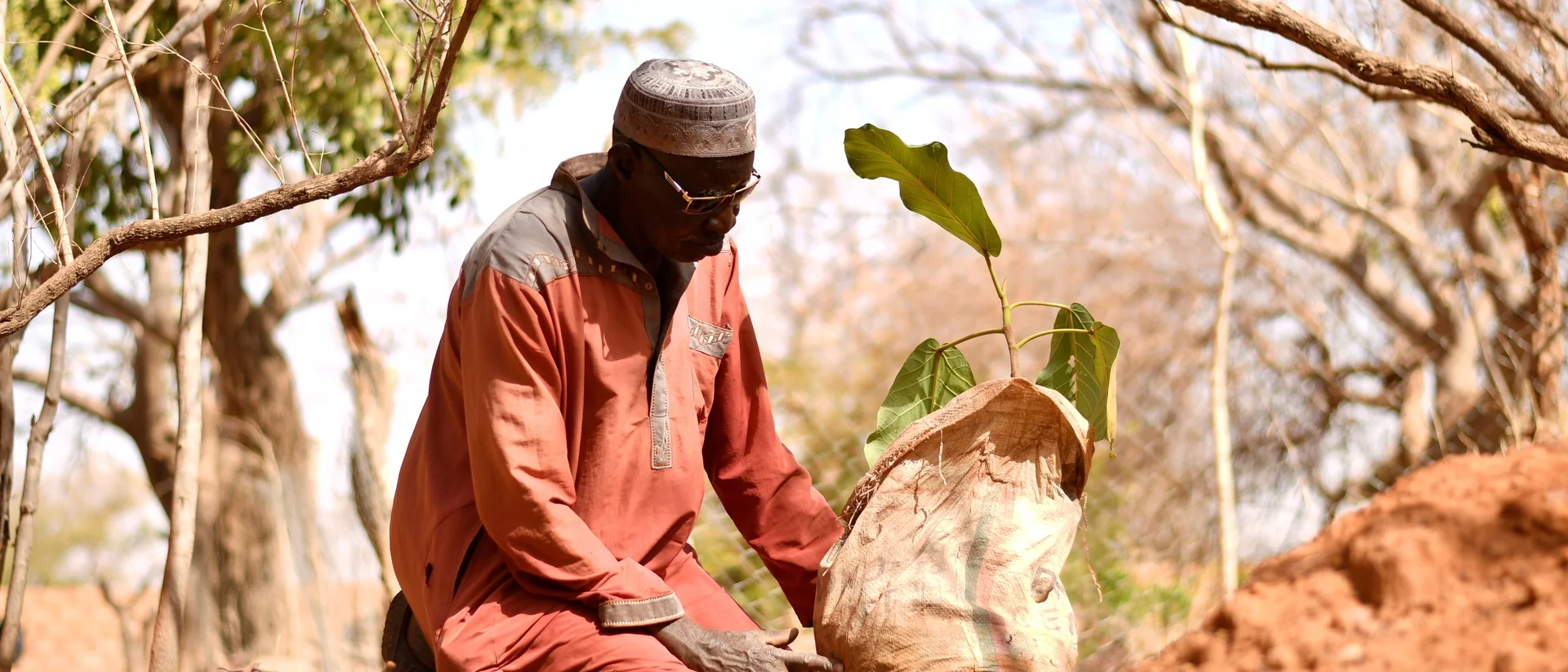
Yacouba Sawadogo was a farmer in Burkina Faso who fought the desert with holes. He spent four decades digging zaï pits by hand. Each pit was packed with compost to capture rainfall and feed the soil below. Cracked, barren land became a living forest of nearly 40 hectares with more than 60 species. He won the Right Livelihood Award - the Alternative Nobel - in 2018.
The Farmer Who Turned the Desert Into a Forest
When the rains stopped coming to northern Burkina Faso in the early 1980s, the land turned to dust and farmers abandoned their fields. One man picked up a digging tool and decided to fight back - not with machinery or aid money, but with holes.
A Technique Older Than Plows
The technique Yacouba Sawadogo revived is called zaï: small planting pits dug into the baked earth, spaced at intervals, then filled with compost and organic waste. The pits capture rare rainfall before it runs off, and concentrate nutrients exactly where seeds need them. Sawadogo improved on the traditional method by enlarging the holes and mixing in manure, which attracted termites. The termites tunneled deeper into the soil, breaking up the hardened crust and letting roots push through ground that had been sealed shut for years.
He also built stone bunds across slopes to slow runoff, and organised twice-yearly market days at his farm from 1984, where farmers from more than a hundred villages came to swap seeds, share techniques, and learn from his land firsthand.
One Farm Becomes a Forest
Starting around 1980, Sawadogo worked land near Ouahigouya in Burkina Faso's Sahel region. Neighbours and officials mocked him for planting trees on ground they called worthless. He kept digging. Over four decades, the barren, cracked earth became a living forest of nearly 40 hectares, holding more than 60 species of trees and shrubs - one of the most diverse farmer-planted forests in the entire Sahel.
The water table beneath his farm rose by an average of about 5 metres between the mid-1980s and 2009, and by as much as 17 metres in some areas, as measured in the surrounding wells.
The Idea That Spread Across the Sahel
What began as one farmer's stubbornness became a regional movement. In 1989, farmers from Niger's Tahoua region visited Sawadogo's fields and returned home to restore their own land using zaï. By 2016 the use of zaï and related techniques had helped restore the productive capacity of tens of thousands of hectares of degraded land in Burkina Faso and Niger alone.
A 2010 documentary, The Man Who Stopped the Desert, brought his story to international audiences. He was named a UN Convention to Combat Desertification Global Dryland Champion in 2013, won the UN Champions of the Earth award in 2020, and received the Right Livelihood Award in 2018 - often called the "Alternative Nobel" - for "turning barren land into forest and demonstrating how farmers can regenerate their soil with innovative use of indigenous and local knowledge."
He Kept Digging Until the End
Yacouba Sawadogo died on 3 December 2023 at the age of 77. He had never stopped farming his forest and training visitors. The desert did not come back.
Frequently Asked Questions
What is the zaï technique that Yacouba Sawadogo used?
How large was the forest Yacouba Sawadogo created?
What awards did Yacouba Sawadogo receive?
How did Yacouba Sawadogo's method spread across the Sahel?
When did Yacouba Sawadogo die?
Verified Fact
Verified Jun 23, 2026 · 4 sources checked
Source: Right Livelihood FoundationShow verification details
Claims checked
- Built a nearly 40-hectare forest from barren land using zaï pits
- Zaï pits capture rainfall, not slow it (earlier wording corrected)
- Won the Right Livelihood Award in 2018
- Restored tens of thousands of hectares in Burkina Faso and Niger
- Forest contains more than 60 species of trees and bushes
Sources: Right Livelihood Foundation, Wikipedia, BRACED, kiddle.co
Related Topics
More from Places & Culture
View all Places & Culture →