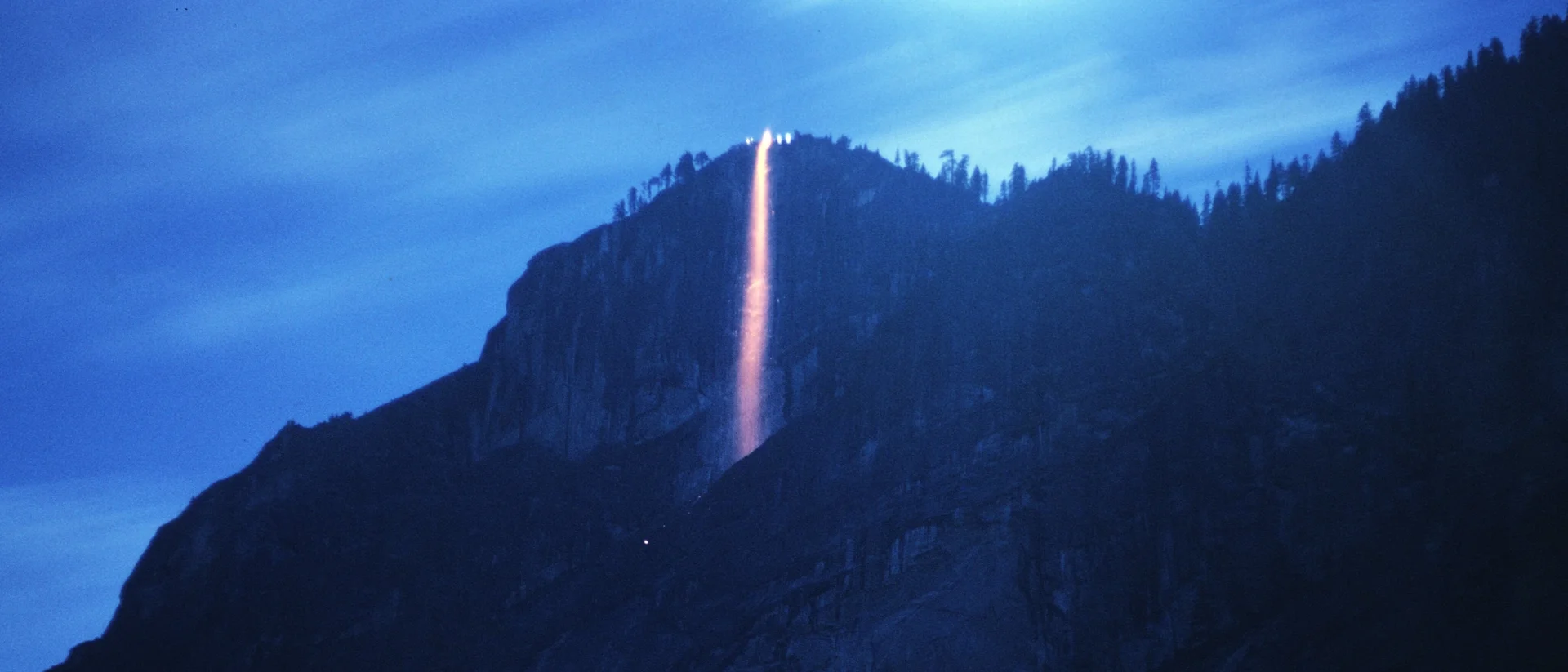
Yosemite ran a real fire waterfall for nearly a century. On summer nights, workers built a bonfire of red fir bark at the edge of Glacier Point. At 9pm, a caller shouted, "Let the Fire Fall!" Workers then pushed the embers off the cliff in a 3,000-foot cascade of flame. The Park Service banned it in 1968, calling it "as appropriate as horns on a rabbit."
For Nearly 100 Years, Yosemite Set a Cliff on Fire
Every summer night for nearly a century, Yosemite National Park set one of its own cliffs on fire. Not a wildfire. Not a lightning strike. A planned, nightly show, built and pushed off the edge by park employees, while thousands of tourists watched from the meadow floor.
A Bonfire Built to Be Pushed Off a Cliff
The tradition began informally in 1872, when innkeeper James McCauley started burning bonfires at Glacier Point, a granite outcrop towering above Yosemite Valley.
By the early 1900s, Camp Curry founder David Curry had turned it into a nightly summer ritual.
Workers gathered huge stacks of red fir bark, hauled it to the edge of Glacier Point, and lit it each evening.
The fire burned for hours until it collapsed into a deep bed of glowing coals.
"Let the Fire Fall"
At 9pm sharp, a host down in the valley would call up to the fire crew above.
Over the decades the exact wording changed, but by the mid-1900s it had settled into a simple exchange: "Is the fire ready?" "The fire is ready." "Let the fire fall."
On that command, workers used long metal rakes to shove the burning coals over the cliff edge.
The embers streamed 3,000 feet down the granite face in a glowing cascade that looked, from below, exactly like a waterfall made of fire.
Not Every Night, Not Always Running
The firefall was never a single, unbroken century-long show.
It stopped when the Glacier Point concession changed hands in the 1890s, paused again during World War II, and was revived each time public demand brought it back.
What stayed constant across the gaps was the basic idea: a man-made fire spectacle, performed for a paying audience, inside a national park built to protect nature untouched.
"Horns on a Rabbit"
By the 1960s, the crowds had become the problem.
Thousands of cars jammed Yosemite Valley's roads every summer evening, and visitors trampled the fragile meadows searching for a clear view of the cliff.
In 1968, National Park Service director George Hartzog ordered it stopped for good.
His reasoning became famous: a nightly bonfire pushed off a cliff, he said, was about as appropriate to a national park as "horns on a rabbit."
The last firefall fell on a quiet winter night, January 25, 1968, with almost no one watching.
The Firefall People See Today Is a Different Thing Entirely
Every February, photographers now flock to Yosemite for what's often called a "firefall."
That one is completely natural: for a few evenings each winter, the setting sun lines up with Horsetail Fall on El Capitan and turns the flowing water gold and orange, like liquid fire.
It requires no bonfire, no workers, and no cliff-edge rake.
It is easy to see the two events as the same tradition.
They are not.
One was sunlight hitting water.
The other was a real fire, built and shoved off a cliff by hand, every summer night, for the better part of a hundred years.
Frequently Asked Questions
What was the Yosemite Firefall?
Why did the National Park Service end the Yosemite Firefall?
What was the 'Let the Fire Fall' call?
Is the Yosemite Firefall the same as the Horsetail Fall firefall people see today?
When did the Yosemite Firefall run?
Verified Fact
Verified Jul 7, 2026 · 3 sources checked
Source: WikipediaShow verification details
Claims checked
- Firefall began informally in 1872 by James McCauley
- Red fir bark used as fuel
- Embers fell 3,000 feet from Glacier Point
- 9pm timing and call-and-response ritual
- Park Service banned it in 1968, calling it "as appropriate as horns on a rabbit"
Sources: Wikipedia, History.com, YouTube
Related Topics
More from Places & Culture
View all Places & Culture →