
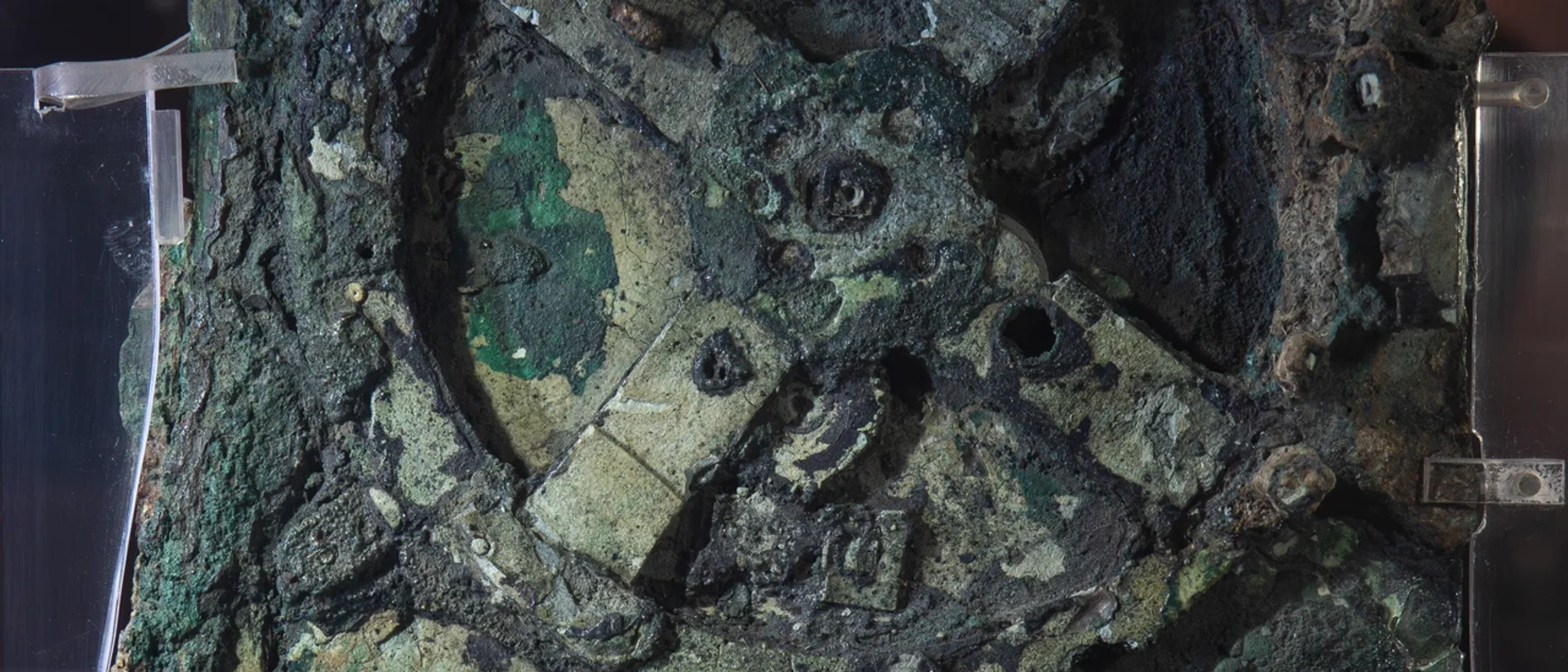
In 1901, sponge divers exploring a 2,000-year-old shipwreck off Greece hauled up a corroded lump of bronze. Decades of scanning revealed what it was: a mechanical computer of around 30 interlocking gears that tracked the Sun, Moon and planets and predicted eclipses. Nothing this complex appears again for more than a thousand years.
The 2,000-Year-Old Computer Found in a Shipwreck
When sponge divers hauled up a misshapen lump of corroded bronze from a Roman-era shipwreck in 1901, they had no idea they were holding the most sophisticated machine the ancient world ever built. The object sat in a Greek museum for decades before anyone truly grasped what it was.
The Shipwreck Off Antikythera
In 1900, a crew of Greek sponge divers took shelter from a storm near the tiny island of Antikythera, between Crete and the Greek mainland. Diving to pass the time, they found a wreck on the seabed - the remains of a large Roman cargo ship that had sunk around the first century B.C. The haul included bronze statues, glassware, and pottery. Among the fragments recovered in 1901 was a small, heavily corroded bronze object the size of a shoebox. Nobody knew what it was.
What the Scans Revealed
The object broke into three main pieces and dried out over decades in the Athens museum, its internal structure completely hidden under layers of corrosion. Early X-ray studies by Derek de Solla Price in the early 1970s hinted at an intricate arrangement of gears inside. Then in 2005, a team led by Mike Edmunds and Tony Freeth applied high-resolution CT scanning to the fragments, publishing their findings in 2006. The results were extraordinary. The scans revealed at least 30 surviving bronze gears with precisely cut triangular teeth - with the original mechanism estimated to have had 37 or more - a gear train complex enough to track the motions of the Sun, the Moon, and all five planets visible to the naked eye.
What It Actually Did
The mechanism was hand-cranked using a knob on its side. Turn it forward or backward and the gears moved hands across a circular dial on the front face, showing the current position of the Sun and Moon against the zodiac and a 365-day Egyptian calendar. A small ball on the front face rotated to show the current phase of the Moon. On the back were two spiral dials. One tracked a 19-year cycle linking the solar and lunar calendars - known as the Metonic cycle - using 235 months. The other predicted solar and lunar eclipses using the 223-month Saros cycle, a pattern first identified by Babylonian astronomers. Glyphs beside each eclipse slot recorded whether it was solar or lunar, and what time of day to expect it.
Nothing Like It for a Thousand Years
The CT scans also uncovered hidden inscriptions - an instruction manual in ancient Greek engraved on the inner surfaces of the case. Scholars working on the text found references to Rhodes, suggesting the device was probably built there. The ship carrying it sank around 60-70 B.C., though the mechanism itself was likely manufactured earlier - estimates range from roughly 87 B.C. to as early as 150 B.C. Some researchers trace its mathematical foundations to the astronomer Hipparchus, who worked on Rhodes in the second century B.C. What makes the Antikythera mechanism so startling is not just its sophistication - it is the gap that follows it. No mechanism of comparable mechanical complexity appears anywhere in the historical record for more than a thousand years. The closest parallel is the astronomical clock, which did not emerge in Europe until the 14th century A.D.
Where It Is Today
The three surviving bronze fragments are on permanent display at the National Archaeological Museum in Athens. Researchers are still working to decode the full text of the inscriptions and settle remaining questions about its planetary display. In 2021, a team at University College London led by Professor Tony Freeth published a new model proposing how the front planetary dials may have been arranged - the debate is not entirely closed. What is beyond dispute is the conclusion forced by the evidence: someone in the ancient Mediterranean world built a mechanical computer two thousand years before anyone was supposed to know how.
Enjoyed this? Get a new fact every morning.
A fascinating fact in your inbox every morning. Free. Unsubscribe anytime.
Frequently Asked Questions
What is the Antikythera mechanism?
When and where was the Antikythera mechanism found?
How did scientists figure out what the Antikythera mechanism did?
Where is the Antikythera mechanism kept today?
Why is the Antikythera mechanism so significant?
Verified Fact
Verified Jun 15, 2026 · 6 sources checked
Source: View sourceShow verification details
Claims checked
- 2,000-year-old shipwreck off Greece yielded a bronze mechanical computer predicting eclipses
- Mechanism recovered in 1901; surviving gears number at least 30, original likely 37 or more
- CT scanning done in 2005, findings published 2006
- Device made circa 87-150 BC; ship sank circa 60-70 BC
- Tracks Metonic and Saros cycles, confirmed by 2021 UCL model
Sources: Smithsonian Magazine, Wikipedia, World History Encyclopedia, UCL Engineering, Interesting Engineering, Scientific Reports