
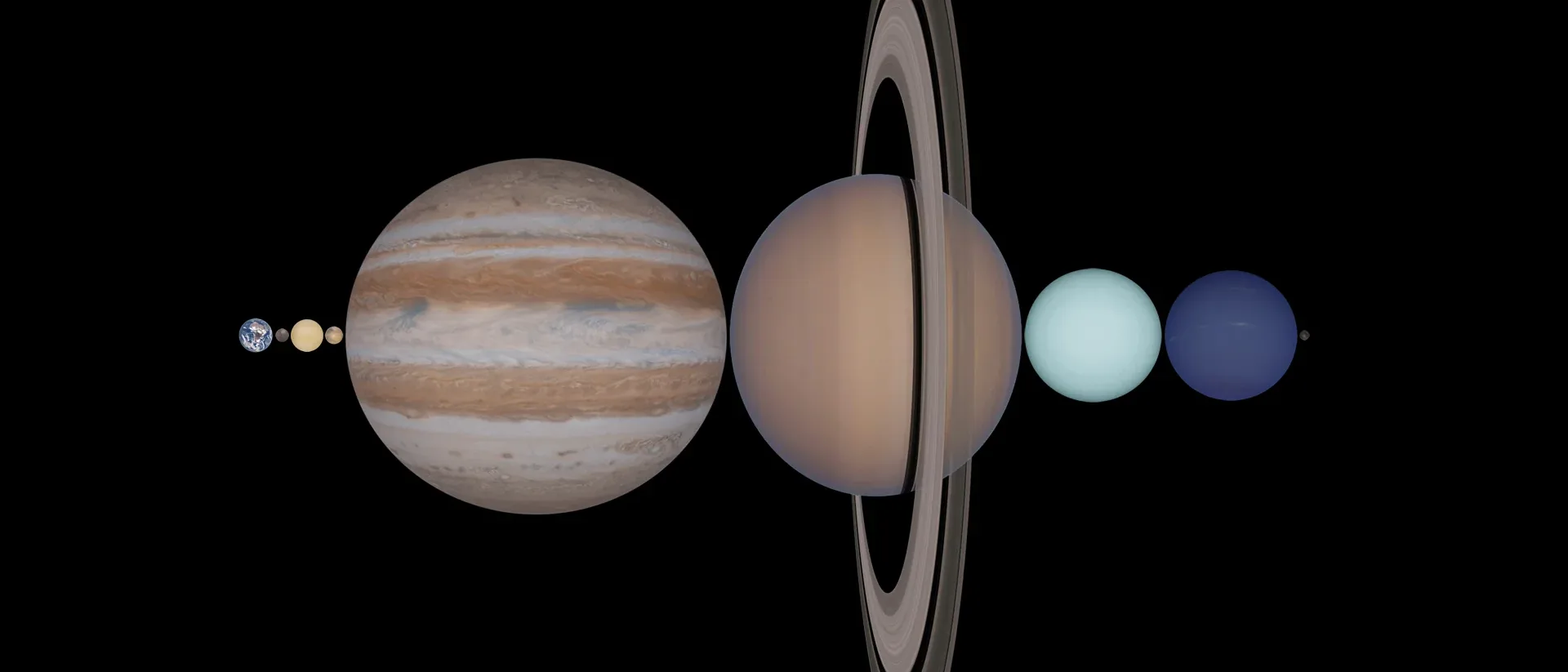
Every other planet in the solar system can fit between Earth and the Moon - with roughly 4,400 km to spare.
Every Planet in the Solar System Fits Between Earth and the Moon
Space is incomprehensibly vast, and yet one of the most mind-bending facts about our solar system involves a distance we can almost relate to: the gap between Earth and the Moon. At an average distance of about 384,400 kilometers, the Moon is our closest celestial neighbor. But what makes this distance truly astonishing is what you could fit inside it - every other planet in the solar system, lined up side by side.
The Numbers Behind the Claim
To understand how this works, you need to know the diameters of all seven other planets. Here they are, from smallest to largest:
Mercury: 4,879 km
Mars: 6,771 km
Venus: 12,104 km
Neptune: 49,244 km
Uranus: 50,724 km
Saturn: 116,464 km
Jupiter: 139,822 km
Add those together and you get approximately 380,008 kilometers. The average Earth-Moon distance is 384,400 kilometers, leaving about 4,392 kilometers to spare - roughly the width of Mercury. It's a staggeringly tight fit, and it reveals just how enormous our neighboring gas giants truly are relative to the cosmic distances we tend to take for granted.
Jupiter and Saturn Do the Heavy Lifting
When you look at the numbers, it becomes clear that two planets dominate the lineup. Jupiter, the solar system's undisputed heavyweight, accounts for about 139,822 km of the total - roughly 36 percent of the entire Earth-Moon distance all by itself. Saturn adds another 116,464 km, bringing the two gas giants' combined contribution to approximately 256,286 km, or about two-thirds of the distance to the Moon.
The remaining five planets - Mercury, Venus, Mars, Uranus, and Neptune - together account for only about 123,722 km. To put that in perspective, Jupiter alone is larger than all five of those planets combined. This stark disparity highlights just how massive the gas giants are compared to the rocky inner planets and even the ice giants of the outer solar system.
But There's a Catch: The Moon's Distance Isn't Constant
This fact comes with an important asterisk. The Moon doesn't orbit Earth in a perfect circle - its orbit is elliptical, meaning the Earth-Moon distance changes constantly. At its closest approach, called perigee, the Moon can be as near as 356,500 km. At its farthest point, called apogee, it can be as distant as 406,700 km.
At apogee, the planets fit comfortably with over 26,000 km to spare. At the average distance of 384,400 km, they still fit, but just barely. And at perigee? The total diameter of all seven planets exceeds the Earth-Moon gap by roughly 23,500 km. So during a supermoon - when the Moon is at or near perigee - you actually cannot fit all the planets between Earth and the Moon.
There's another subtlety worth noting. The commonly cited calculation uses mean diameters, which average out the equatorial and polar widths of each planet. The gas giants, especially Jupiter and Saturn, are noticeably oblate - they bulge at their equators due to rapid rotation. Saturn is about 11,808 km wider around the middle than it is tall pole-to-pole. If you use equatorial diameters instead, the total jumps to roughly 387,942 km, which exceeds even the average Earth-Moon distance.
A Sense of Cosmic Scale
This fact went viral in 2014 when a Reddit user posted an image showing all the planets lined up in the gap between Earth and the Moon. It quickly spread across social media because it challenged people's intuitions about the scale of the solar system. Most of us grow up seeing diagrams of the planets where Earth and Jupiter look relatively similar in size, and the distances between them appear manageable. The reality is wildly different.
Consider this: if you were driving at highway speed - say, 100 km/h - it would take you about 160 days of nonstop driving to cover the distance from Earth to the Moon. Light makes the same journey in just 1.28 seconds. And yet all the planets, including a gas giant so large that over 1,300 Earths could fit inside it, can squeeze into that same gap.
The fact also underscores how empty space really is. The solar system stretches roughly 9 billion kilometers from the Sun to Neptune's orbit, yet all of its planetary matter could fit within a space smaller than the orbit of our own Moon. The vast majority of the solar system is, quite literally, nothing.
What About Pluto and the Dwarf Planets?
If you add Pluto (diameter: 2,376 km) to the lineup, the total only rises to about 382,384 km, so it still fits within the average Earth-Moon distance with about 2,016 km to spare. Adding the dwarf planet Eris (diameter: approximately 2,326 km) as well pushes the total to roughly 384,710 km, which is about 310 km more than the average Earth-Moon distance of 384,400 km. So at the Moon's average distance, Pluto fits but Eris does not; both fit comfortably only once the Moon nears apogee.
This remarkable coincidence has no deep physical significance - there's no reason the planetary diameters should add up to the lunar distance. It's simply a striking numerical accident that happens to perfectly illustrate the bizarre scales at work in our corner of the universe. And that's exactly what makes it so compelling: sometimes the most powerful facts are the ones that make you stop and reconsider everything you thought you knew about the space around you.
Frequently Asked Questions
Can all the planets really fit between Earth and the Moon?
How much space is left over after fitting all the planets?
Which planets take up the most room?
Does this calculation include Pluto?
Verified Fact
Verified Sep 11, 2026 · 4 sources checked
Source: View sourceShow verification details
Claims checked
- Every planet's diameter added together (Mercury through Neptune) comes to about 380,008 km
- The average Earth-Moon distance is 384,400 km, leaving about 4,392 km to spare (roughly Mercury's width)
- The planets only fit at the Moon's average distance or beyond, not at perigee (closest approach)
- Jupiter's share of the total distance corrected to 36% (was stated as 37% in the article)
- Adding Pluto and Eris together still fits within the Earth-Moon gap
Sources: Universe Today, BBC Sky at Night Magazine, NASA Solar System fact sheets