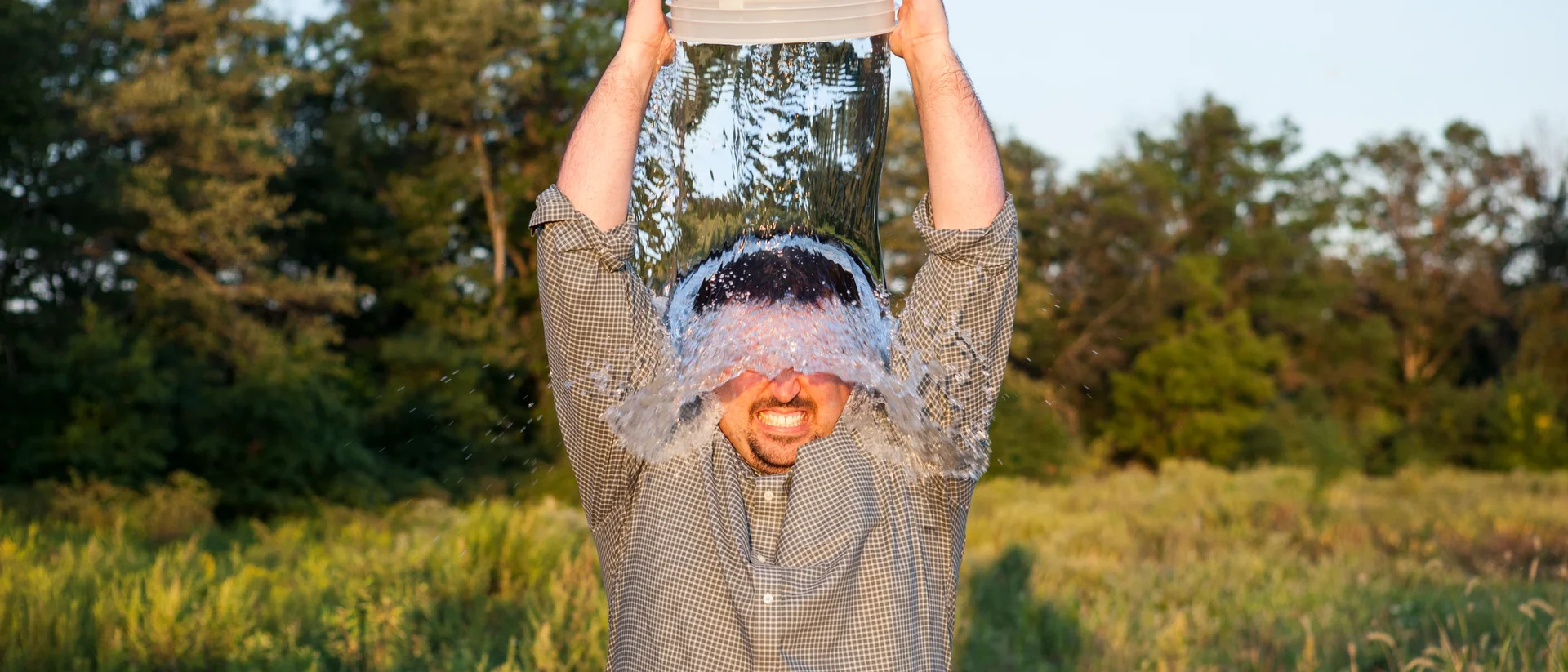
More than 17 million people worldwide dumped ice water on their own heads in 2014, and the Ice Bucket Challenge helped pay for Project MinE, a global hunt for ALS genes. In 2016 its team of more than 80 scientists in 11 countries found NEK1, a gene whose variants turn up in nearly 3 percent of ALS cases in North America and Europe.
The Ice Bucket Challenge Found a Gene
In 2014, more than 17 million people worldwide dumped ice water over their own heads, and the money went to the ALS Association. Two years later, scientists in 11 countries announced a gene that the project it helped fund had found.
A Dare Between Golfers
The ALS Ice Bucket Challenge began as a dare. In mid-July 2014, golfer Chris Kennedy took a cold-water challenge and nominated his cousin, Jeanette Senerchia, whose husband Anthony had ALS.
The Senerchias passed the idea to Pat Quinn of Yonkers, New York, who has been credited as a co-founder of the challenge. Quinn pushed it out to his friends, including Pete Frates, another man living with ALS.
From there it spread through feeds across the country. Between July 29 and August 21, 2014, the ALS Association received $41.8 million from more than 739,000 new donors, and it passed $100 million by the end of August. The association says the challenge inspired more than 17 million people to take part and raised $115 million for the association.
Where Some of It Went
A small slice of that money went to Project MinE, an international effort to sequence the genomes of thousands of people with ALS. The ALS Association contributed $1 million to the project.
The association also published how it planned to spend the full amount. A July 2015 accounting of the roughly $115 million showed $77 million (about 67 percent) for research, $23 million for patient and community services, $10 million for public and professional education, $3 million for fundraising and $2 million for external processing fees.
Project MinE was only one of many projects the money reached, and the ice bucket donations were one source of its funding among others, which is why the story below says the challenge helped pay for it.
The Gene
On July 25, 2016, the journal Nature Genetics published the project's first results. Led by John Landers of the University of Massachusetts Medical School and Jan Veldink of University Medical Center Utrecht, the team ran whole-exome analyses on 1,022 people with familial ALS and 7,315 controls. It was described as the largest study of inherited ALS, with more than 80 researchers from 11 countries, according to UMass Medical School.
They found that variants in a gene called NEK1 raise the risk of ALS. In total the authors observed NEK1 risk variants in nearly 3 percent of ALS cases, which the press reported as about 3 percent in North America and Europe.
What It Did and Did Not Do
Scientists were careful about the claim. NEK1 is not a cure. A second Project MinE paper the same week named another gene, C21orf2.
What a new gene gives researchers is another target. NEK1 is tied to how cells build cilia, repair DNA and keep their internal scaffolding stable, and the finding could support targeted drug development.
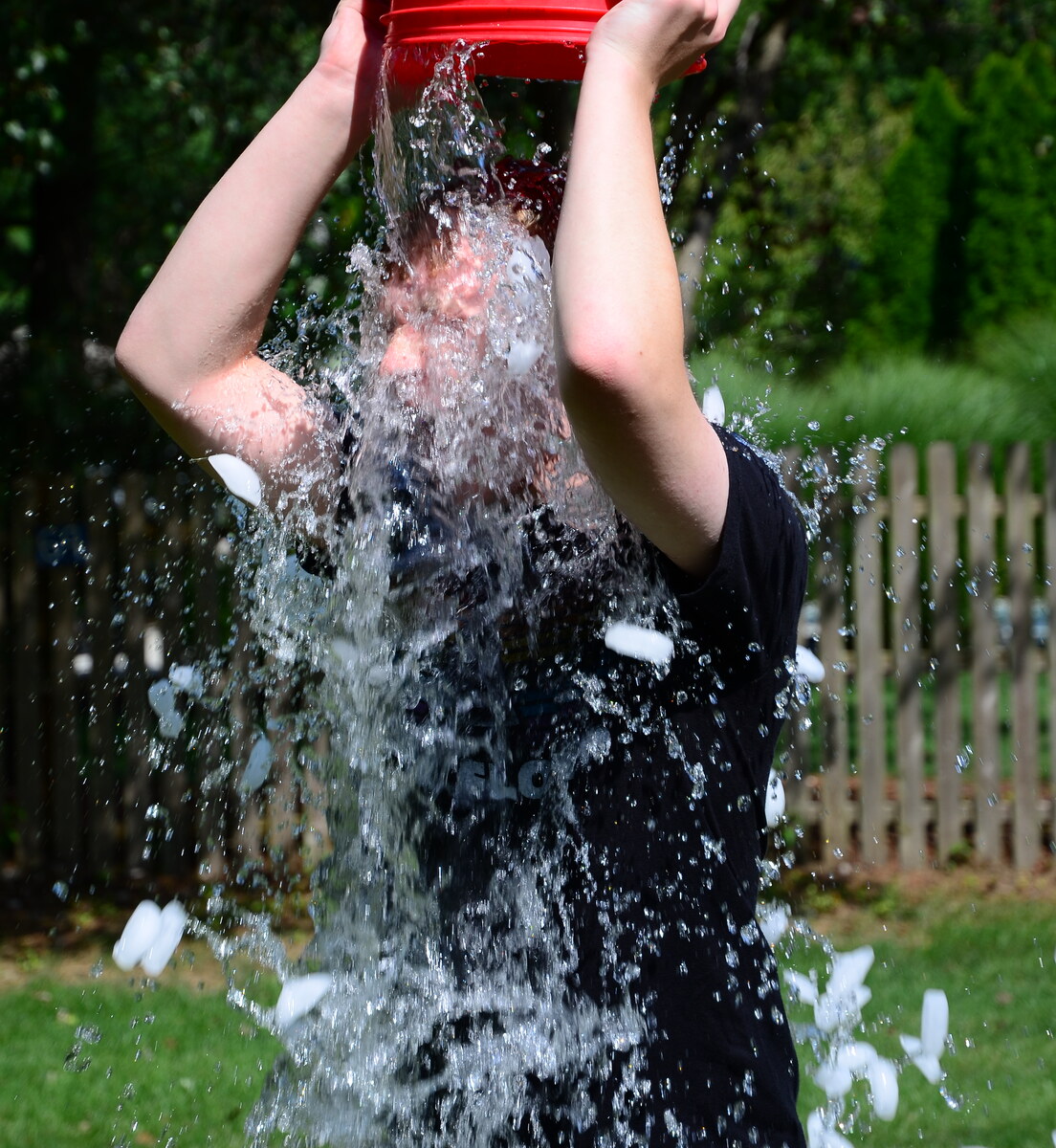
The challenge itself has come back. In July 2026, former NFL running back Chris Johnson, who announced his own ALS diagnosis, revived the challenge with an Instagram post two days later, asking others to join in, the Associated Press reported.
Source:ABC7 News
Enjoyed this fact?
1 person loved this
Get a new fact every morning.
A fascinating fact in your inbox every morning. Free. Unsubscribe anytime.
Frequently Asked Questions
How many people took part in the ALS Ice Bucket Challenge?
Did the Ice Bucket Challenge really lead to a gene discovery?
What is the NEK1 gene?
Where did the Ice Bucket Challenge money go?
Verified Fact
Verified Oct 22, 2026 · 7 sources checked
Source: ABC7 NewsShow verification details
Claims checked
- More than 17 million people took part worldwide
- The ALS Association gave $1 million to Project MinE from the challenge money
- Project MinE's NEK1 study involved more than 80 researchers in 11 countries
- NEK1 variants appear in nearly 3 percent of ALS cases in North America and Europe
- Chris Johnson revived the challenge in July 2026
- Percentages of the money split and the detail on his daughter pouring the water removed as unsupported
Sources: Nature Genetics, UMass Medical School, ABC7, CBS News, Fox 4, Associated Press, Georgetown University
Related Topics
More from Science & Space
View all Science & Space →