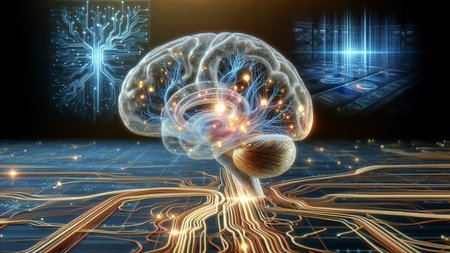
The use of emoticons affects our corresponding brain areas and can actually trigger emotions.
Your Brain Thinks Emoticons Are Real Faces
When you see a simple smiley face like :-), something remarkable happens in your brain: the same neural circuits that light up when you look at a real human face spring into action. Your brain doesn't just "understand" emoticons intellectually—it actually processes them as faces, triggering genuine emotional responses in the process.
This isn't just speculation. Neuroscientists have measured it.
Your Brain's Face-Recognition System Goes Wild
Using EEG (electroencephalography) technology, researchers have discovered that emoticons activate specific brain regions associated with face processing, particularly the fusiform face area (FFA) and the occipital face area (OFA). These are the same areas that activate when you look at your friend's face or a photograph of a person.
Even more fascinating: this neural response happens fast. Brain activity associated with face recognition appears as early as 100-150 milliseconds after seeing an emoticon—about the same speed as recognizing an actual human face. Your brain identifies :-) as a face almost before you're consciously aware you've seen it.
They Don't Just Look Like Faces—They Feel Like Them Too
The emotional impact goes deeper than recognition. Studies measuring event-related potentials (ERPs) found that sad-looking emojis produced significantly more negative neural amplitudes compared to happy or neutral ones. In other words, your brain has an emotional reaction to these clusters of punctuation marks.
Research has shown that:
- Emojis increase the emotional arousal of text messages
- The emotional tone of emojis biases how you interpret the entire message
- Negative emojis trigger stronger late positive potentials (LPPs) in the brain—the same response pattern seen with genuinely upsetting stimuli
- People recognize emotions in emojis faster and more accurately (92.7%) than in actual human facial expressions (87.35%)
That last point is particularly wild: we're actually better at reading emotions in simplified cartoon faces than in real ones, at least in some contexts.
Why Does This Happen?
Your brain is a pattern-recognition machine that evolved to detect faces quickly—it was a survival advantage for our ancestors to instantly recognize whether that shape in the bushes was a friend, foe, or just foliage. This system is so sensitive that it sees faces everywhere: in clouds, toast, electrical outlets, and yes, in combinations of punctuation marks.
When early internet users started typing :-) to convey emotion in text-only communication, they accidentally hacked into this ancient neural circuitry. The brain's face-detection system doesn't care that it's looking at ASCII characters instead of eyes and a mouth. The configuration is what matters—two dots above a curved line triggers the same "that's a face!" response as an actual smile.
The Real-World Impact
This neural reality has practical implications. Adding emojis to messages doesn't just clarify intent—it actually changes the emotional experience of reading them. Studies show that positive emojis in the upper part of your visual field enhance your ability to perceive positive emotions, while negative emojis in the lower field boost negative emotion perception.
Text without emoticons is processed more like abstract language. Text with emoticons activates both language centers and face-processing regions, creating a richer, more emotionally resonant experience. That's why a simple "ok" feels cold, while "ok 😊" feels warm—your brain is literally having an emotional response to that yellow circle.
So the next time someone dismisses emoticons as frivolous, remember: your brain disagrees. To your neural circuits, :-) isn't just a symbol of happiness—it's a face, and it makes you feel something real.
Frequently Asked Questions
Do emoticons actually trigger emotions in the brain?
What part of the brain responds to emojis?
Why does the brain see emoticons as faces?
Are emojis better than real faces for showing emotion?
How do emoticons change the way we read text messages?
Verified Fact
This fact has been reviewed and verified against original sources.
Show verification details
Multiple peer-reviewed neuroscience studies confirm that emoticons activate face-processing brain regions (FFA, OFA) and trigger neural responses similar to viewing actual human faces.
Related Topics
More from Science & Space
View all Science & Space →