
In 1977, researchers detected a strong and unusual radio signal from space that lasted 72 seconds. It hasn't been detected since.
The Wow! Signal: 72 Seconds That Changed SETI Forever
On August 15, 1977, astronomer Jerry R. Ehman was reviewing data from Ohio State University's Big Ear radio telescope when he spotted something that made him grab a red pen. On the computer printout showing a sequence of letters and numbers—"6EQUJ5"—he circled the anomaly and scribbled one word: "Wow!"
That exclamation gave the most famous signal in SETI history its name.
The Wow! signal was a narrowband radio transmission that lasted exactly 72 seconds—not because the signal itself was that long, but because that's how long Big Ear's fixed design could observe any point in the sky as Earth rotated. For those 72 seconds, the telescope detected something 30 times stronger than the background noise of deep space.
Why Scientists Got Excited
The signal hit all the right notes for potential extraterrestrial contact. It came through at 1,420 MHz—the frequency of neutral hydrogen, which scientists theorized an alien civilization might use because it's a universal constant. The signal was incredibly focused, not the random static of natural space phenomena.
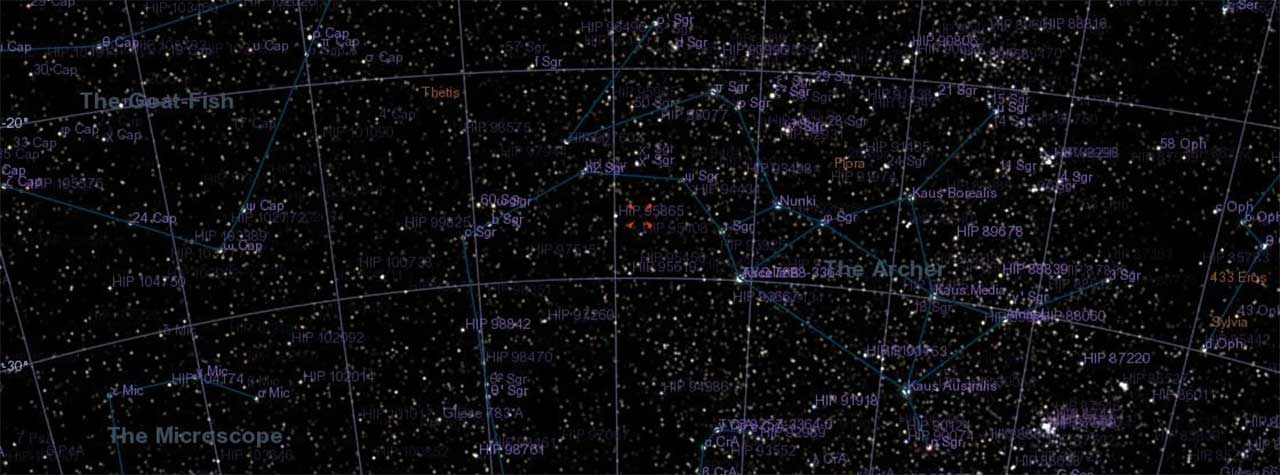
It appeared to originate from the direction of Sagittarius, near the Chi Sagittarii star group. And perhaps most tantalizing: it matched exactly what researchers expected an artificial signal to look like.
The Mystery Deepens
Then... nothing. Despite numerous follow-up observations targeting the same region of space, the signal never repeated. Big Ear itself listened to that patch of sky multiple times. Other telescopes joined the search. Decades passed.
The Wow! signal remained a one-time event.
This silence created a paradox. Natural cosmic phenomena like pulsars and quasars repeat. Random interference typically shows up multiple times or across different frequencies. But a genuine alien transmission might also be a one-off—perhaps a brief, directed message or a signal we happened to catch mid-transmission.
The Latest Theories
For nearly 50 years, scientists have proposed explanations. Early ideas included Earth-based interference, reflections from space debris, or interstellar scintillation. In 2016, one researcher suggested comets with hydrogen clouds, but that theory was quickly challenged.
A 2022 study offered a newer possibility: a magnetar—a hypermagnetized, hyperdense neutron star—could have flared and struck a cold cloud of hydrogen gas, causing it to briefly "light up" in radio wavelengths. It's a natural explanation that fits the data, though it remains debated.
Jerry Ehman himself has remained cautiously skeptical about alien origins, but admits: "We should have seen it again when we looked for it 50 times. Something suggests it was an Earth-sourced signal." Yet no definitive terrestrial source has ever been identified.
The Legacy Lives On
That original printout—complete with Ehman's red-penned "Wow!"—is now preserved by the Ohio Historical Society. It represents both the promise and frustration of SETI: clear evidence that something extraordinary happened, but no way to prove what.
The Wow! signal stands as the most compelling unexplained detection in the search for extraterrestrial intelligence. Was it aliens trying to contact us? A bizarre natural phenomenon? Interference from a passing satellite? Without a repeat performance, we may never know.
But for 72 seconds in 1977, humanity might have been listening to someone—or something—trying to say hello.
Frequently Asked Questions
What was the Wow signal and when was it detected?
Why was the Wow signal only 72 seconds long?
Has the Wow signal ever been detected again?
What are the leading theories about the Wow signal's origin?
Where did the Wow signal come from in space?
Verified Fact
This fact has been reviewed and verified against original sources.
Show verification details
The fact is accurate. The Wow! signal was detected on August 15, 1977 (not just '1977' generically), lasted for the full 72-second observation window, and has never been detected again despite numerous follow-up searches.