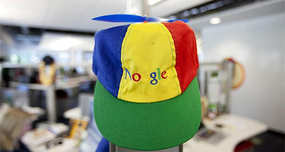
The search engine Google got its name from the word 'googol', which refers to the number one with a hundred zeros after it.
Google's Name Came From a Misspelled Math Term
Before Google became the verb we use for searching anything online, it was just a typo. The world's most powerful search engine got its name from "googol"—a mathematical term for the number 1 followed by 100 zeros (10100). But here's the kicker: they spelled it wrong.
In 1996, Stanford PhD students Larry Page and Sergey Brin were working on a research project originally called "BackRub" (yes, really). The name came from the search engine's analysis of the web's "back links"—a revolutionary approach at the time that would eventually become the PageRank algorithm.
The Brainstorming Session That Changed Everything
Fast forward to 1997. During a brainstorming session, fellow Stanford student Sean Anderson suggested the word "googolplex"—an even larger number (10 to the power of googol). Larry Page liked the idea but wanted something shorter and snappier. He suggested "googol" instead.
The concept was perfect: a massive number to represent their goal of organizing the seemingly infinite amount of information on the internet. There was just one problem.
When Anderson went to check if the domain was available, he accidentally searched for "google.com" instead of "googol.com." Finding it unregistered, he grabbed it on the spot. Page and Brin liked the misspelling enough to keep it, and the rest is history.
What Even Is a Googol?
The term "googol" was coined in 1920 by nine-year-old Milton Sirotta, nephew of American mathematician Edward Kasner. When Kasner asked the boy what he'd call a really big number, Milton came up with "googol." It's written as 1 followed by 100 zeros—a number so large it exceeds the estimated number of atoms in the observable universe (around 1080).
To put it in perspective:
- A million has 6 zeros
- A billion has 9 zeros
- A trillion has 12 zeros
- A googol has 100 zeros
You'd run out of ink, paper, and probably patience before you could write out a googol in full.
From BackRub to World Domination
Page and Brin officially founded Google on September 4, 1998. Their PageRank algorithm revolutionized search by analyzing the web's link structure rather than just counting keywords—essentially treating links like academic citations, where more "votes" meant more credibility.
Today, Google processes over 8.5 billion searches per day. Not bad for a company named after a spelling mistake.
The irony? A search engine built to help people find correct information was itself born from a typo. And that misspelled mathematical term is now worth over a trillion dollars and has become synonymous with searching itself. "Just google it" has entered the lexicon of dozens of languages worldwide.
So next time you google something, remember: you're using a deliberately misspelled word representing a number so massive it's almost meaningless—to search through information that actually exists. The internet is weird like that.
Frequently Asked Questions
What does googol mean in math?
Did Google misspell googol on purpose?
When was Google founded?
What was Google called before Google?
How big is a googol compared to atoms in the universe?
Verified Fact
This fact has been reviewed and verified against original sources.
Show verification details
Confirmed accurate. The name Google comes from 'googol' (10^100), though it was actually a misspelling. Sean Anderson suggested 'googolplex' in 1997, Larry Page shortened it to 'googol,' but it was registered as 'google.com' by mistake.