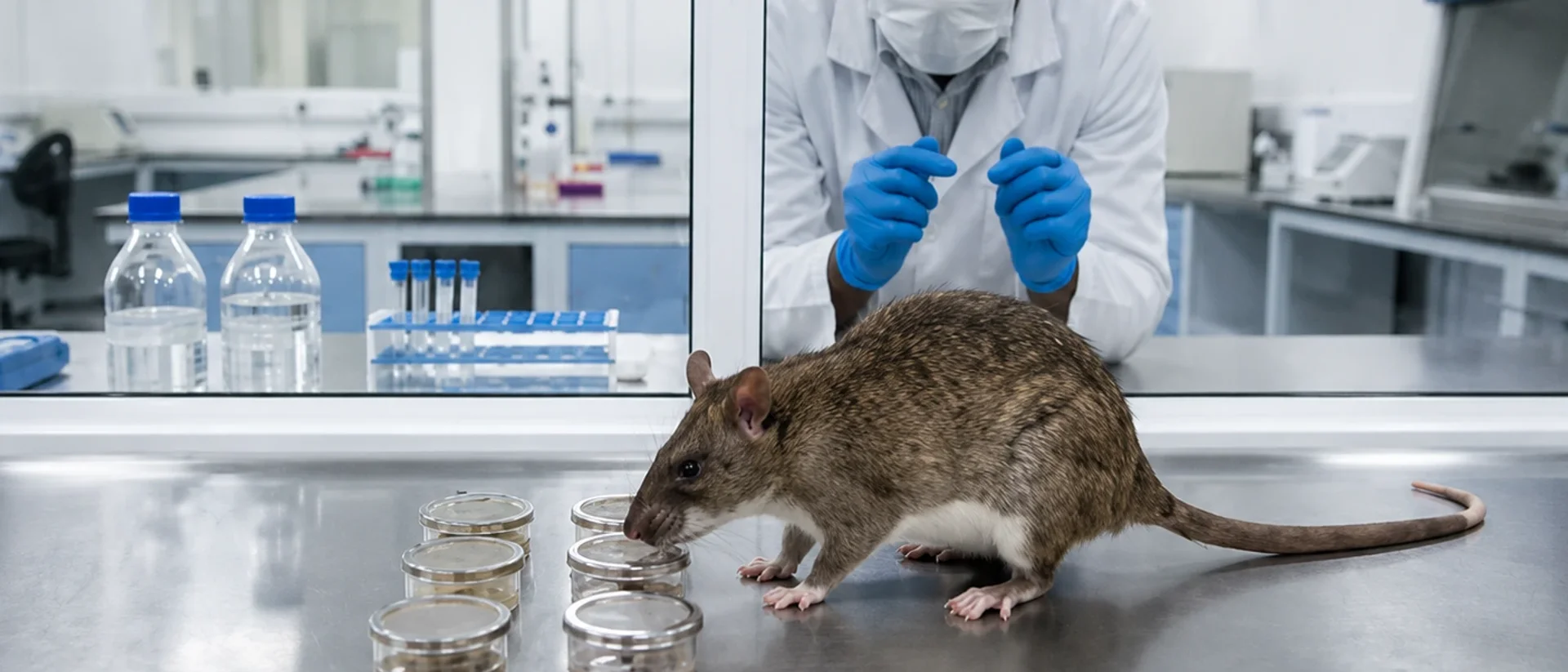
African giant pouched rats can screen 100 TB sputum samples in under 20 minutes. A lab technician takes at least four days to do the same work. APOPO trains these rats, called HeroRATs, to spot TB cases standard tests miss. They also sniff out buried landmines. Too light to set the mines off.
One Rat, 100 Samples, 20 Minutes
A rat the size of a rabbit twitches its nose over a row of plastic cups. Each cup holds a sputum sample from a patient told their tuberculosis test came back negative. The rat has around 20 minutes to recheck 100 of them. A human technician using standard microscopy would need at least four days.
A Nose That Standard Diagnostics Cannot Match
African giant pouched rats detect volatile organic compounds specific to Mycobacterium tuberculosis - compounds that smear microscopy often cannot identify, particularly in patients with low bacterial loads.
The Belgian nonprofit APOPO has trained these rats since 1997, calling them HeroRATs.
Each takes around nine months to reach full certification, learning to pause and signal over a positive sample before moving on.
The Numbers Behind the Speed
APOPO's own data is clear: one trained rat screens 100 samples in under 20 minutes, a task that takes a lab technician at least four days using conventional microscopy.
A 2024 study published in PLOS ONE examined over 43,000 sputum samples from more than 34,000 suspected TB patients across 69 Tanzanian health facilities.
Adding HeroRATs to the diagnostic process increased TB case detection by 48 percent overall - a 44 percent gain over Xpert testing, one of the most advanced tools available.
The cost per sample for a rat is approximately $1, versus $18 for an Xpert test.
The Second Job: Clearing Minefields
The same species also works across Africa and Southeast Asia sniffing out buried landmines and unexploded ordnance.
APOPO's mine-detection rats have located over 155,000 landmines and explosives, helping to restore safety to nearly two million people.
One rat can search 200 square meters in 20 minutes - work that would take a human deminer with a metal detector up to four days.
Unlike metal detectors, the rats ignore scrap metal and only respond to the scent of explosives. At one to two kilograms, they are too light to trigger any mine.
How They Are Trained
APOPO began as a research project at Antwerp University in Belgium and has since grown into an international operation across sub-Saharan Africa and Southeast Asia.
HeroRATs are trained using positive reinforcement - food rewards for correct detections - and live in APOPO's care for their entire lives.
The organisation also explores detection of other diseases where scent provides diagnostic clues that laboratory equipment misses.
Frequently Asked Questions
What are APOPO's HeroRATs?
How fast can a HeroRat screen TB samples?
Do the HeroRATs set off landmines?
How accurate are HeroRATs at detecting tuberculosis?
How long does it take to train a HeroRat?
Verified Fact
Verified Jun 30, 2026 · 5 sources checked
Source: APOPOShow verification details
Claims checked
- One rat screens 100 TB samples in under 20 minutes versus 4 days for a lab tech
- Raises TB detection by up to 48%, and 44% over Xpert
- Costs about $1 per sample versus $18 for Xpert
- Trained rats clear 200 sq m of landmines in 20 minutes (versus 4 days) and weigh 1-2 kg
- Founded in 1997 with Antwerp University (not Ghent)
Sources: APOPO, PLOS ONE, Red Social Innovation, Wikipedia, World Economic Forum
Related Topics
More from Animals
View all Animals →